Which of the following are most likely to be fixed costs of an airline? Select TWO that apply.
Correct Answer: A,D
Explanation Fixed costs (FC) are costs that do not vary with volume. To an airline once aircraft are purchased, flight crews trained and departures scheduled, costs are disproportionately fixed. Variable costs (VC) arethose which vary with the amount produced. Fuel, catering services and marketing are examples of variable. LO 2, AC 2.1
Question 27
Where can we find the data on macroeconomics? 1. From trade journal 2. From supplier's marketing catalogue 3. From stock exchange market 4. From government's statistics
Correct Answer: B
Explanation Macroeconomic indicators are statistics or data readings that reflect the economic circumstances of a particular country, region or sector. They are used by analysts and governments to assess the current and future health of the economy and financial markets. Macroeconomic indicators will vary in their meaning and the impact that they have on the economy, but broadly speaking there are two main types of indicator. - Leading indicators, which forecast where an economy might be heading. They are often used by governments to implement policies because they represent the first phase of a new economic cycle. These include the yield curve, interest rates and share prices. - Lagging indicators, which reflect an economy's historical performance and only change after a trend has been established. They are used to confirm a trend is underway. These include gross domestic product (GDP), inflation and employment figures. There is also the category of coincident indicators, but these are generally grouped in with lagging indicators as they either happen at the same time or after an economic shift. The best macroeconomic indicator to watch will heavily depend on your personal preferences, what positions you are taking and which country your portfolio is focused on. However, there are some very common indicators that most traders and investors will keep an eye on. For simplicity's sake, we have split these out into leading and lagging indicators. Top leading indicators: 1. The stock market 2. House prices 3. Bond yields 4. Production and manufacturing statistics 5. Retail sales 6. Interest rates Top laggingindicators: 1. GDP growth rates 2. The Consumer Price Index (CPI) and inflation 3. Currency strength and stability 4. Labour market statistics 5. Commodity prices A procurement professional may find stock market data from the security exchange, whilemost lagging indicators (such as GDP, CPI, unemployment rate, currency and inflation rate, etc) can be found from government statistics data.
Question 28
Which ofthe following is a true statement regarding macroeconomic factors and their potential impact on negotiations?
Correct Answer: C
Explanation 'Macroeconomic factors always directly influence the negotiations': This statement is false. For any given negotiation it is not the macroeconomic factor itself that necessarily influences the negotiation but the change or rate of change that factor. 'Changes in macroeconomic factors may affect businesses and individualsdifferently': This statement is true. Macroeconomic factors are factors that have general effects on the economy and many businesses may be completely unaffected or affected more or less than others in the same industry by a change in a factor. 'Macroeconomic factors cannot be influenced by anyone's expectation or sentiment': This statement is false. When it comes to macroeconomic factors another key consideration is expectation regarding what might happen to these factors, or specifically the measures, metrics or percentage rates associated with these factors in the future. 'Expectations on macroeconomic prospect are always correct': This statement is false. Expectations are not always correct. LO 2, AC 2.2
Question 29
Which of the following is categorised as fixed cost?
Correct Answer: B
Anorganisation's expense can be categorised into three groups: Fixed Costs - costs that do not change with output. Variable Costs - costs that vary in direct proportion to output. Semi-variable costs - costs that are a combination of the above, with both a fixed and variable element. Among the four options: "Land rental paid in advance": This is fixed cost. The rental won't increase when the production increases. "Additional pallet hires due to higher demand in year-end season": This can be identified as semi-variable cost (or step cost). "Governments taxes": The taxes are often levied by a percentage of income or revenue. Therefore, it is variable "Raw materials for next year production": This is obviously variable cost.
Question 30
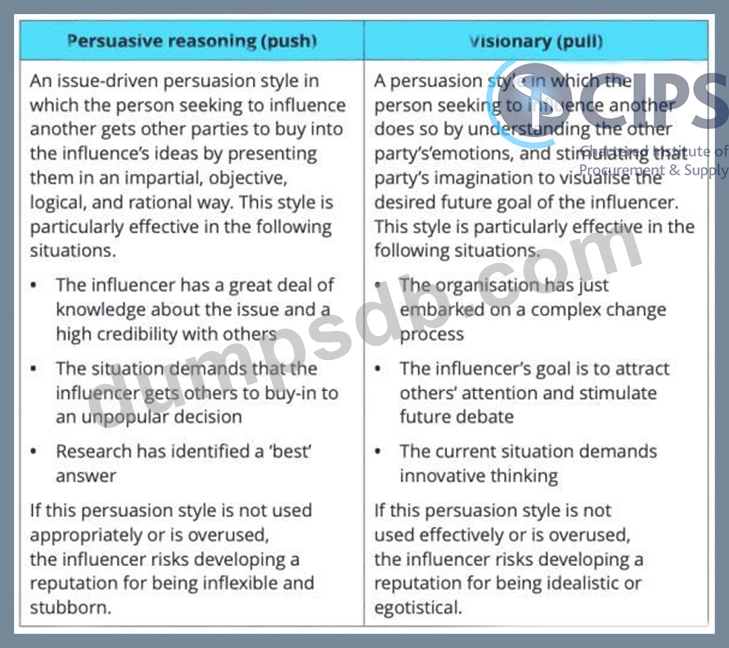
In which of the following persuasion methods, the influencer uses logics and objective reasons to persuade the others to buy intoinfluencer's ideas?
Correct Answer: A
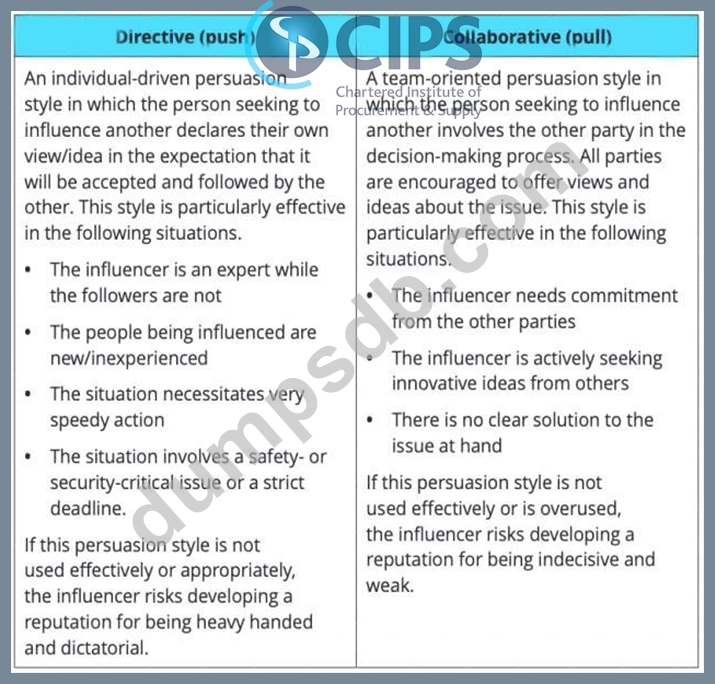
There are two major persuasion methods: 'push' and 'pull'. Persuasion can be defined as encouraging someone to do something that you want them to do for you. Persuasion is reasoning with someone so that they will believe or do something they might not otherwise do. Persuasion can be considered as 'pushing' on TOP so that they can accept the change in attitude or behaviour as a result of your actions. Influence is the ability to affect the manner of thinking of another. Influence can be considered as pulling on TOP so that you achieve the same result, but TOP feels they have changed their attitude or behaviour as a resultof their reflection and thinking, and not your direct actions. There are multiple variables to consider when choosing between 'push' and 'pull'. Professor Fiona Dent of Ashridge Business School proposes situations when each style might be most appropriate, breaking down push into 'directive' and 'reasoning' and 'pull' into 'collaborative' and 'visionary': Table Description automatically generated Text Description automatically generated Using logical and objective reasons is one of the typical characteristics of persuasion reasoning method.