In OSPF, which LSA type is responsible for pointing to the ASBR router?
Correct Answer: D
Summary ASBR LSA (Type 4) - Generated by the ABR to describe an ASBR to routers in other areas so that routers in other areas know how to get to external routes through that ASBR. For example, suppose R8 is redistributing external route (EIGRP, RIP...) to R3. This makes R3 an Autonomous System Boundary Router (ASBR). When R2 (which is an ABR) receives this LSA Type 1 update, R2 will create LSA Type 4 and flood into Area 0 to inform them how to reach R3. When R5 receives this LSA it also floods into Area 2. In the above example, the only ASBR belongs to area 1 so the two ABRs (R2 & R5) send LSA Type 4 to area 0 & area 2 (not vice versa). This is an indication of the existence of the ASBR in area 1. Note: + Type 4 LSAs contain the router ID of the ASBR. + There are no LSA Type 4 injected into Area 1 because every router inside area 1 knows how to reach R3. R3 only uses LSA Type 1 to inform R2 about R8 and inform R2 that R3 is an ASBR.
Question 212
Which QoS mechanism will prevent a decrease in TCP performance?
Correct Answer: E
Explanation Weighted Random Early Detection (WRED) is just a congestion avoidance mechanism. WRED drops packets selectively based on IP precedence. Edge routers assign IP precedences to packets as they enter the network. When a packet arrives, the following events occur: The average queue size is calculated. 2. If the average is less than the minimum queue threshold, the arriving packet is queued. 3. If the average is between the minimum queue threshold for that type of traffic and the maximum threshold for the interface, the packet is either dropped or queued, depending on the packet drop probability for that type of traffic. 4. If the average queue size is greater than the maximum threshold, the packet is dropped. WRED reduces the chances of tail drop (when the queue is full, the packet is dropped) by selectively dropping packets when the output interface begins to show signs of congestion (thus it can mitigate congestion by preventing the queue from filling up). By dropping some packets early rather than waiting until the queue is full, WRED avoids dropping large numbers of packets at once and minimizes the chances of global synchronization. Thus, WRED allows the transmission line to be used fully at all times. WRED generally drops packets selectively based on IP precedence. Packets with a higher IP precedence are less likely to be dropped than packets with a lower precedence. Thus, the higher the priority of a packet, the higher the probability that the packet will be delivered.
Question 213
Refer to exhibit. VLANs 50 and 60 exist on the trunk links between all switches All access ports on SW3 are configured for VLAN 50 and SW1 is the VTP server Which command ensures that SW3 receives frames only from VLAN 50?
Correct Answer: A
Explanation SW3 does not have VLAN 60 so it should not receive traffic for this VLAN (sent from SW2). Therefore we should configure VTP Pruning on SW3 so that SW2 does not forward VLAN 60 traffic to SW3. Also notice that we need to configure pruning on SW1 (the VTP Server), not SW2.
Question 214
A client device fails to see the enterprise SSID, but other devices are connected to it. What is the cause of this issue?
Correct Answer: D
Question 215
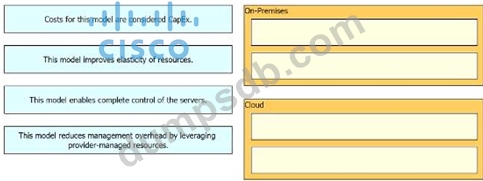
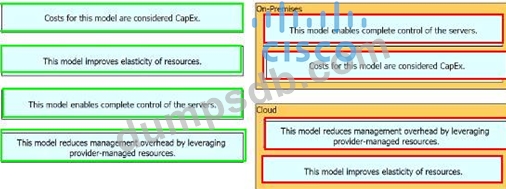
Drag and drop the characteristics from the left onto the infrastructure deployment models on the right.