Latest 350-401 Exam Premium Dumps provide by TrainingQuiz.com to help you Passing 350-401 Exam! TrainingQuiz.com offers the updated 350-401 exam dumps, the TrainingQuiz.com 350-401 exam questions has been updated to correct Answer. Get the latest TrainingQuiz.com 350-401 pdf dumps with Exam Engine here:
(382 Q&As Dumps, 40%OFF Special Discount: DumpsDB)
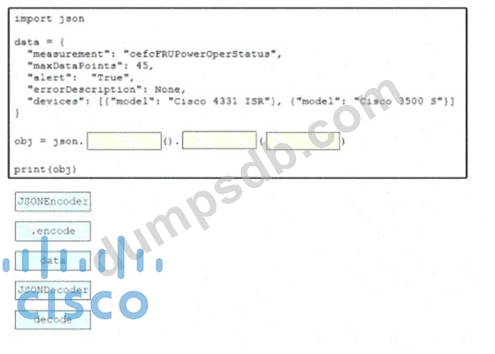
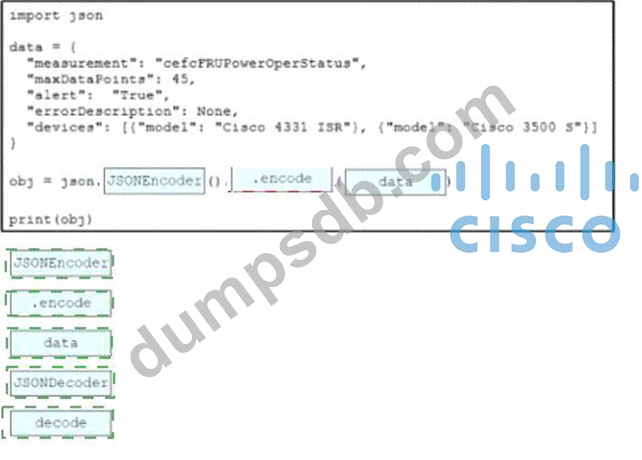
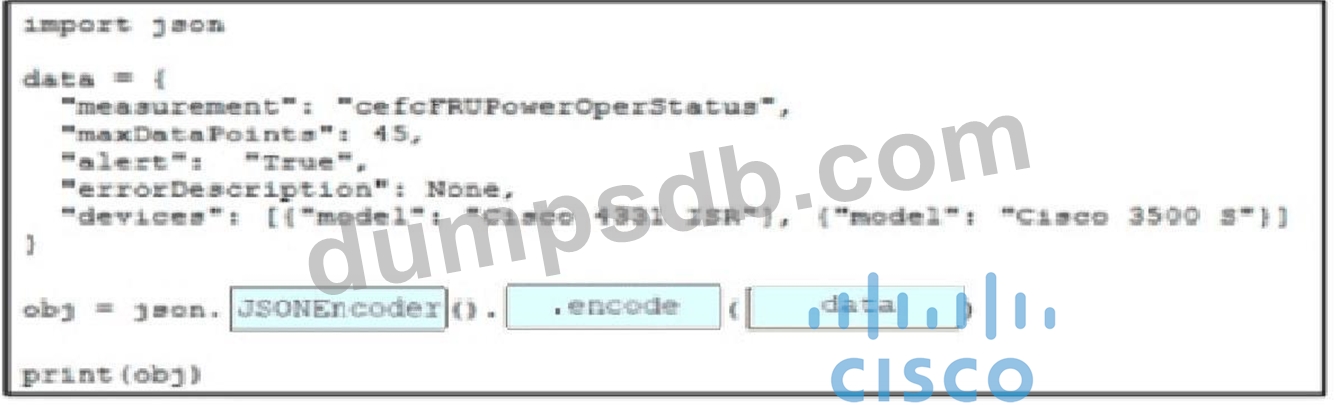
Drag and drop the code snippets from the bottom onto the blanks in the script to convert a Python object into a JSON string. Not all options are used
Correct Answer:
Explanation:
Question 102
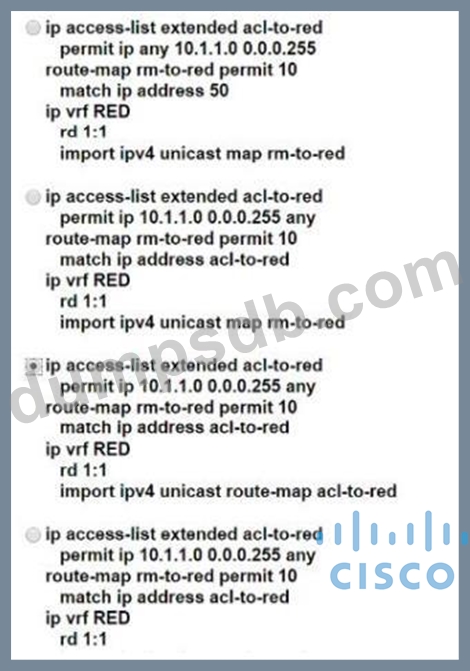
An engineer must configure a router to leak routes between two VRFs Which configuration must the engineer apply?
Correct Answer: B
Question 103
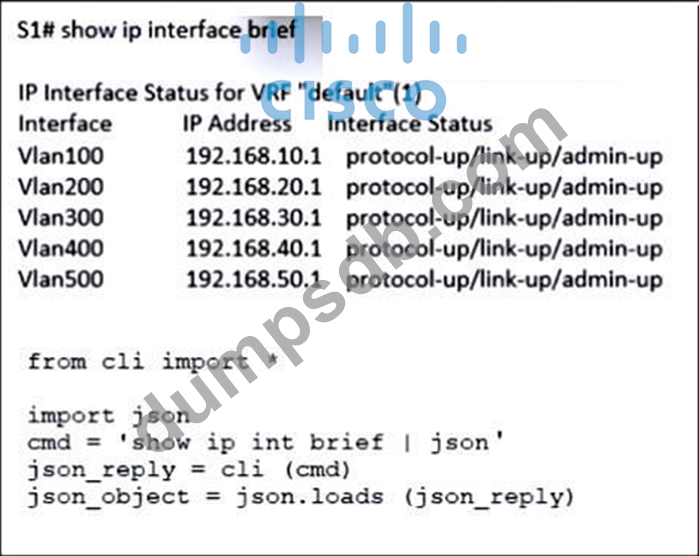
Refer to the exhibit. An engineer must pull the interface detail from multiple devices in the network and print out the management IP for the devices based on the JSON responses. VLAN 100 is present on all switches and is used for management. Which line of code must be applied?
Correct Answer: C
The goal is to extract the IP address of the interface in VLAN100, which is the first entry in the command output. - The variable json_object holds a parsed JSON structure of the CLI output. - TABLE_intfis the top-level key holding the interface table. - ROW_intfis likely a list of interfaces. - ROW_intf[0]refers to the first interface, which is Vlan100, with IP address 192.168.10.1. - The key "prefix" holds the IP address. So, json_object["TABLE_intf"]["ROW_intf"][0]["prefix"]correctly pulls the management IP.
Question 104
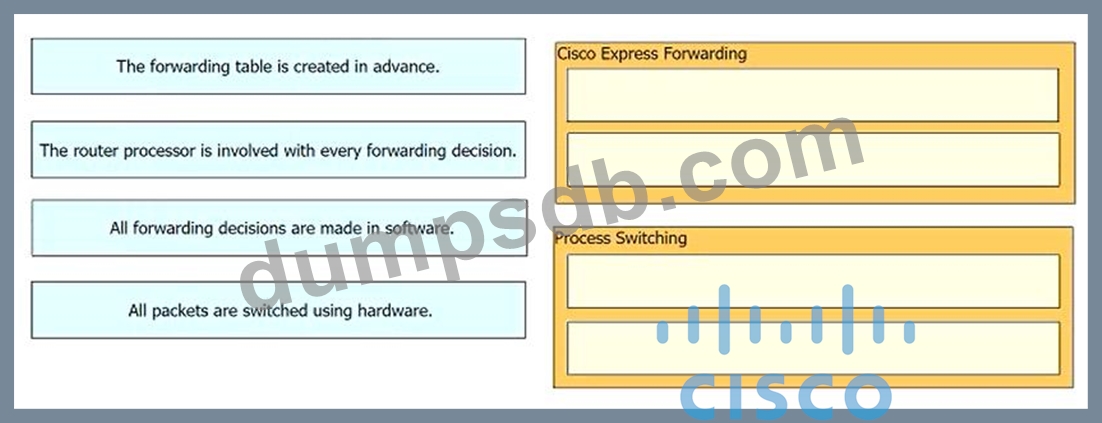
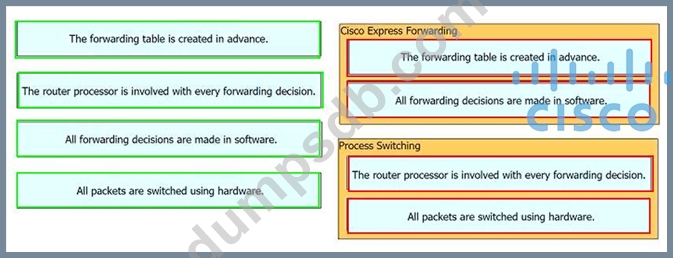
Drag and drop the characteristics from the left onto the switching mechanisms they describe on the right.
Correct Answer:
Question 105
Which QoS mechanism will prevent a decrease in TCP performance?
Correct Answer: E
Explanation Weighted Random Early Detection (WRED) is just a congestion avoidance mechanism. WRED drops packets selectively based on IP precedence. Edge routers assign IP precedences to packets as they enter the network. When a packet arrives, the following events occur: The average queue size is calculated. 2. If the average is less than the minimum queue threshold, the arriving packet is queued. 3. If the average is between the minimum queue threshold for that type of traffic and the maximum threshold for the interface, the packet is either dropped or queued, depending on the packet drop probability for that type of traffic. 4. If the average queue size is greater than the maximum threshold, the packet is dropped. WRED reduces the chances of tail drop (when the queue is full, the packet is dropped) by selectively dropping packets when the output interface begins to show signs of congestion (thus it can mitigate congestion by preventing the queue from filling up). By dropping some packets early rather than waiting until the queue is full, WRED avoids dropping large numbers of packets at once and minimizes the chances of global synchronization. Thus, WRED allows the transmission line to be used fully at all times. WRED generally drops packets selectively based on IP precedence. Packets with a higher IP precedence are less likely to be dropped than packets with a lower precedence. Thus, the higher the priority of a packet, the higher the probability that the packet will be delivered. Reference: https://www.cisco.com/c/en/us/td/docs/ios-xml/ios/qos_conavd/configuration/15- mt/qos-conavd-15-mt-book/qos-conavd-cfg-wred.html WRED is only useful when the bulk of the traffic is TCP/IP traffic. With TCP, dropped packets indicate congestion, so the packet source will reduce its transmission rate. With other protocols, packet sources may not respond or may resend dropped packets at the same rate. Thus, dropping packets does not decrease congestion. Reference: https://www.cisco.com/c/en/us/td/docs/ios-xml/ios/qos_conavd/configuration/xe- 16/qos-conavd-xe-16-book/qos-conavd-oview.html Note: Global synchronization occurs when multiple TCP hosts reduce their transmission rates in response to congestion. But when congestion is reduced, TCP hosts try to increase their transmission rates again simultaneously (known as slow-start algorithm), which causes another congestion. Global synchronization produces this graph: