An engineer is implementing a network access control solution for a client. The client has separate data and voice VLANs and the deployment is now entering the testing phase. Which configuration must be made next to ensure there are no user authentication issues?
Correct Answer: B
When implementing network access control solutions, such as 802.1X, for environments with separate data and voice VLANs, it is critical to ensure that the voice VLAN ID does not conflict with other configurations or settings that may cause authentication issues. Voice VLANs are often used for devices like IP phones that bypass certain user authentication steps to ensure uninterrupted service. A misconfigured or conflicting voice VLAN ID can lead to network disruptions or unexpected behavior during testing.
Question 377
Which network monitoring solution uses streams and pushes operational data to provide a near real-time view of activity?
Correct Answer: D
The traditional use of the pull model, where the client requests data from the network does not scale when what you want is near real-time data. Moreover, in some use cases, there is the need to be notified only when some data changes, like interfaces status, protocol neighbors change etc. Model-Driven Telemetry is a new approach for network monitoring in which data is streamed from network devices continuously using a push model and provides near real-time access to operational statistics. Applications can subscribe to specific data items they need, by using standard-based YANG data models over NETCONF-YANG. Cisco IOS XE streaming telemetry allows to push data off of the device to an external collector at a much higher frequency, more efficiently, as well as data on-change streaming. The traditional use of the pull model, where the client requests data from the network does not scale when what you want is near real-time data. Moreover, in some use cases, there is the need to be notified only when some data changes, like interfaces status, protocol neighbors change etc. Model-Driven Telemetry is a new approach for network monitoring in which data is streamed from network devices continuously using a push model and provides near real-time access to operational statistics. Applications can subscribe to specific data items they need, by using standard-based YANG data models over NETCONF-YANG. Cisco IOS XE streaming telemetry allows to push data off of the device to an external collector at a much higher frequency, more efficiently, as well as data on-change streaming. Reference: The traditional use of the pull model, where the client requests data from the network does not scale when what you want is near real-time data. Moreover, in some use cases, there is the need to be notified only when some data changes, like interfaces status, protocol neighbors change etc. Model-Driven Telemetry is a new approach for network monitoring in which data is streamed from network devices continuously using a push model and provides near real-time access to operational statistics. Applications can subscribe to specific data items they need, by using standard-based YANG data models over NETCONF-YANG. Cisco IOS XE streaming telemetry allows to push data off of the device to an external collector at a much higher frequency, more efficiently, as well as data on-change streaming.
Question 378
Which IPS engine detects ARP spoofing?
Correct Answer: A
The Atomic ARP engine is a signature engine that defines basic Layer 2 ARP signatures and provides more advanced detection of the ARP spoof tools dsniff and ettercap. ARP spoofing is an attack that involves sending spoofed ARP messages over a local area network to associate the attacker's MAC address with the IP address of the target. The Atomic ARP engine inspects the Layer 2 ARP protocol and compares the ARP requests and replies with the MAC address table to detect any anomalies or inconsistencies. The Atomic ARP engine can also detect gratuitous ARP messages, which are unsolicited ARP replies that can be used to poison the ARP cache of other hosts. The Atomic ARP engine is different from other IPS engines because most engines are based on Layer 3 IP protocol. References := https://www.cisco.com/c/en/us/td/docs/security/ips/6-1/configuration/guide/cli/cliguide/cli_signature_engines. html https://security.stackexchange.com/questions/71023/can-suricata-ips-detect-and-prevent-arp-poisoning-attacks
Question 379
Which components does a southbound API within a software-defined network architecture communicate?
Correct Answer: A
Question 380
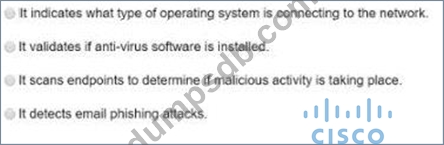
What is a benefit of conducting device compliance checks?