

Question 1
Which functions does the bearer network NMS mainly provide?
Question 2
An interface sends 300 Mbit/s user BE traffic. The downstream HQoS scheduling is configured at this interface as follows SQ: cir 15 Mbit/s pw 200 Mbit/s FQ. queue be Ipq shaping 10 CQ: port-queue be Ipq shaping shaping-percentage 10 outbound, port shaping 100 How much traffic is at the downstream outbound interface after HQoS scheduling?
Question 3
acl number 2000
rule 15 permit source 225.0.0.0 0.0.0.255
#
interface Ethernet6/1/1
ip address 40.1.1.4 255.255.255.0
igmp version 3
igmp group-policy 2000
igmp enable
pim sm
#
The preceding are partial router configurations. Which of the following behaviors does Ethernet
6/1/1 perform after receiving Internet Group Management Protocol Version 2 (IGMPv2) Report messages for multicast groups 225.0.0.1 and 225.0.1.1?
Question 4
Exhibit:
RTA is an edge router of the MPLS backbone network. It provides the access services for users under Layer 2 switches and different users by subinterface . User A access VLAN 12 and has subscribed to the His, VoIP, and IPTV services. According to 802 1p priorities, the value indicates the His service, 1 indicates the VoIp service, and 4 indicates the IPTV service. RTA is configured on he access side as follows.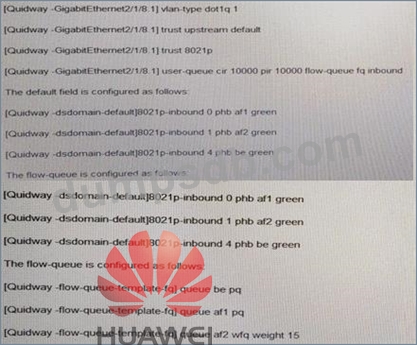
What is the descending order of service priorities?
Question 5
Which statement about the Ethernet clock synchronization technology used m actual solutions is true?