

Question 6
In the access architecture of an IP bearer network, the OSPF protocol is enabled between two access routers, two firewalls (in transparent mode), and two Layer 3 switches. Softswitches work in active/standby mode. VRRP is enabled between the softswitches to provide a gateway. In normalcases, SW1 is the master router and SW2 is the backup router. Considering the reliability of the access network, how would you plan the cost value of each link in the OSPF area?
Question 7
Which of the following methods can be used to ensure loop-free and reachable Martini VPLS links?
Question 8
Configurations are as follows:
#
multicast routing-enable
#
msdp
peer 2.2.2.2 connect-interface loopback0
peer 3.3.3.3 connect-interface loopback0
import-source acl 3000
peer 2.2.2.2 sa--policy import acl 3001
peer 3.3.3.3 sa--policy export acl 3002
#
Interface loopback0
ip address 1.1.1.1 32
pim sm
#
acl 3000
rule 5 deny ip destination 230.0.0.1 0 source 30.0.0.1 0
rule 10 permit ip
#
acl 3001
rule 5 permit ip destination 231.0.0.1 0 source 30.0.0.1 0
#
acl 3002
rule 5 permit ip destination 233.0.0.1 0 source 30.0.0.1 0
#
Which statement is true?
Question 9
Exhibit: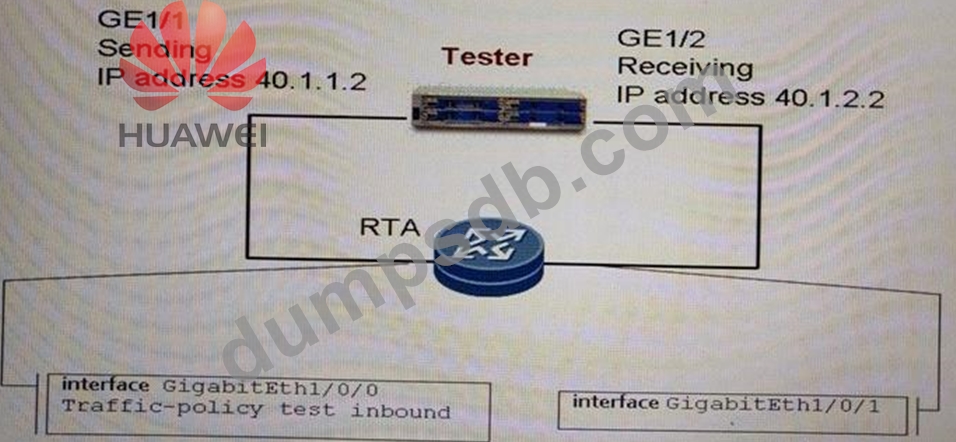
As shown in the figure, complex traffic classification is configured for RTA's upstream GigabitEthernet 1/0/0. The QoS is configured as follows: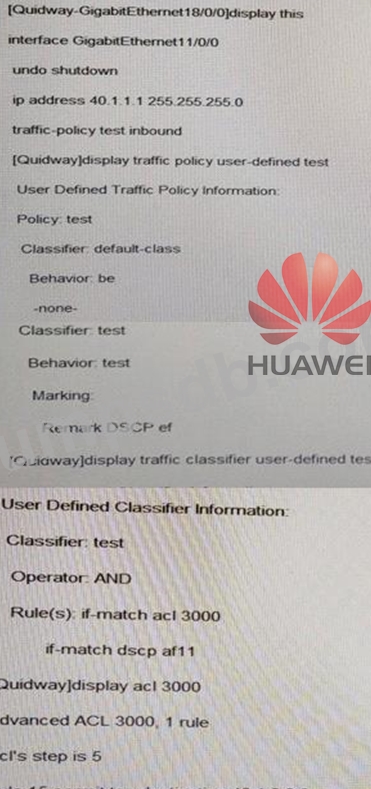
A tester sends TCP packets from GE 1/1 to GE 1/2 at 40 1.2.2 IF DSCP values of packets GE receives are not 46, what are the possible causes?
Question 10
As shown I the figure, the asymmetric VLL FRR networking is used AC interfaces on PE 1, PE 2 and PE 3 are
configured as follows:
Which of the following statements are the true on the condition that IGP and MPLS are configured correctly
on the public network?