

Question 6
Which of the following would achieve the HIGHEST level of testing independence for a project's system test level?
Question 7
After a record of poor quality software releases (incorrect menu selection options, new features that do not work, users allowed to change security levels without administrator rights), you have been asked to review the test capability in your company.
You have limited time to do the review before the next project, which type of testing would be MOST appropriate to review first?
Question 8
Which ONE of the following is the BEST way to take advantage of the different mindsets of testers and developers?
Question 9
Which of the following options BEST explains the pesticide paradox principle of testing?
Question 10
You are performing a review of your colleague's test cases based on the following test basis document: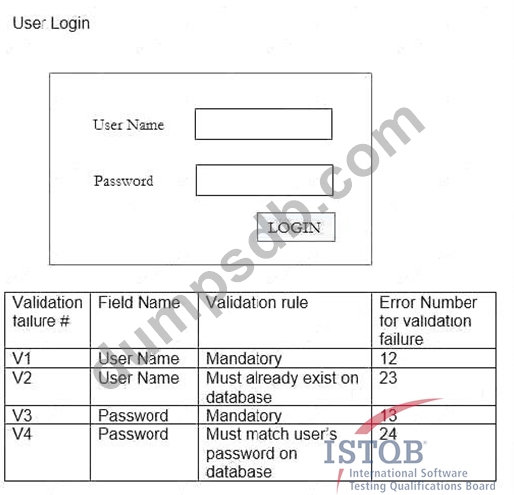
The Test Cases are as follows:
TC1. Success - valid 'User Name' and 'Password'; Customer Menu displayed TC2. Failure - 'User Name' field has blank entry; Error Number 12 displayed TC3. Failure - 'User Id' entered does not exist on database (i.e. unregistered user); Error Number 23 displayed TC4. Failure - 'Password' entered does not match user's password on database; Error Number 24 displayed You are guided by the following checklist in your review:
C1. There must be one test case to cover success
C2. There must be one test case for each error path (e.g. validation failure) C3. Each test case must use terminology consistent with the test basis document (field names, error numbering, etc.) Record a separate defect for each missing test case (checklist items C1 and C2) and for each test case that does not meet checklist item C3.
How many defects should you record?