

Question 51
Note: This question is part of a series of questions that present the same scenario. Each question in the series contains a unique solution that might meet the stated goals. Some question sets might have more than one correct solution, while others might not have a correct solution.
After you answer a question in this sections, you will NOT be able to return to it. As a result, these questions will not appear in the review screen.
You network contains an Active Directory domain named contoso.com. The domain contains a DHCP server named Server1. All client computers run Windows 10 and are configured as DHCP clients.
Your helpdesk received calls today from users who failed to access the network from their Windows 10 computer.
You open the DHCP console as shown in the exhibit.
You need to ensure that all of the Windows 10 computers can receive a DHCP lease.
Solution: You authorize the server.
Does this meet the goal?
Question 52
Your company has 10 offices. Each office has a local network that contains several Hyper-V hosts that run Windows Server 2016. All of the offices are connected by high speed, low latency WAN links.
You need to ensure that you can use QoS policies for Live Migration traffic between the offices.
Which component should you install?
Question 53
Your company has a main office in London and a branch office in Seattle. The offices connect to each other by using a WAN link.
In the London office, you have a Distributed File System (DFS) server named FS1 that contains a folder named Folder1.
In the Seattle office, you have a DFS server named FS2.
All servers run Windows Server 2016.
You configure replication of Folder1 to FS2.
Users in both offices frequently add files in Folder1.
You monitor DFS Replication, and you discover excessive replication over the WAN link during business hours.
You need to reduce the amount of bandwidth used for replication during business hours. The solution must ensure that the users can continue to save content to Folder1.
What should you do?
Question 54
You have a virtual machine named VM1 that runs Windows Server 2016, VM1 hosts a service that requires high network throughput.
VM1 has a virtual network adapter that connects to a Hyper-V switch named vSwitch1.
vSwitch1 has one network adapter. The network adapter supports Remote Direct Memory Access (RDMA), the single root I/O virtualization (SR-IOV) interface, Quality of Service? (QoS), and Receive Side Scaling (RSS).
You need to ensure that the traffic from VM1 can be processed by multiple networking processors.
Which Windows PowerShell command should you run on the host of VM1?
Question 55
Note: This question is part of a series of questions that use the same scenario. For your convenience, the scenario is repeated in each question. Each question presents a different goal and answer choices, but the text of the scenario is exactly the same in each question in this series.
Your network contains an Active Directory domain named contoso.com. The functional level of the domain is Windows Server 2012.
The network uses an address space of 192.168.0.0/16 and contains multiple subnets.
The network is not connected to the Internet.
The domain contains three servers configured as shown in the following table.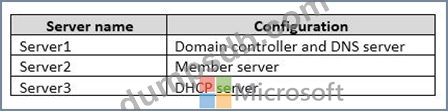
Client computers obtain TCP/IP settings from Server3.
You add a second network adapter to Server2. You connect the new network adapter to the Internet.
You install the Routing role service on Server2.
Server1 has four DNS zones configured as shown in the following table.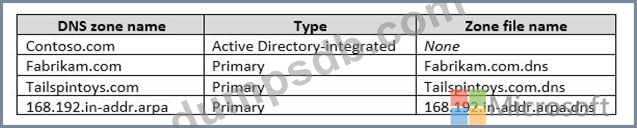
You need to ensure that when a computer is removed from the network, the associated records are deleted automatically after 15 days.
Which two actions should you perform? Each correct answer presents part of the solution.