

Question 31
You have a server named Host1 that runs Windows Server 2016.
You configure Host1 as a virtualization host and create 20 new virtual machines on Host1.
You need to ensure that all of the virtual machines can connect to the Internet through
Host1.
Which three actions should you perform? Each correct answer presents part of the solution.
Question 32
You have an Active Directory domain named Contoso.com. The domain contains Hyper-V hosts named Server1 and Server2 that run Windows Server 2016. The Hyper-V hosts are configured to use NVGRE for network virtualization.
You have six virtual machines that are connected to an external switch. The virtual machines are configured as shown.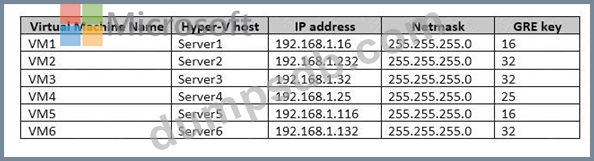
To which virtual machine or virtual machines can VM1 and VM3 connect? To answer, select the appropriate options in the answer area.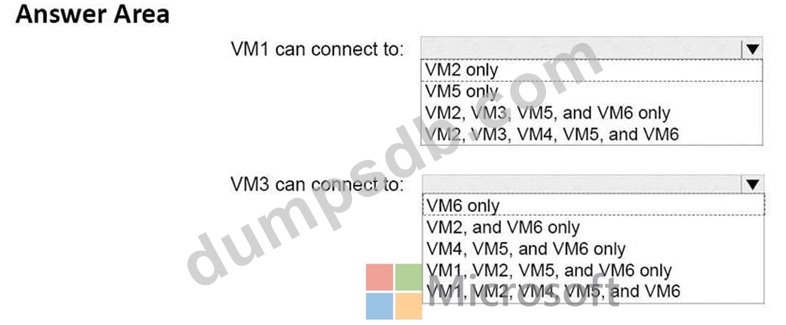

Question 33
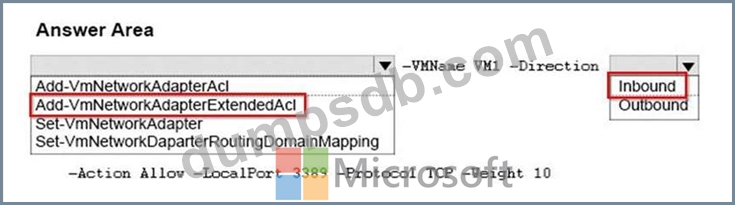
You have a virtual machine named VM1 that runs Windows Server 2016. VM1 is a Remote Desktop Services (RDS) server.
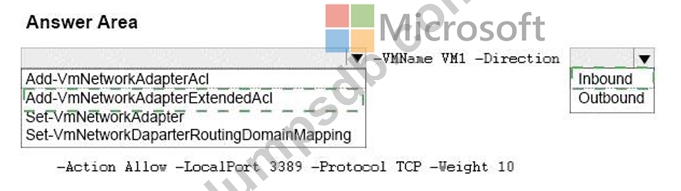
You need to ensure that only TCP port 3389 can be used to connect to VM1 over the network.
Which command should you run on the Hyper-V host? To answer, select the appropriate options in the answer area.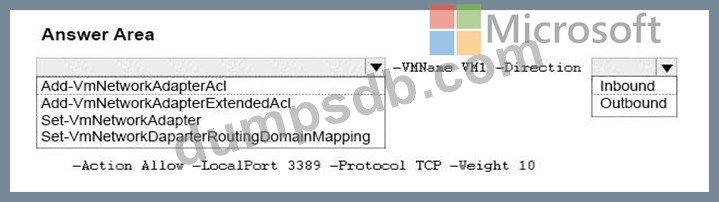
Question 34
Your network contains an Active Directory domain named contoso.com. The domain contains a domain- based Distributed File System (DFS) namespace named Namespace1 that has access-based enumeration enabled. Namespace1 has a folder named Folder1. Folder1 has a target of \\Server1\Folder1.
The permissions for folder1 are configured as shown in the following table.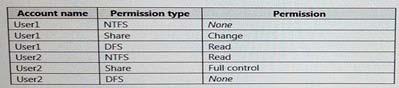
Access-based enumeration is disabled for the share of Folder1.
You need to ensure that both User1 and User2 can see Folder1 When they
access\\Contoso.com\NameSpace1.
What should you do?
Question 35
Note: This question is part of a series of questions that present the same scenario. Each question in the series contains a unique solution. Determine whether the solution meets the stated goals.
Refer to exhibit: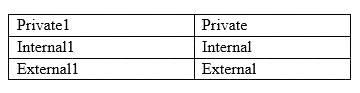
Server1 has two virtual machines named VM1 and VM that run Windows Server 2016. VM1 connects to Private VM2 has two network adapters.
You need to ensure that VM1 connects to the corporate network by using NAT.
Solution: You connect VM1 to Internal1. You run the New-NetNatIpAddress and the New-NetNat cmdlets on Server1. You configure VM1 to use VM2 as the default gateway.
Does this meet the goal?