

Question 21
Note: This question is part of a series of questions that use the same or similar answer choices. An answer choice may be correct for more than one question in the series. Each question is independent of the other questions in this series. Information and details provided in a question apply only to that question.
You create a table by running the following Transact-SQL statement: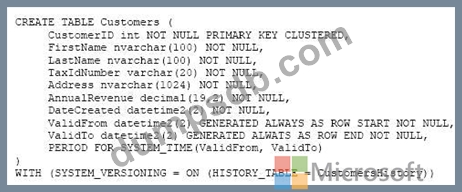
You need to return normalized data for all customers that were added in the year 2014.
Which Transact-SQL statement should you run?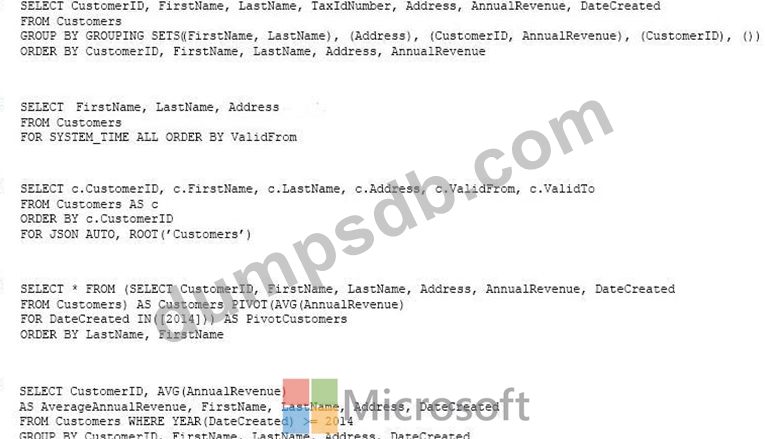
Question 22
Note: This question is part of a series of questions that use the same or similar answer choices. An answer choice may be correct for more than one question in the series. Each question is independent of the other questions in this series. Information and details provided in a question apply only to that question.
You have a database that contains several connected tables. The tables contain sales data for customers in the United States only.
You have the following partial query for the database. (Line numbers are included for reference only.)
You need to complete the query to generate the output shown in the following table.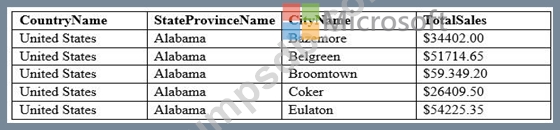
Which statement clause should you add at line 3?
Question 23
Note: This question is part of a series of questions that present the same scenario. Each question in the series contains a unique solution that might meet the stated goals. Some question sets might have more than one correct solution, while others might not have a correct solution.
After you answer a question in this section, you will NOT be able to return to it. As a result, these questions will not appear in the review screen.
You are building a stored procedure that will be used by hundreds of users concurrently.
You need to store rows that will be processed later by the stored procedure. The object that stores the rows must meet the following requirements:
Be indexable
Contain up-to-date statistics
Be able to scale between 10 and 100,000 rows
The solution must prevent users from accessing one another's data.
Solution: You create a table variable in the stored procedure.
Does this meet the goal?
Question 24
You have a database that contains the following tables:
Customer
CustomerAudit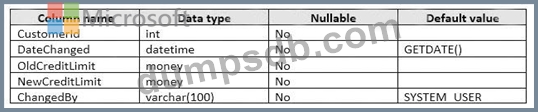
Where the value of the CustomerID column equals 3, you need to update the value of the CreditLimit column to 1000 for the customer. You must ensure that the change to the record in the Customer table is recorded on the CustomerAudit table.
Which Transact-SQL statement should you run?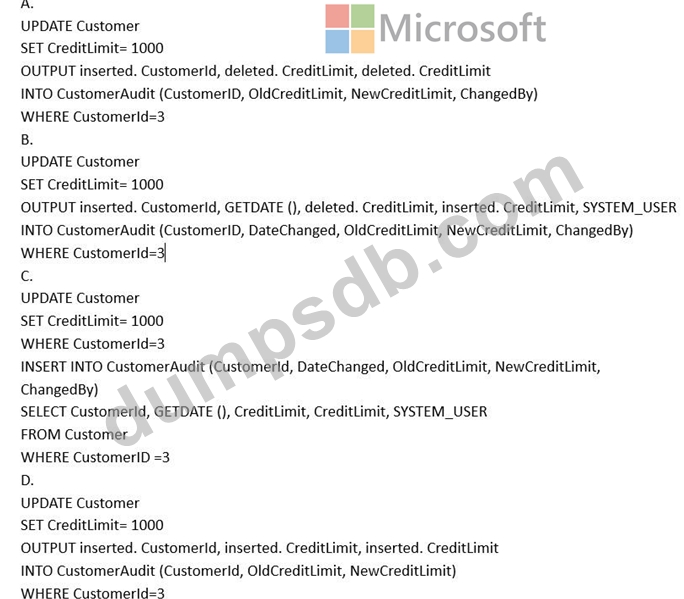
Question 25
Note: This question is part of a series of questions that use the same or similar answer choices. An answer choice may be correct for more than one question in the series. Each question is independent of the other questions in this series. Information and details provided in a question apply to that question.
You have a database for a banking system. The database has two tables named tblDepositAcct and tblLoanAcct that store deposit and loan accounts, respectively. Both tables contain the following columns: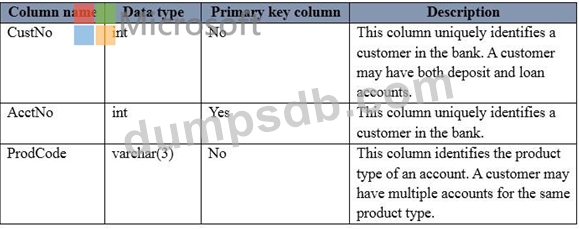
You need to determine the total number of customers who have either deposit accounts or loan accounts, but not both types of accounts.
Which Transact-SQL statement should you run?
A: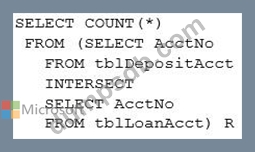
B: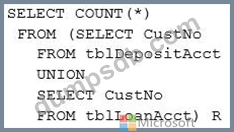
C: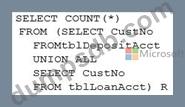
D:
E:
F: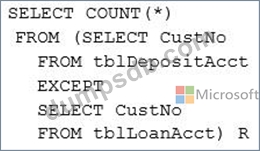
G:
H: