

Question 176
Note: This question is part of a series of questions that use the same or similar answer choices. An answer choice may be correct for more than one question in the series. Each question is independent of the other questions in this series. Information and details provided in a question apply to that question.
You have a database for a banking system. The database has two tables named tblDepositAcct and tblLoanAcct that store deposit and loan accounts, respectively. Both tables contain the following columns: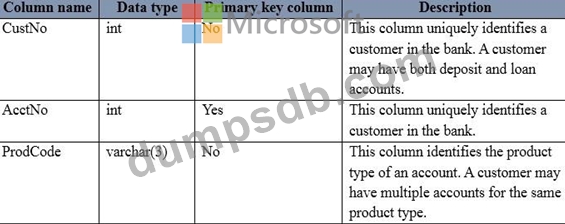
You need to determine the total number of customers who have either deposit accounts or loan accounts, but not both types of accounts.
Which Transact-SQL statement should you run?
A: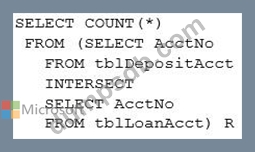
B: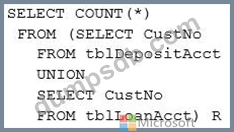
C: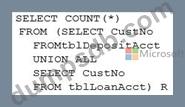
D:
E:
F: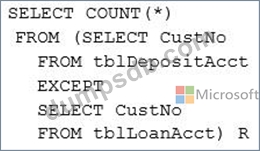
G:
H:
Question 177
Note: This question is part of a series of questions that use the same or similar answer choices. An answer choice may be correct for more than one question in the series. Each question is independent of the other questions in this series. Information and details provided in a question apply only to that question.
You create a table by running the following Transact-SQL statement: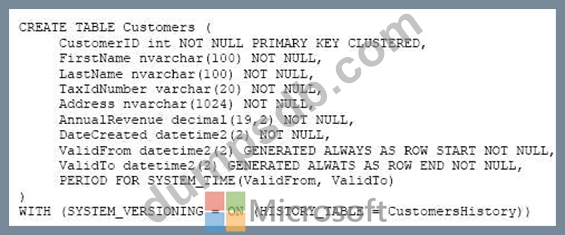
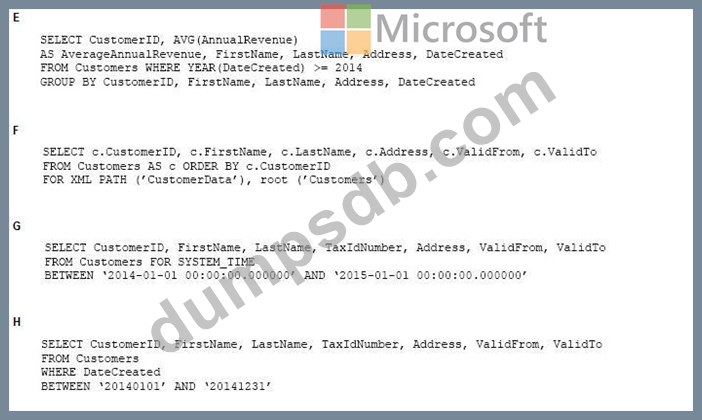
You are developing a report that aggregates customer data only for the year 2014. The report requires that the data be denormalized.
You need to return the data for the report.
Which Transact-SQL statement should you run?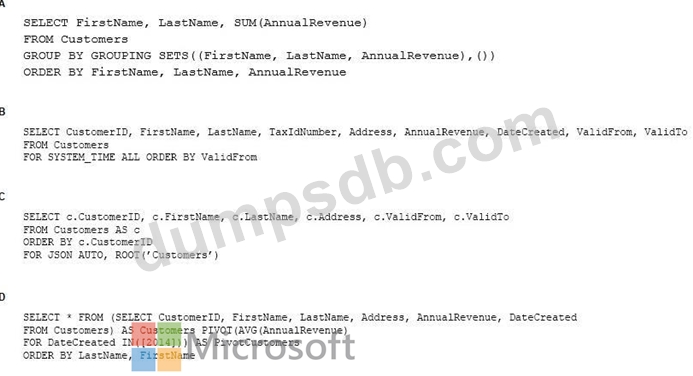
Question 178
Note: This question is part of a series of questions that present the same scenario. Each question in the series contains a unique solution that might meet the stated goals. Some question sets might have more than one correct solution, while others might not have a correct solution.
After you answer a question in this section. You will NOT be able to return to it. As a result, these questions will not appear in the review screen.
You have a table named Products that stores information about products your company sells. The table has a column named ListPrice that stores retail pricing information for products.
Some products are used only internally by the company. Records for these products are maintained in the Products table for inventory purposes. The price for each of these products is $0.00. Customers are not permitted to order these products.
You need to increase the list price for products that cost less than $100 by 10 percent. You must only increase pricing for products that customers are permitted to order.
Solution: You run the following Transact-SQL statement: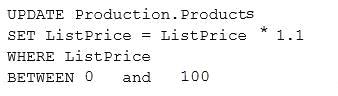
Does the solution meet the goal?
Question 179
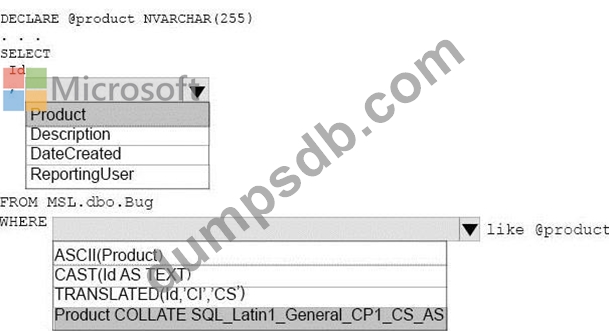
You develop and deploy a project management application. The application uses a Microsoft SQL Server database to store data. You are developing a software bug tracking add-on for the application.
The add-on must meet the following requirements:
* Allow case sensitive searches for product.
* Filter search results based on exact text in the description.
* Support multibyte Unicode characters.
You run the following Transact-SQL statement: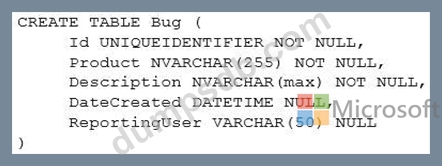
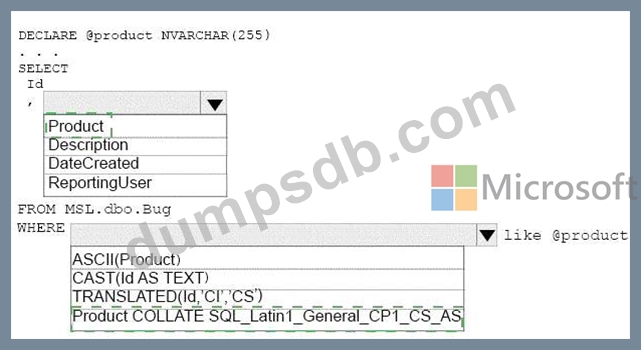
Users report that searches for the product Salt also return results for the product salt.
You need to ensure that the query returns the correct results.
How should you complete the Transact-SQL statement? To answer, select the appropriate Transact-SQL segments in the answer area.
NOTE: Each correct selection is worth one point.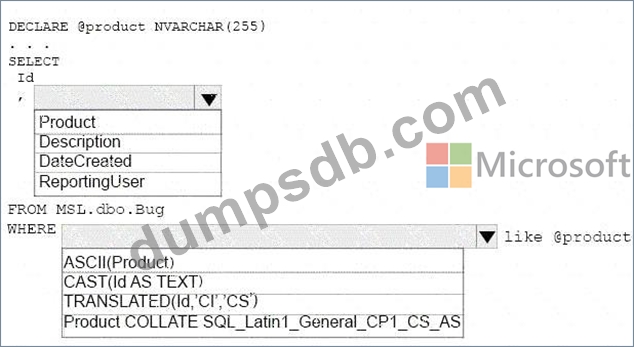
Question 180
Note: This question is part of a series of questions that present the same scenario. Each question in the series contains a unique solution that might meet the stated goals. Some question sets might have more than one correct solution, while others might not have a correct solution.
After you answer a question in this section. You will NOT be able to return to it. As a result, these questions will not appear in the review screen.
You have a database that contains a single table named tblVehicleRegistration. The table is defined as follows: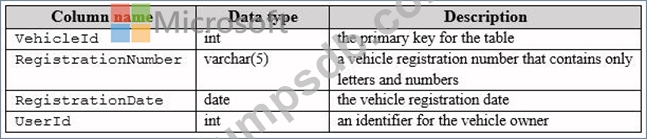
You run the following query:
The query output window displays the following error message: "Conversion failed when converting the varchar value 'AB012' to data type int." You need to resolve the error.
Solution: You modify the Transact-SQL statement as follows:
Does the solution meet the goal?