

Question 171
HOTSPOT
Note: This question is part of a series of questions that use the same scenario. For your convenience, the scenario is repeated in each question. Each question presents a different goal and answer choices, but the text of the scenario is exactly the same in each question in this series.
You are developing a database to track customer orders. The database contains the following tables: Sales.Customers, Sales.Orders, and Sales.OrderLines.
The following table describes the columns in Sales.Customers.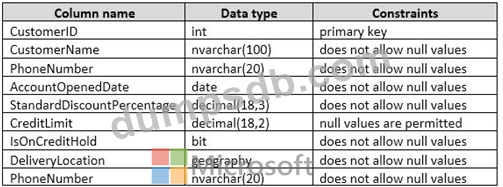
The following table describes the columns in Sales.Orders.
The following table describes the columns in Sales.OrderLines.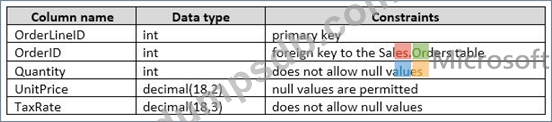
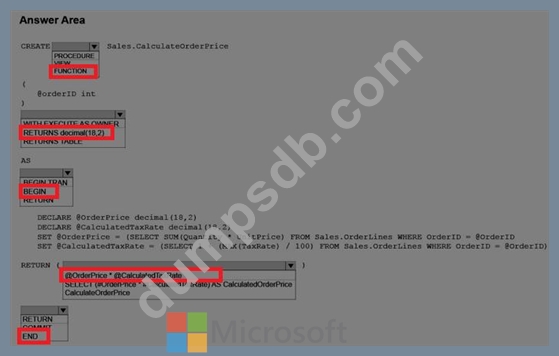
You need to create a database object that calculates the total price of an order including the sales tax. The database object must meet the following requirements:
- Reduce the compilation cost of Transact-SQL code by caching the plans and reusing them for repeated execution.
- Return a value.
- Be callable from a SELECT statement.
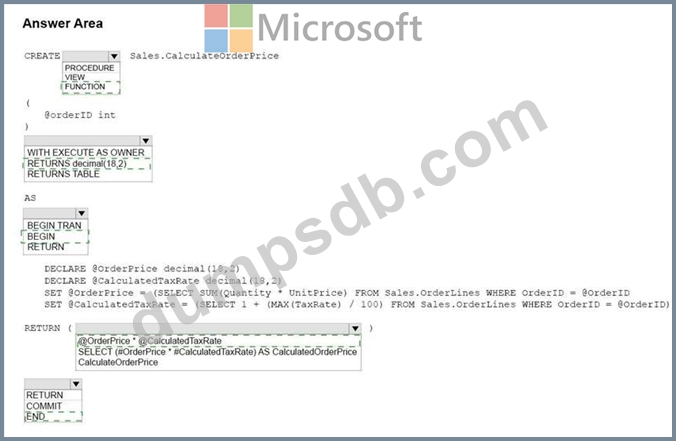
How should you complete the Transact-SQL statements? To answer, select the appropriate Transact-SQL segments in the answer area.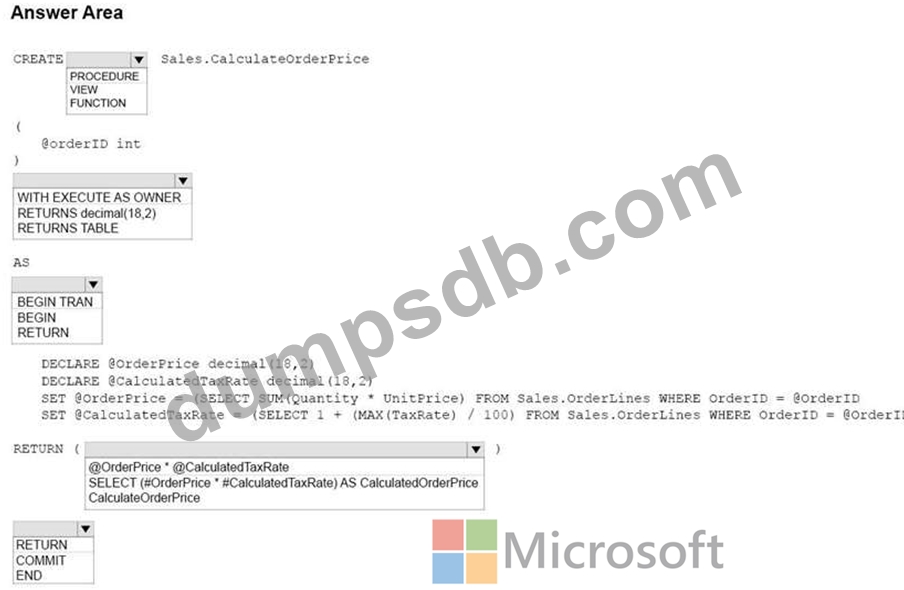
Question 172
Note: This question is part of a series of questions that use the same scenario. For your convenience, the scenario is repeated in each question. Each question presents a different goal and answer choices, but the text of the scenario is exactly the same in each question in this series.
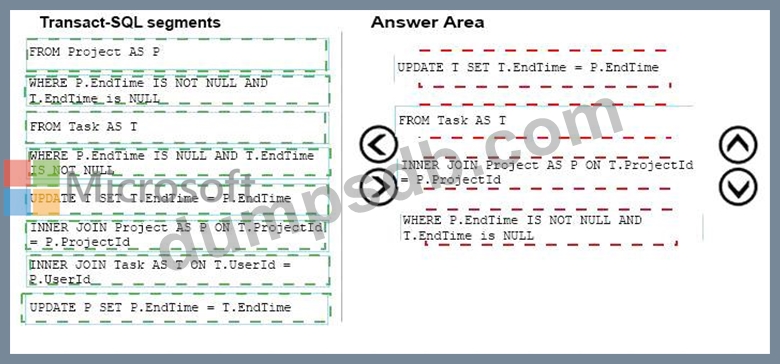
You query a database that includes two tables: Project and Task. The Project table includes the following columns: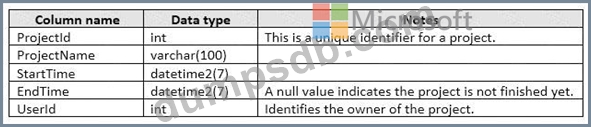
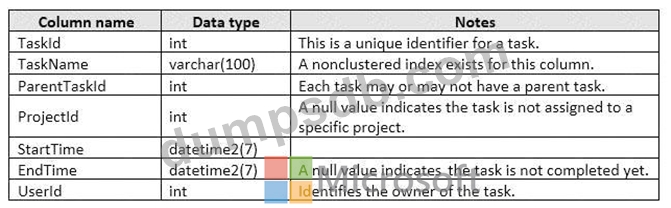
When running an operation, you updated a column named EndTime for several records in the Project table, but updates to the corresponding task records in the Task table failed.
You need to synchronize the value of the EndTime column in the Task table with the value of the EndTime column in the project table. The solution must meet the following requirements:
* If the EndTime column has a value, make no changes to the record.
* If the value of the EndTime column is null and the corresponding project record is marked as completed, update the record with the project finish time.
Which four Transact-SQL segments should you use to develop the solution? To answer, move the appropriate Transact-SQL segments from the list of Transact-SQL segments to the answer area and arrange them in the correct order.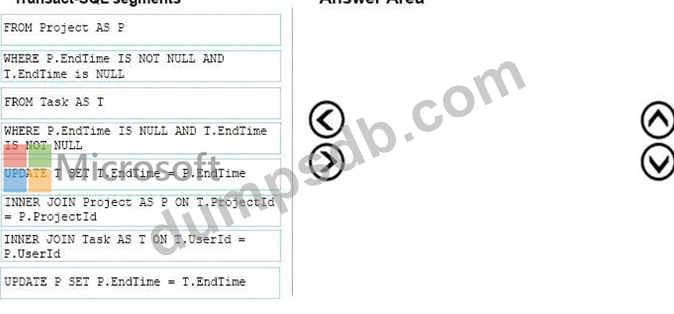

Question 173
Note: This question is part of a series of questions that present the same scenario. Each question in the series contains a unique solution that might meet the stated goals. Some question sets might have more than one correct solution, while others might not have a correct solution.
After you answer a question in this section. You will NOT be able to return to it. As a result, these questions will not appear in the review screen.
You have a database that contains a single table named tblVehicleRegistration. The table is defined as follows:
You run the following query:
The query output window displays the following error message: "Conversion failed when converting the varchar value 'AB012' to data type int." You need to resolve the error.
Solution: You modify the Transact-SQL statement as follows:
Does the solution meet the goal?
Question 174
You create a table named Sales.Categories by running the following Transact-SQL statement: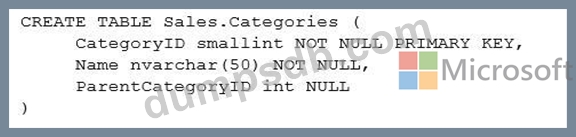
You add the following data to the table.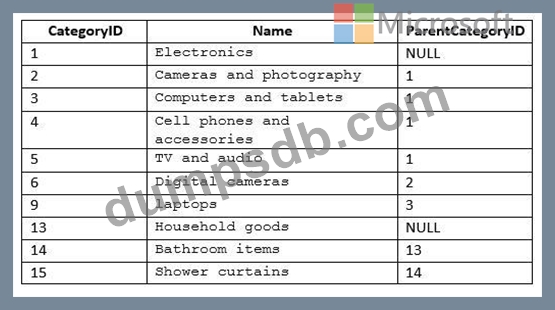
You need to create a query that uses a common table expression (CTE) to show the parent category of each category. The query must meet the following requirements:
* Return all columns from the Categories table in the order shown.
* Exclude all categories that do not have a parent category.
Construct the query using the following guidelines:
* Name the expression ParentCategories.
* Use PC as the alias for the expression.
* Use C as the alias for the Categories table.
* Use the AS keyword for all table aliases.
* Use individual column names for each column that the query returns.
* Do not use a prefix for any column name.
* Do not surround object names with square brackets.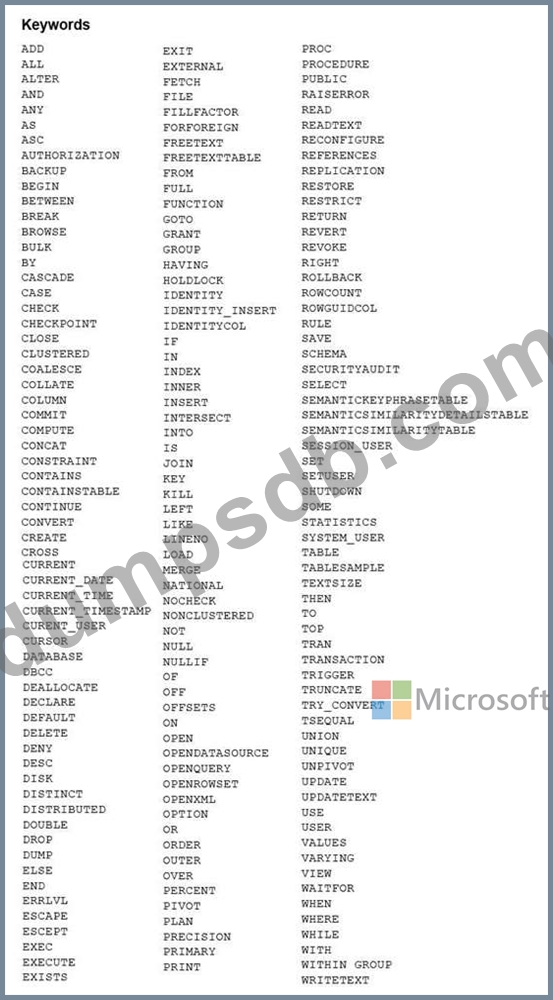
Part of the correct Transact-SQL has been provided in the answer area below. Enter the code in the answer area that resolves the problem and meets the stated goals or requirements. You can add code within the code that has been provided as well as below it.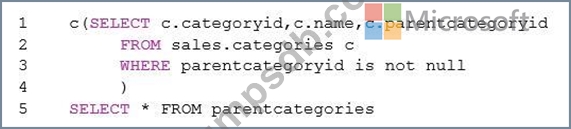
Use the Check Syntax button to verify your work. Any syntax or spelling errors will be reported by line and character position. You may check syntax as many times as needed.
Question 175
Note: This question is part of a series of questions that present the same scenario. Each question in the series contains a unique solution that might meet the stated goals. Some question sets might have more than one correct solution, while others might not have a correct solution.
After you answer a question in this section. you will NOT be able to return to it. As a result, these questions will not appear in the review screen.
You have a database that tracks orders and deliveries for customers in North America. The database contains the following tables:
Sales.Customers
Application.Cities
Sales.CustomerCategories
The company's development team is designing a customer directory application. The application must list customers by the area code of their phone number. The area code is defined as the first three characters of the phone number.
The main page of the application will be based on an indexed view that contains the area and phone number for all customers.
You need to return the area code from the PhoneNumber field.
Solution: You run the following Transact-SQL statement: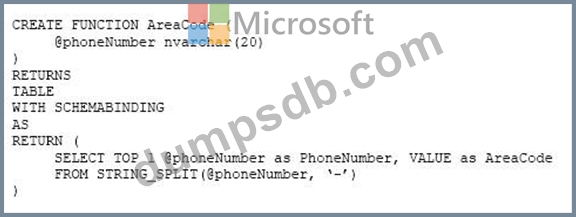
Does the solution meet the goal?