Question 161
Note: This question is part of a series of questions that present the same scenario. Each question in the series contains a unique solution that might meet the stated goals. Some question sets might have more than one correct solution, while others might not have a correct solution.
After you answer a question in this section. You will NOT be able to return to it. As a result, these questions will not appear in the review screen.
You have a table named Products that stores information about products your company sells. The table has a column named ListPrice that stores retail pricing information for products.
Some products are used only internally by the company. Records for these products are maintained in the Products table for inventory purposes. The price for each of these products is $0.00. Customers are not permitted to order these products.
You need to increase the list price for products that cost less than $100 by 10 percent. You must only increase pricing for products that customers are permitted to order.
Solution: You run the following Transact-SQL statement: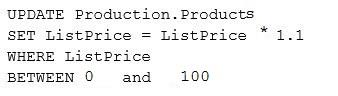
Does the solution meet the goal?
Question 162
HOTSPOT
You have a database that contains the following tables: tblRoles, tblUsers, and tblUsersInRoles.
The table tblRoles is defined as follows.
You have a function named ufnGetRoleActiveUsers that was created by running the following Transact-SQL statement: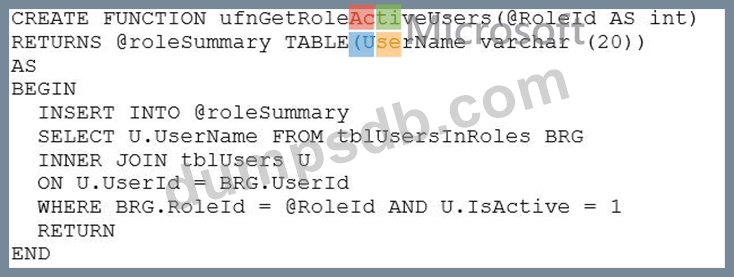
You need to list all roles and their corresponding active users. The query must return the
RoleId, RoleName, and UserName columns. If a role has no active users, a NULL value should be returned as the UserName for that role.
How should you complete the Transact-SQL statement? To answer, select the appropriate
Transact-SQL segments in the answer area.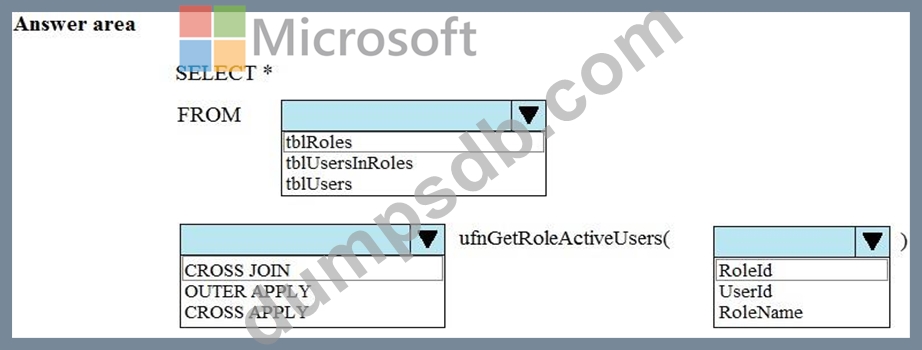

Question 163
You have a database named MyDb. You run the following Transact-SQL statements: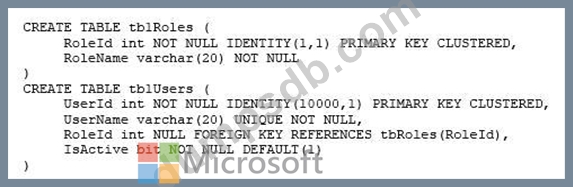
A value of 1 in the IsActive column indicates that a user is active.
You need to create a count for active users in each role. If a role has no active users. you must display a zero as the active users count.
Which Transact-SQL statement should you run?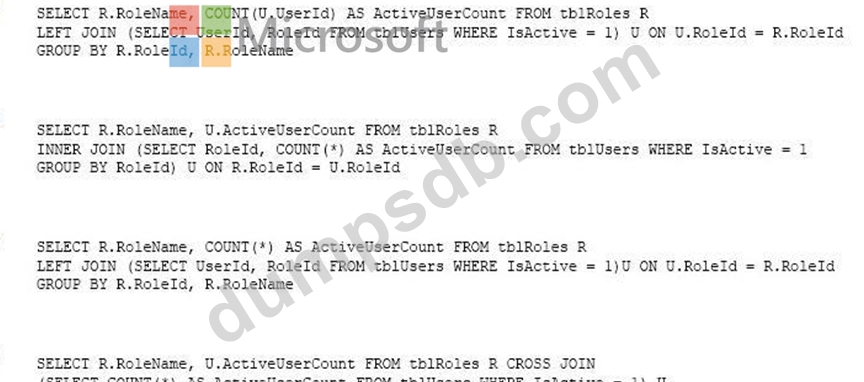
Question 164
Note: This question is part of a series of questions that present the same scenario. Each question in the series contains a unique solution that might meet the stated goals. Some question sets might have more than one correct solution, while others might not have a correct solution.
After you answer a question in this section. You will NOT be able to return to it. As a result, these questions will not appear in the review screen.
You create a table named Customer by running the following Transact-SQL statement: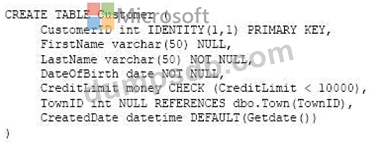
You must insert the following data into the Customer table:
You need to ensure that both records are inserted or neither record is inserted.
Solution: You run the following Transact-SQL statement:
Does the solution meet the goal?
Question 165
Note: This question is part of a series of questions that use the same or similar answer choices. An answer choice may be correct for more than one question in the series. Each question is independent of the other questions in this series. Information and details provided in a question apply only to that question.
You have a database that contains several connected tables. The tables contain sales data for customers in the United States only.
You have the following partial query for the database. (Line numbers are included for reference only.)
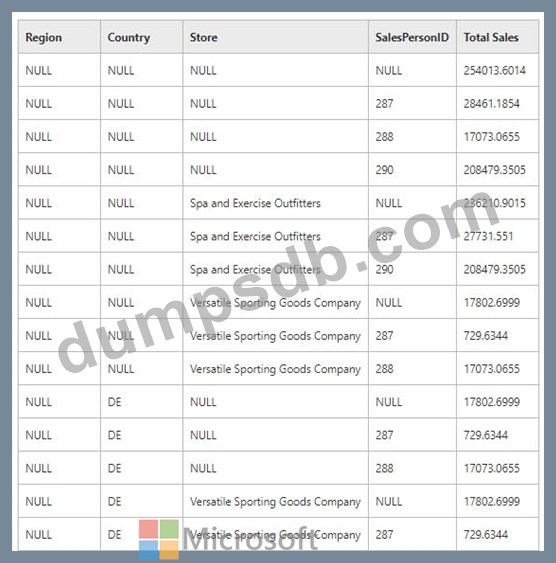
You need to complete the query to generate the output shown in the following table.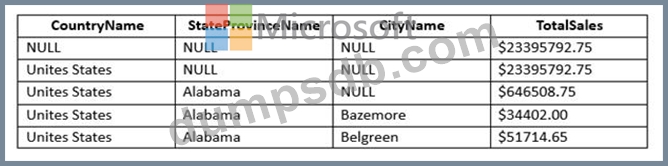
Which statement clause should you add at line 3?