

070-761 Premium Dumps
Latest 070-761 Exam Premium Dumps provide by TrainingQuiz.com to help you Passing 070-761 Exam! TrainingQuiz.com offers the updated 070-761 exam dumps, the TrainingQuiz.com 070-761 exam questions has been updated to correct Answer. Get the latest TrainingQuiz.com 070-761 pdf dumps with Exam Engine here:
(205 Q&As Dumps, 40%OFF Special Discount: DumpsDB)

Question 141
You need to develop a Transact-SQL statement that meets the following requirements:
- The statement must return a custom error when there are problems updating a table.
- The error number must be value 50555.
- The error severity level must be 14.
- A Microsoft SQL Server alert must be triggered when the error condition occurs.
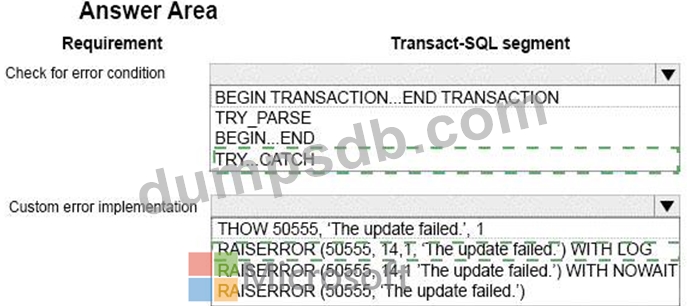
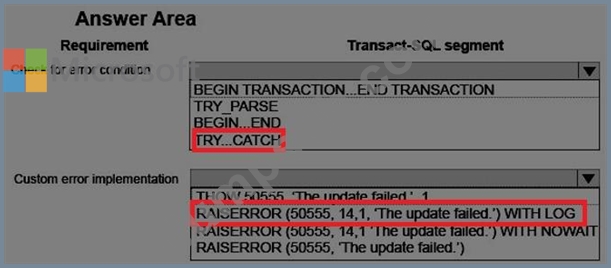
Which Transact-SQL segment should you use for each requirement? To answer, select the appropriate Transact-SQL segments in the answer area.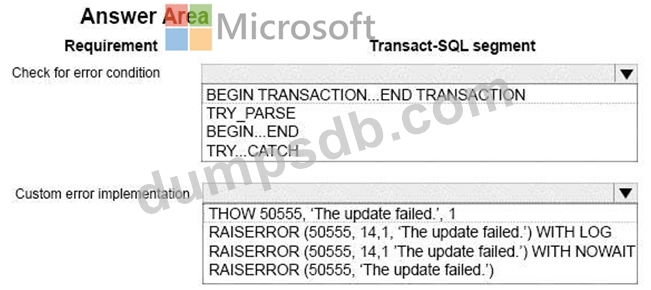
Question 142
DRAG DROP
Note: This question is part of a series of questions that use the same scenario. For your convenience, the scenario is repeated in each question. Each question presents a different goal and answer choices, but the text of the scenario is exactly the same in each question in this series.
Start of repeated scenario
You have a database that contains the tables shown in the exhibit. (Click the Exhibit button.)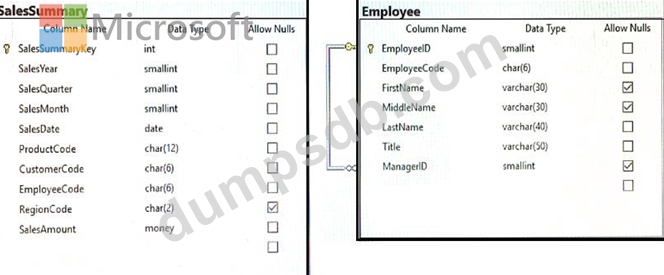
You review the Employee table and make the following observations:
Every record has a value in the ManagerID except for the Chief Executive Officer (CEO).
The FirstName and MiddleName columns contain null values for some records.
The valid values for the Title column are Sales Representative manager, and CEO.
You review the SalesSummary table and make the following observations:
The ProductCode column contains two parts: The first five digits represent a product code, and the last
seven digits represent the unit price. The unit price uses the following pattern: ####.##.
You observe that for many records, the unit price portion of the ProductCode column contains values.
The RegionCode column contains NULL for some records.
Sales data is only recorded for sales representatives.
You are developing a series of reports and procedures to support the business. Details for each report or procedure follow.
Sales Summary report: This report aggregates data by year and quarter. The report must resemble the following table.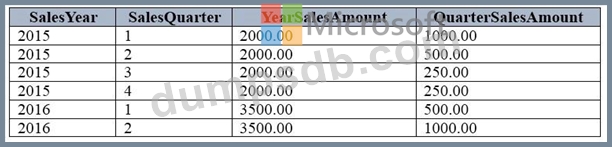
Sales Manager report: This report lists each sales manager and the total sales amount for all employees that report to the sales manager.
Sales by Region report: This report lists the total sales amount by employee and by region. The report must include the following columns: EmployeeCode, MiddleName, LastName, RegionCode, and SalesAmount. If MiddleName is NULL, FirstName must be displayed. If both FirstName and MiddleName have null values, the world Unknown must be displayed/ If RegionCode is NULL, the word Unknown must be displayed.
Report1: This report joins data from SalesSummary with the Employee table and other tables. You plan to create an object to support Report1. The object has the following requirements:
be joinable with the SELECT statement that supplies data for the report
can be used multiple times with the SELECT statement for the report
be usable only with the SELECT statement for the report
not be saved as a permanent object
Report2: This report joins data from SalesSummary with the Employee table and other tables.
You plan to create an object to support Report1. The object has the following requirements:
be joinable with the SELECT statement that supplies data for the report
can be used multiple times for this report and other reports
accept parameters
be saved as a permanent object
Sales Hierarchy report: This report aggregates rows, creates subtotal rows, and super-aggregates rows over the SalesAmount column in a single result-set. The report uses SaleYear, SaleQuarter, and SaleMonth as a hierarchy. The result set must not contain a grand total or cross-tabulation aggregate rows.
Current Price Stored Procedure: This stored procedure must return the unit price for a product when a product code is supplied. The unit price must include a dollar sign at the beginning. In addition, the unit price must contain a comma every three digits to the left of the decimal point, and must display two digits to the left of the decimal point. The stored procedure must not throw errors, even if the product code contains invalid data.
End of Repeated Scenario
You need to create the query for the Sales Managers report.
Which four Transact-SQL segments should you use to develop the solution? To answer, move the appropriate Transact-SQL segments from the list of Transact-SQL segments to the answer area and arrange them in the correct order.
Select and Place: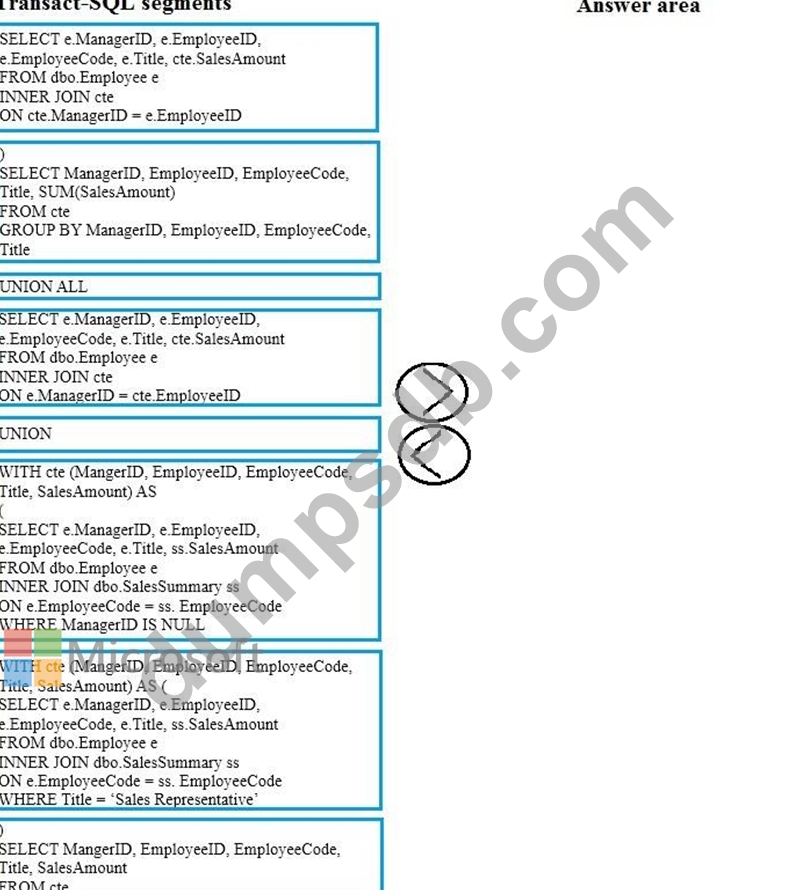

Question 143
You need to create a database object that meets the following requirements:
* accepts a product identifies as input
* calculates the total quantity of a specific product, including quantity on hand and quantity on order
* caches and reuses execution plan
* returns a value
* can be called from within a SELECT statement
* can be used in a JOIN clause
What should you create?
Question 144
You have a database that includes the tables shown in the exhibit. (Click the exhibit button.)
You need to create a list of all customers, the order ID for the last order that the customer placed, and the date that the order was placed. For customers who have not placed orders, you must substitute a zero for the order ID and 01/01/1990 for the date.
Which Transact-SQL statement should you run?
A:
B:
C:
D:
Question 145
Note: This question is part of a series of questions that present the same scenario. Each question in the series contains a unique solution that might meet the stated goals. Some question sets might have more than one correct solution, while others might not have a correct solution.
After you answer a question in this section, you will NOT be able to return to it. As a result, these questions will not appear in the review screen.
You are building a stored procedure that will be used by hundreds of users concurrently.
You need to store rows that will be processed later by the stored procedure. The object that stores the rows must meet the following requirements:
* Be indexable
* Contain up-to-date statistics
* Be able to scale between 10 and 100,000 rows
The solution must prevent users from accessing one another's data.
Solution: You create a table variable in the stored procedure.
Does this meet the goal?