

Question 126
Note: This question is part of a series of questions that present the same scenario. Each question in the series contains a unique solution that might meet the stated goals. Some question sets might have more than one correct solution, while others might not have a correct solution.
After you answer a question in this section. You will NOT be able to return to it. As a result, these questions will not appear in the review screen.
You have a table named Products that stores information about products your company sells. The table has a column named ListPrice that stores retail pricing information for products.
Some products are used only internally by the company. Records for these products are maintained in the Products table for inventory purposes. The price for each of these products is $0.00. Customers are not permitted to order these products.
You need to increase the list price for products that cost less than $100 by 10 percent. You must only increase pricing for products that customers are permitted to order.
Solution: You run the following Transact-SQL statement:
Does the solution meet the goal?
Question 127
You have a database that contains the following tables:
Customer
CustomerAudit
Where the value of the CustomerID column equals 3, you need to update the value of the CreditLimit column to 1000 for the customer. You must ensure that the change to the record in the Customer table is recorded on the CustomerAudit table.
Which Transact-SQL statement should you run?
Question 128
Note: This question is part of a series of questions that use the same or similar answer choices. An answer choice may be correct for more than one question in the series. Each question is independent of the other questions in this series. Information and details provided in a question apply only to that question.
You create a table by running the following Transact-SQL statement: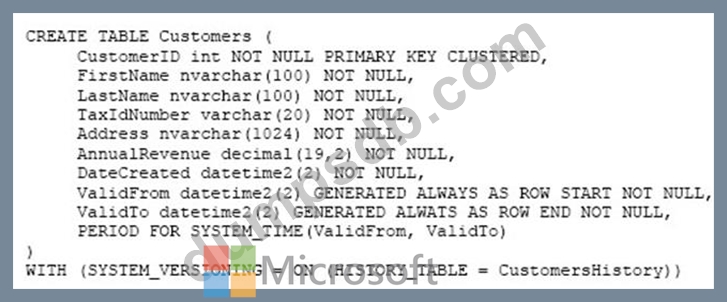
You need to return normalized data for all customers that were added in the year 2014.
Which Transact-SQL statement should you run?
A:
B:
C:
D:
E:
F:
G:
H:
Question 129
Note: This question is part of a series of questions that use the same or similar answer choices. An answer choice may be correct for more than one question in the series. Each question is independent of the other questions in this series. Information and details provided in a question apply only to that question.
You create a table by running the following Transact-SQL statement:
You need to audit all customer data.
Which Transact-SQL statement should you run?

Question 130
You have a database that contains the following tables.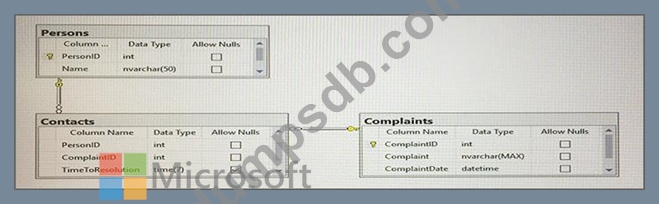
You need to create a query that lists all complaints from the Complaints table, and the name of the person handling the complaints if a person is assigned. The ComplaintID must be displayed first, followed by the person name.
Construct the query using the following guidelines:
- Use two-part column names.
- Use one-part table names.
- Do not use aliases for column names or table names.
- Do not use Transact-SQL functions.
- Do not use implicit joins.
- Do not surround object names with square brackets.
Part of the correct Transact-SQL has been provided in the answer area below. Enter the code in the answer area that resolves the problem and meets the stated goals or requirements. You can add code within the code that has been provided as well as below it.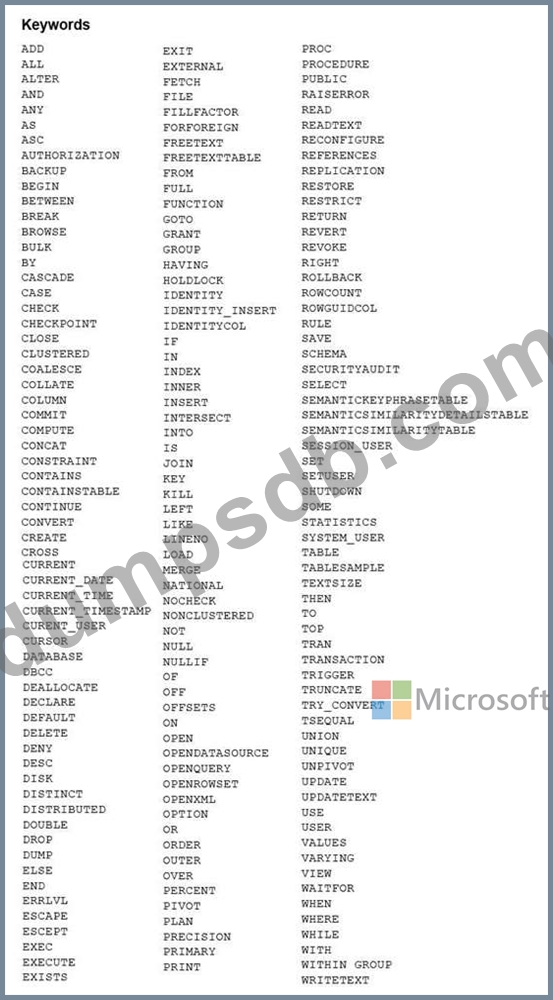

Use the Check Syntax button to verify your work.
Any syntax or spelling errors will be reported by line and character position.