

Question 46
You have a Microsoft 365 subscription.
The Global administrator role is assigned to your user account. You have a user named Admin1.
You create an eDiscovery case named Case1.
You need to ensure that Admin1 can view the results of Case1.
What should you do first?
Question 47
An administrator configures Azure AD Privileged Identity Management as shown in the following exhibit.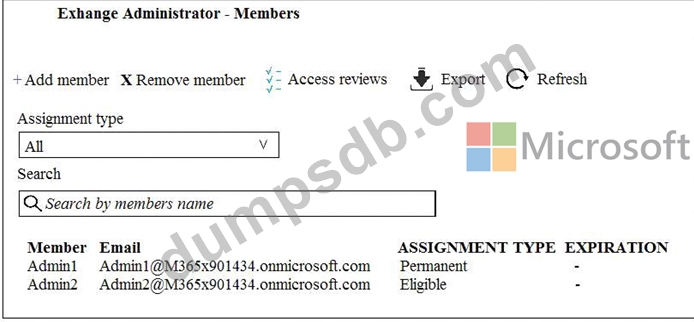
What should you do to meet the security requirements?
Question 48
Note: This question is part of series of questions that present the same scenario. Each question in the series contains a unique solution that might meet the stated goals. Some question sets might have more than one correct solution, while others might not have a correct solution.
After you answer a question in this section, you will NOT be able to return to it. As a result, these questions will not appear in the review screen.
You have a Microsoft 365 E5 subscription that is associated to a Microsoft Azure Active Directory (Azure AD) tenant named contoso.com.
You use Active Directory Federation Services (AD FS) to federate on-premises Active Directory and the tenant. Azure AD Connect has the following settings:
* Source Anchor: objectGUID
* Password Hash Synchronization: Disabled
* Password writeback: Disabled
* Directory extension attribute sync: Disabled
* Azure AD app and attribute filtering: Disabled
* Exchange hybrid deployment: Disabled
* User writeback: Disabled
You need to ensure that you can use leaked credentials detection in Azure AD Identity Protection.
Solution: You modify the Source Anchor settings.
Does that meet the goal?
Question 49
You have a Microsoft 365 subscription that includes a user named User1.
You have a conditional access policy that applies to Microsoft Exchange Online. The conditional access policy is configured to use Conditional Access App Control.
You need to create a Microsoft Cloud App Security policy that blocks User1 from printing from Exchange Online.
Which type of Cloud App Security policy should you create?
Question 50
You have a Microsoft 365 subscription and a Microsoft Defender Advanced Threat Protection (Microsoft Defender ATP) subscription.
You have devices enrolled in Microsoft Endpoint Manager as shown in the following table: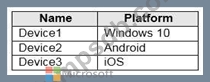
You integrate Microsoft Defender ATP and Endpoint Manager.
You plan to evaluate the Microsoft Defender ATP risk level for the devices.
You need to identify which devices can be evaluated.
Which devices should you identify?