

Question 61
Note: This question is part of series of questions that present the same scenario. Each question in the series contains a unique solution that might meet the stated goals. Some question sets might have more than one correct solution, while others might not have a correct solution.
After you answer a question in this section, you will NOT be able to return to it. As a result, these questions will not appear in the review screen.
You have a Microsoft 365 tenant. You create a label named CompanyConfidential in Microsoft Azure Information Protection.
You add CompanyConfidential to a global policy.
A user protects an email message by using CompanyConfidential and sends the label to several external recipients. The external recipients report that they cannot open the email message.
You need to ensure that the external recipients can open protected email messages sent to them.
Solution: You create a new label in the global policy and instruct the user to resend the email message.
Does this meet the goal?
Question 62
Note: This question is part of a series of questions that present the same scenario. Each question in the series contains a unique solution that might meet the stated goals. Some question sets might have more than one correct solution, while others might not have a correct solution.
After you answer a question in this section, you will NOT be able to return to it. As a result, these questions will not appear in the review screen.
You have a Microsoft 365 subscription.
You have a user named User1. Several users have full access to the mailbox of User1.
Some email messages sent to User1 appear to have been read and deleted before the user viewed them.
When you search the audit log in Security & Compliance to identify who signed in to the mailbox of User1, the results are blank.
You need to ensure that you can view future sign-ins to the mailbox of User1.
You run the Set-AuditConfig -Workload Exchangecommand.
Does that meet the goal?
Question 63
Your network contains an on-premises Active Directory domain named contoso.com. The domain contains the groups shown in the following table.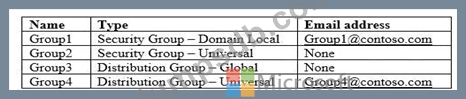
The domain is synced to a Microsoft Azure Active Directory (Azure AD) tenant that contains the groups shown in the following table.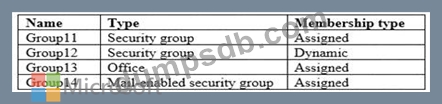
You create an Azure Information Protection policy named Policy1.
You need to apply Policy1.
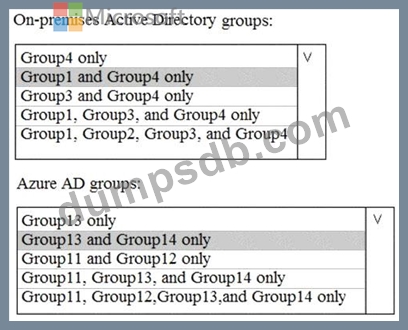
To which groups can you apply Policy1? To answer, select the appropriate options in the answer area.
NOTE: Each correct selection is worth one point.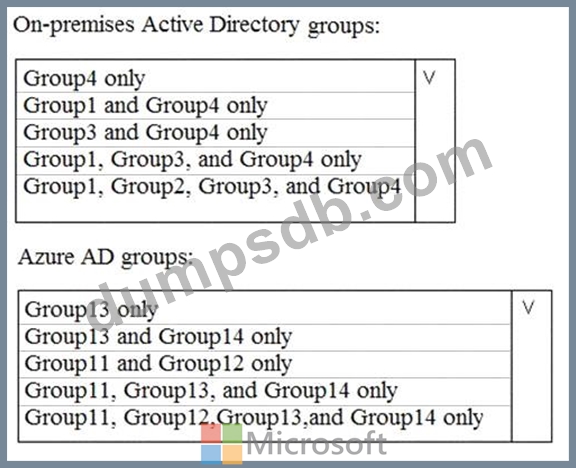

Question 64
You have a Microsoft 365 E5 subscription.
Users and device objects are added and removed daily. Users in the sales department frequently change their device.
You need to create three following groups: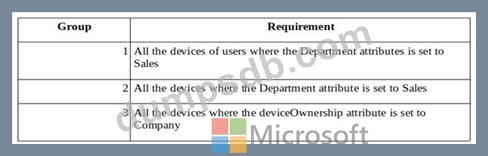
The solution must minimize administrative effort.
What is the minimum number of groups you should create for each type of membership? To answer, select the appropriate options in the answer area.
NOTE: Each correct selection is worth one point.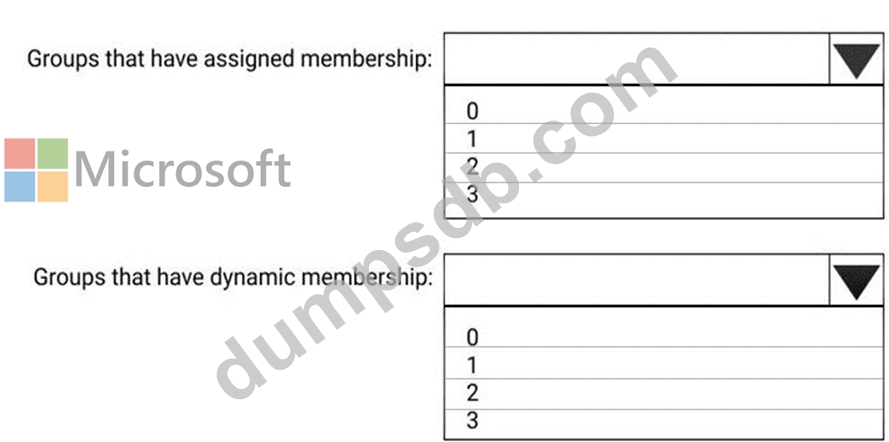
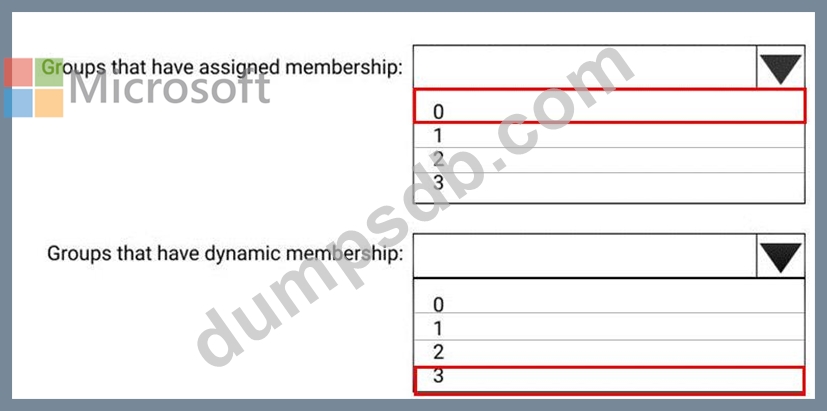
Question 65
You have a Microsoft 365 subscription that contains the users shown in the following table.
You enable self-service password reset for Group1 and configure security questions as the only authentication method for self-service password reset.
You need to identify which user must answer security questions to reset his password.
Which user should you identify?