

Question 51
An API client is implemented as a Mule application that includes an HTTP Request operation using a default configuration. The HTTP Request operation invokes an external API that follows standard HTTP status code conventions, which causes the HTTP Request operation to return a 4xx status code.
What is a possible cause of this status code response?
Question 52
Refer to the exhibit.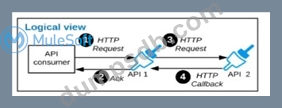
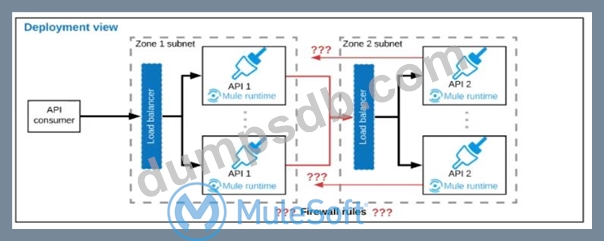
A business process involves two APIs that interact with each other asynchronously over HTTP. Each API is implemented as a Mule application. API 1 receives the initial HTTP request and invokes API 2 (in a fire and forget fashion) while API 2, upon completion of the processing, calls back into API l to notify about completion of the asynchronous process.
Each API Is deployed to multiple redundant Mule runtimes and a separate load balancer, and is deployed to a separate network zone.
In the network architecture, how must the firewall rules be configured to enable the above Interaction between API 1 and API 2?
Question 53
A mule application is deployed to a Single Cloudhub worker and the public URL appears in Runtime Manager as the APP URL.
Requests are sent by external web clients over the public internet to the mule application App url. Each of these requests routed to the HTTPS Listener event source of the running Mule application.
Later, the DevOps team edits some properties of this running Mule application in Runtime Manager.
Immediately after the new property values are applied in runtime manager, how is the current Mule application deployment affected and how will future web client requests to the Mule application be handled?
Question 54
What limits if a particular Anypoint Platform user can discover an asset in Anypoint Exchange?
Question 55
A Mule application uses the Database connector.
What condition can the Mule application automatically adjust to or recover from without needing to restart or redeploy the Mule application?