

Question 61
Refer to the exhibit.
A Mule application is being designed to be deployed to several CIoudHub workers. The Mule application's integration logic is to replicate changed Accounts from Satesforce to a backend system every 5 minutes.
A watermark will be used to only retrieve those Satesforce Accounts that have been modified since the last time the integration logic ran.
What is the most appropriate way to implement persistence for the watermark in order to support the required data replication integration logic?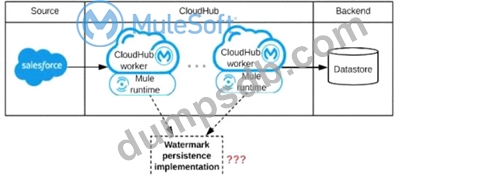
Question 62
An Integration Mule application is being designed to synchronize customer data between two systems. One system is an IBM Mainframe and the other system is a Salesforce Marketing Cloud (CRM) instance. Both systems have been deployed in their typical configurations, and are to be invoked using the native protocols provided by Salesforce and IBM.
What interface technologies are the most straightforward and appropriate to use in this Mute application to interact with these systems, assuming that Anypoint Connectors exist that implement these interface technologies?
Question 63
A Mule application uses the Database connector.
What condition can the Mule application automatically adjust to or recover from without needing to restart or redeploy the Mule application?
Question 64
Refer to the exhibit.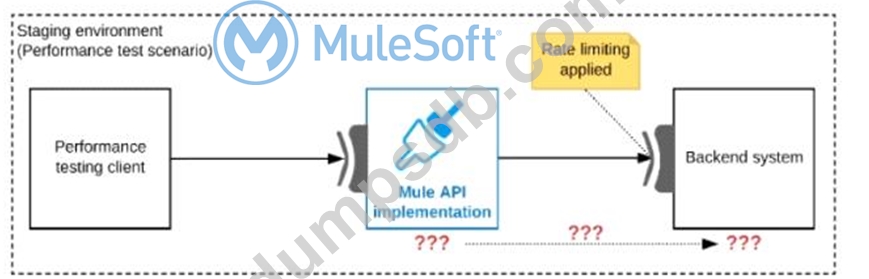
One of the backend systems invoked by an API implementation enforces rate limits on the number of requests a particular client can make. Both the backend system and the API implementation are deployed to several non-production environments in addition to production.
Rate limiting of the backend system applies to all non-production environments. The production environment, however, does NOT have any rate limiting.
What is the most effective approach to conduct performance tests of the API implementation in a staging (non-production) environment?
Question 65
Mule application A receives a request Anypoint MQ message REQU with a payload containing a variable-length list of request objects. Application A uses the For Each scope to split the list into individual objects and sends each object as a message to an Anypoint MQ queue.
Service S listens on that queue, processes each message independently of all other messages, and sends a response message to a response queue.
Application A listens on that response queue and must in turn create and publish a response Anypoint MQ message RESP with a payload containing the list of responses sent by service S in the same order as the request objects originally sent in REQU.
Assume successful response messages are returned by service S for all request messages.
What is required so that application A can ensure that the length and order of the list of objects in RESP and REQU match, while at the same time maximizing message throughput?