

Question 56
What is true about where an API policy is defined in Anypoint Platform and how it is then applied to API instances?
Question 57
Mule applications that implement a number of REST APIs are deployed to their own subnet that is inaccessible from outside the organization.
External business-partners need to access these APIs, which are only allowed to be invoked from a separate subnet dedicated to partners - called Partner-subnet. This subnet is accessible from the public internet, which allows these external partners to reach it.
Anypoint Platform and Mule runtimes are already deployed in Partner-subnet. These Mule runtimes can already access the APIs.
What is the most resource-efficient solution to comply with these requirements, while having the least impact on other applications that are currently using the APIs?
Question 58
Refer to the exhibit.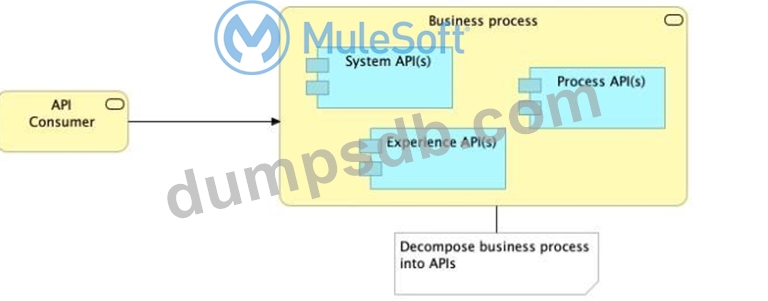
What is the best way to decompose one end-to-end business process into a collaboration of Experience, Process, and System APIs?
A) Handle customizations for the end-user application at the Process API level rather than the Experience API level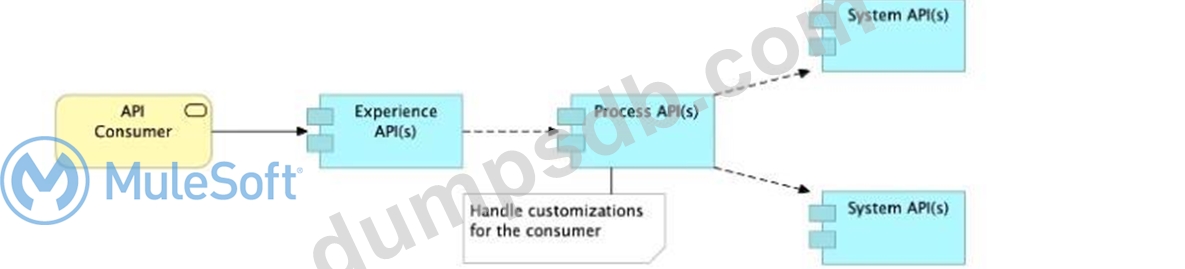
B) Allow System APIs to return data that is NOT currently required by the identified Process or Experience APIs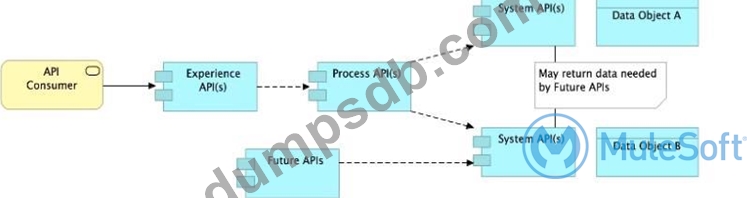
C) Always use a tiered approach by creating exactly one API for each of the 3 layers (Experience, Process and System APIs)
D) Use a Process API to orchestrate calls to multiple System APIs, but NOT to other Process APIs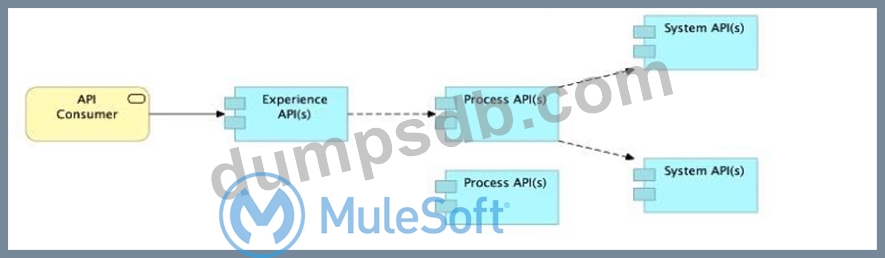
Question 59
What is a best practice when building System APIs?
Question 60
What Mule application deployment scenario requires using Anypoint Platform Private Cloud Edition or Anypoint Platform for Pivotal Cloud Foundry?