Which of the following best describes the purpose of the Gap Analysis technique?
Correct Answer: C
The purpose of the Gap Analysis technique is similar to the previous question, but with a focus on the Target Architecture. The technique helps to identify the items that are not included or specified in the Target Architecture, such as capabilities, services, components, standards, or technologies. These items may be essential for achieving the vision and goals of the enterprise, or for addressing the stakeholder concerns and requirements. By identifying the items omitted from the Target Architecture, the technique helps to ensure that the architecture is comprehensive, feasible, and realistic.
Question 2
Which statement best describes iteration and the ADM?
Correct Answer: D
This statement best describes iteration and the ADM. The ADM is iterative over the whole process between phases and within phases because it allows for feedback loops and refinements at any point in the architecture development and transition process. Iteration enables architects to address changing requirements, assumptions, constraints, and environments; to validate and improve architectures; to manage risks and issues; and to ensure stakeholder satisfaction and value realization. Reference: The TOGAF Standard | The Open Group Website, Section 3.1 Introduction to the ADM.
Question 3
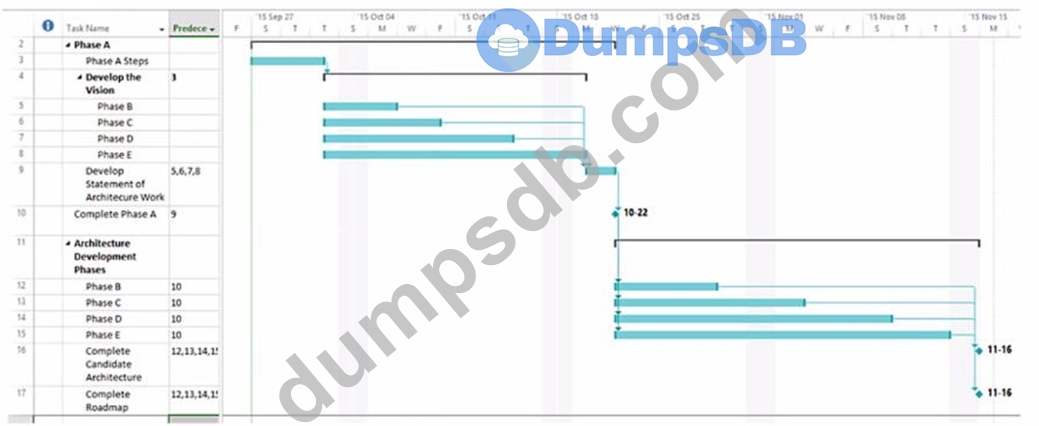
Consider the following chart: Which important concept for Enterprise Architecture Practitioners does it illustrate?
Correct Answer: C
The chart shown is a Gantt chart, which is commonly used for project management to illustrate a project schedule. In the context of TOGAF (The Open Group Architecture Framework), which is a framework for enterprise architecture, this Gantt chart is demonstrating the sequenced approach to the Architecture Development Method (ADM). The ADM is the core process of TOGAF which provides a tested and repeatable process for developing architectures. The ADM is described as being iterative, over the whole process, between phases, and within phases. For each iteration of the ADM, a fresh decision must be taken about each of the parameters (scope, granularity, time period, and architecture assets). The ADM consists of a number of phases that have to be followed in sequence: Preliminary Phase: Framework and principles Phase A: Architecture Vision Phase B: Business Architecture Phase C: Information Systems Architectures, including Data and Application Architectures Phase D: Technology Architecture Phase E: Opportunities and Solutions Phase F: Migration Planning Phase G: Implementation Governance Phase H: Architecture Change Management Requirements Management Each phase is dependent on the outputs of the previous phase and the Requirements Management phase runs throughout. The Gantt chart clearly shows the dependency and sequence in which these phases occur, implying that a structured approach is followed to produce the enterprise architecture. Reference: The TOGAF Standard, Version 9.2, a standard of The Open Group The TOGAF documentation available at https://publications.opengroup.org/standards/architecture and https://publications.opengroup.org/guides/architecture
Question 4
Consider the following statements 1 A whole corporation or a division of a corporation 2 A government agency or a single government department 3 Partnerships and alliances of businesses working together such as a consortium or supply chain What are those examples of according to the TOGAF Standard?
Correct Answer: A
Enterprises are examples of the scope of an architecture according to the TOGAF Standard. An enterprise is defined as any collection of organizations that has a common set of goals and/or a single bottom line. Enterprises can be whole corporations or divisions of a corporation, government agencies or single government departments, partnerships and alliances of businesses working together, etc. Reference: The TOGAF Standard | The Open Group Website, Section 2.1 Core Concepts.
Question 5
What are the following activities part of? * Initial risk assessment * Risk mitigation and residual risk assessment * Risk monitoring
Correct Answer: A
The following activities are part of Risk Management: Initial risk assessment Risk mitigation and residual risk assessment Risk monitoring Risk Management is the process of identifying, assessing, and responding to risks that may affect the achievement of the enterprise's objectives. Risk Management involves balancing positive and negative outcomes resulting from the realization of either opportunities or threats. Reference: The TOGAF Standard | The Open Group Website, Section 3.3.3 Risk Management.