Which of the following is a responsibility of an Architecture Board?
Correct Answer: D
One of the key responsibilities of an Architecture Board within the context of TOGAF is to achieve consistency between sub-architectures. This board is typically responsible for overseeing the development and maintenance of the enterprise architecture, ensuring that it aligns with the organization's overall strategy and objectives. They play a critical role in ensuring that all sub-architectures (like Business Architecture, Data Architecture, Application Architecture, and Technology Architecture) work together cohesively and support the overall enterprise architecture vision and strategy.
Question 12
Refer to the Exhibit. Consider the image showing basic architectural concepts. What are items A and B?
Correct Answer: A
The image shows a diagram that illustrates the basic concepts of architecture description as defined by the ISO/IEC/IEEE 42010:2011 standard1, which is also adopted by the TOGAF standard2. According to the ISO/IEC/IEEE 42010:2011 standard, an architecture description is a work product used to express an architecture, and it consists of one or more architecture views1. An architecture view is a representation of a system from the perspective of a related set of concerns, and it conforms to an architecture viewpoint1. An architecture viewpoint is a specification of the conventions for constructing and using an architecture view to address specific stakeholder concerns1. Therefore, the correct answer is option A, which identifies the items labeled as "A" and "B" in the image as an architecture viewpoint and an architecture view, respectively. Reference: 1: ISO/IEC/IEEE 42010:2011 - Systems and software engineering - Architecture description1 2: TOGAF Standard, Version 9.2 - Part IV: Architecture Content Framework - 31. Architectural Artifacts2
Question 13
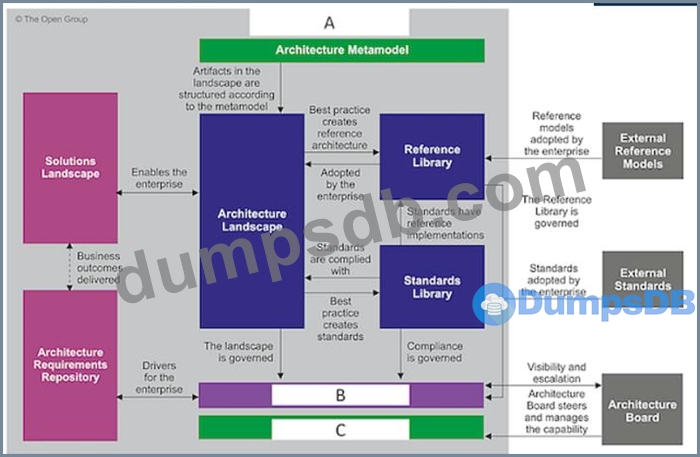
Exhibit: Consider the illustration. What are the items labelled A, B, and C?
Correct Answer: C
* A-Architecture Repository: This is a part of the Architecture Metamodel that contains artifacts structured according to the metamodel. It includes the Architecture Landscape which is adopted by the enterprise and governed by certain standards and practices. * B-Governing Board: The Governing Board ensures visibility and escalation, meaning it oversees and manages the capability of the architecture landscape. It plays a crucial role in governance. * C-Enterprise Capability: This refers to how well an enterprise can execute its mission, meet business objectives or satisfy its stakeholders' needs and expectations. It's influenced by both internal factors (like resources, processes) and external ones (like market trends).
Question 14
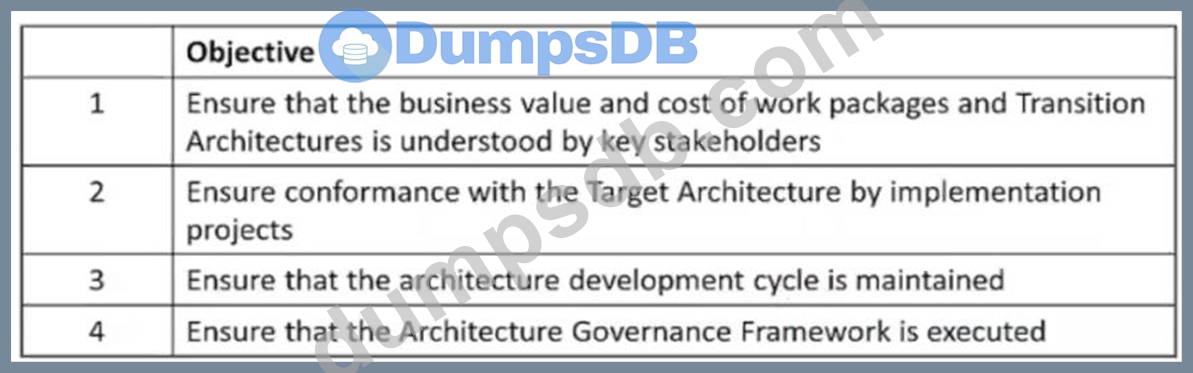
Consider the following ADM phases objectives. Which phase does each objective match?
Correct Answer: B
According to the TOGAF Standard, Version 9.2, the ADM phases and their objectives are as follows1: Preliminary Phase: To prepare and initiate the architecture development cycle, including defining the architecture framework, principles, and governance. Phase A: Architecture Vision: To define the scope, vision, and stakeholders of the architecture initiative, and to obtain approval to proceed. Phase B: Business Architecture: To describe the baseline and target business architecture, and to identify the gaps between them. Phase C: Information Systems Architectures: To describe the baseline and target data and application architectures, and to identify the gaps between them. Phase D: Technology Architecture: To describe the baseline and target technology architecture, and to identify the gaps between them. Phase E: Opportunities and Solutions: To identify and evaluate the opportunities and solutions for implementing the target architecture, and to define the work packages and transition architectures. Phase F: Migration Planning: To finalize the implementation and migration plan, and to ensure alignment with the enterprise portfolio and project management. Phase G: Implementation Governance: To provide architecture oversight and guidance for the implementation projects, and to manage any architecture change requests. Phase H: Architecture Change Management: To monitor the changes in the business and technology environment, and to assess the impact and performance of the architecture. Requirements Management: To manage the architecture requirements throughout the ADM cycle, and to ensure alignment with the business requirements. Based on the above definitions, we can match each objective with the corresponding phase as follows: Objective 1: Ensure that the business value and cost of work packages and transition architectures is understood by key stakeholders. This objective is achieved in Phase H: Architecture Change Management, where the value realization and cost-benefit analysis of the architecture are performed2. Objective 2: Ensure conformance with the Target Architecture by implementation projects. This objective is achieved in Phase F: Migration Planning, where the conformance requirements and criteria for the implementation projects are defined3. Objective 3: Ensure that the architecture development cycle is maintained. This objective is achieved in Phase F: Migration Planning, where the architecture roadmap and iteration cycle are maintained3. Objective 4: Ensure that the Architecture Governance Framework is executed. This objective is achieved in Phase G: Implementation Governance, where the architecture governance processes and procedures are applied to the implementation projects4. Reference: 1: The TOGAF Standard, Version 9.2, Chapter 5: Architecture Development Method (ADM) 2: The TOGAF Standard, Version 9.2, Chapter 21: Architecture Change Management 3: The TOGAF Standard, Version 9.2, Chapter 20: Migration Planning 4: The TOGAF Standard, Version 9.2, Chapter 19: Implementation Governance
Question 15
Exhibit Consider the illustration showing an architecture development cycle Which description matches the phase of the ADM labeled as item 1?
Correct Answer: C
* The illustration shows an architecture development cycle based on the TOGAF ADM (Architecture Development Method), which is a method for developing and managing an enterprise architecture1. * The ADM consists of nine phases, each with a specific purpose and output. The phases are1: oPreliminary Phase: To prepare and initiate the architecture development cycle, including defining the architecture framework, principles, and governance. oPhase A: Architecture Vision: To define the scope, vision, and stakeholders of the architecture initiative, and to obtain approval to proceed. oPhase B: Business Architecture: To describe the baseline and target business architecture, and to identify the gaps between them. oPhase C: Information Systems Architectures: To describe the baseline and target data and application architectures, and to identify the gaps between them. oPhase D: Technology Architecture: To describe the baseline and target technology architecture, and to identify the gaps between them. oPhase E: Opportunities and Solutions: To identify and evaluate the opportunities and solutions for implementing the target architecture, and to define the work packages and transition architectures. oPhase F: Migration Planning: To finalize the implementation and migration plan, and to ensure alignment with the enterprise portfolio and project management. oPhase G: Implementation Governance: To provide architecture oversight and guidance for the implementation projects, and to manage any architecture change requests. oPhase H: Architecture Change Management: To monitor the changes in the business and technology environment, and to assess the impact and performance of the architecture. * In addition to these phases, there is a central process called Requirements Management, which is labeled as item 1 in the illustration. This process operates throughout the ADM cycle, and its purpose is to manage the architecture requirements throughout the architecture development, ensuring that they are aligned with the business requirements and the stakeholder concerns2. * Therefore, the description that matches the phase of the ADM labeled as item 1 is C. Operates the process of managing architecture requirements. Reference: * 1: The TOGAF Standard, Version 9.2, Chapter 5: Architecture Development Method (ADM) * 2: The TOGAF Standard, Version 9.2, Chapter 17: Requirements Management