Which of the following is the ability to develop use and sustain the architecture of a particular enterprise using architecture to govern change?
Correct Answer: A
The ability to develop, use, and sustain the architecture of a particular enterprise using architecture to govern change is an EA Capability. An EA Capability is a set of skills, processes, roles, responsibilities, tools, and techniques that enable an enterprise to successfully develop and maintain its Enterprise Architecture and achieve its desired outcomes. An EA Capability is part of an enterprise's overall capability portfolio and should be aligned with its strategy and objectives. Reference: The TOGAF Standard | The Open Group Website, Section 3.2 Preliminary Phase.
Question 42
Consider the following ADM phases objectives. Objective 1-Determine whether an incremental approach is required, and if so identify Transition Architectures that will deliver continuous business value 2-Generate the initial complete version of the Architecture Roadmap, based upon the gap analysis and candidate Architecture Roadmap components from Phases B, C, and D 3-Finalize the Architecture Roadmap and the supporting Implementation and Migration Plan 4-Ensure that the business value and cost of work packages and Transition Architectures is understood by key stakeholders Which phase does each objective match?
Correct Answer: B
According to the TOGAF standard, the objectives of each ADM phase are as follows1: *Phase E: Opportunities and Solutions oDetermine whether an incremental approach is required, and if so identify Transition Architectures that will deliver continuous business value oIdentify and group major work packages within the Architecture Roadmap oIdentify and group major implementation projects to realize the Architecture Roadmap oIdentify dependencies between increments and projects oEstimate cost, benefit, and risk at a high level for each increment and project oConduct initial prioritization and sequencing of the Architecture Roadmap and projects *Phase F: Migration Planning oGenerate the initial complete version of the Architecture Roadmap, based upon the gap analysis and candidate Architecture Roadmap components from Phases B, C, and D oConfirm the Transition Architectures with relevant stakeholders oCreate the Implementation and Migration Plan, including Transition Architectures, work packages, projects, and other activities oConfirm and agree the Architecture Roadmap and Implementation and Migration Plan with relevant stakeholders *Phase G: Implementation Governance oFinalize the Architecture Roadmap and the supporting Implementation and Migration Plan oEnsure conformance with the Target Architecture by implementation projects oPerform appropriate Architecture Governance functions for the solution and any implementation-driven architecture Change Requests oEnsure that the architecture lifecycle is maintained oEnsure that the Architecture Governance Framework is executed *Phase H: Architecture Change Management oEnsure that the business value and cost of work packages and Transition Architectures is understood by key stakeholders oManage risks and issues related to the Architecture Roadmap and Implementation and Migration Plan oMonitor the implementation projects and Transition Architectures oManage changes to the architecture baseline oManage changes to the Architecture Capability Therefore, the correct matching of the objectives and the phases is: *1G: Determine whether an incremental approach is required, and if so identify Transition Architectures that will deliver continuous business value *2E: Generate the initial complete version of the Architecture Roadmap, based upon the gap analysis and candidate Architecture Roadmap components from Phases B, C, and D *3F: Finalize the Architecture Roadmap and the supporting Implementation and Migration Plan *4F: Ensure that the business value and cost of work packages and Transition Architectures is understood by key stakeholders References: 1: The TOGAF Architecture Development Method
Question 43
What is an objective of the ADM Preliminary Phase?
Correct Answer: B
The Preliminary Phase is the preparatory phase of the Architecture Development Method (ADM) cycle, which sets the context and direction for the architecture work. One of the objectives of this phase is to select and implement tools to support the Architecture Capability, which is the ability of an organization to perform enterprise architecture effectively and efficiently. Tools can include software applications, methods, techniques, standards, and frameworks that assist the architecture development and governance processes. The selection and implementation of tools should be based on the requirements and constraints of the organization, and the alignment with the Architecture Principles and the Architecture Vision3 References: 3: The TOGAF Standard, Version 9.2, Part II: Architecture Development Method (ADM), Chapter 6: Preliminary Phase : The TOGAF Standard, Version 9.2, Part VI: Architecture Capability Framework, Chapter 45: Establishing and Maintaining an Enterprise Architecture Capability : The TOGAF Standard, Version 9.2, Part VI: Architecture Capability Framework, Chapter 46: Tools for Architecture Development
Question 44
Complete the sentence The TOGAF standard covers the development of four architecture domains. Business. Data, Technology and__________________.
Correct Answer: D
The TOGAF standard covers the development of four architecture domains: Business, Data, Technology and Application. These domains represent different aspects of an enterprise's architecture and provide a consistent way of describing, analyzing, and designing them. Reference: The TOGAF Standard | The Open Group Website, Section 2.2 Architecture Development Method (ADM).
Question 45
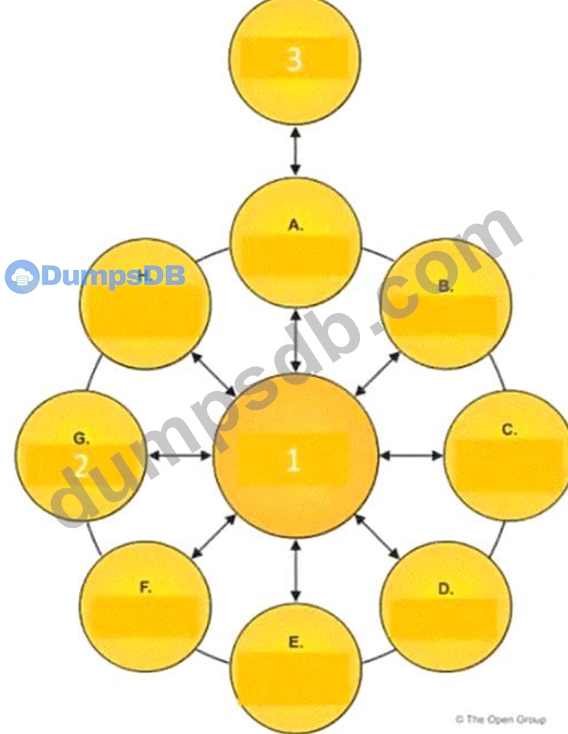
Exhibit Consider the illustration showing an architecture development cycle Which description matches the phase of the ADM labeled as item 2?
Correct Answer: D
Based on the illustration, the phase of the ADM labeled as item 2 is the Implementation Governance phase. This phase provides architectural oversight for the implementation. It ensures that the implementation project conforms to the architecture. It also provides a framework for monitoring and managing the implementation. The Implementation Governance phase involves the following activities: * Finalizing the Architecture Roadmap and the supporting Implementation and Migration Plan * Assigning an Architecture Board to oversee the implementation * Establishing Architecture Contracts with the implementation partners * Reviewing and approving the implementation project plans and deliverables * Performing Architecture Compliance reviews to ensure alignment with the architecture * Performing Architecture Audit reviews to ensure quality and performance of the architecture * Resolving any architecture issues or change requests that arise during the implementation * Maintaining the architecture lifecycle and ensuring its continuity The Implementation Governance phase is essential for ensuring that the architecture is realized as intended and that it delivers the expected business value and outcomes. References: : Implementation Governance