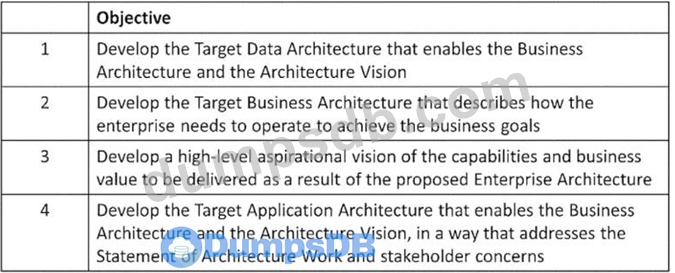
Consider the following ADM phases objectives. Which phase does each objective match?
Correct Answer: A
* The objectives listed in the question correspond to the objectives of different phases of the TOGAF ADM (Architecture Development Method), which is a method for developing and managing an enterprise architecture1. * The ADM consists of nine phases, each with a specific purpose and output. The phases are1: * Preliminary Phase: To prepare and initiate the architecture development cycle, including defining the architecture framework, principles, and governance. * Phase A: Architecture Vision: To define the scope, vision, and stakeholders of the architecture initiative, and to obtain approval to proceed. * Phase B: Business Architecture: To describe the baseline and target business architecture, and to identify the gaps between them. * Phase C: Information Systems Architectures: To describe the baseline and target data and application architectures, and to identify the gaps between them. * Phase D: Technology Architecture: To describe the baseline and target technology architecture, and to identify the gaps between them. * Phase E: Opportunities and Solutions: To identify and evaluate the opportunities and solutions for implementing the target architecture, and to define the work packages and transition architectures. * Phase F: Migration Planning: To finalize the implementation and migration plan, and to ensure alignment with the enterprise portfolio and project management. * Phase G: Implementation Governance: To provide architecture oversight and guidance for the implementation projects, and to manage any architecture change requests. * Phase H: Architecture Change Management: To monitor the changes in the business and technology environment, and to assess the impact and performance of the architecture. * Based on the above definitions, we can match each objective with the corresponding phase as follows: * Objective 1: Develop the Target Data Architecture that enables the Business Architecture and the Architecture Vision. This objective is achieved in Phase C: Information Systems Architectures, where the data architecture is defined as a subset of the information systems architecture2. * Objective 2: Develop the Target Business Architecture that describes how the enterprise needs to operate to achieve the business goals. This objective is achieved in Phase B: Business Architecture, where the business architecture is defined as a subset of the enterprise architecture3. * Objective 3: Develop a high-level aspirational vision of the capabilities and business value to be delivered as a result of the proposed Enterprise Architecture. This objective is achieved in Phase A: Architecture Vision, where the architecture vision is defined as a high-level description of the target architecture and its benefits4. * Objective 4: Develop the Target Application Architecture that enables the Business Architecture and the Architecture Vision, in a way that addresses the Statement of Architecture Work and stakeholder concerns. This objective is achieved in Phase C: Information Systems Architectures, where the application architecture is defined as a subset of the information systems architecture2. References: * 1: The TOGAF Standard, Version 9.2, Chapter 5: Architecture Development Method (ADM) * 2: The TOGAF Standard, Version 9.2, Chapter 9: Phase C: Information Systems Architectures * 3: The TOGAF Standard, Version 9.2, Chapter 8: Phase B: Business Architecture * 4: The TOGAF Standard, Version 9.2, Chapter 7: Phase A: Architecture Vision
Question 37
Complete the sentence The Enterprise Continuum provides methods for classifying architecture artifacts as they evolve from________________________.
Correct Answer: D
The Enterprise Continuum provides methods for classifying architecture artifacts as they evolve from generic architectures to Organization-Specific Architectures. Generic architectures are architectures that have been developed for use across a wide range of enterprises with similar characteristics. They provide common models, functions, and services that can be reused and adapted for specific purposes. Organization-Specific Architectures are architectures that have been tailored to meet the needs and requirements of a particular enterprise or a major organizational unit within an enterprise. They reflect the unique vision, goals, culture, structure, processes, systems, and technologies of that enterprise or unit. Reference: The TOGAF Standard | The Open Group Website, Section 2.3 Enterprise Continuum.
Question 38
Consider the following statements 1 A whole corporation or a division of a corporation 2 A government agency or a single government department 3 Partnerships and alliances of businesses working together such as a consortium or supply chain What are those examples of according to the TOGAF Standard?
Correct Answer: A
Enterprises are examples of the scope of an architecture according to the TOGAF Standard. An enterprise is defined as any collection of organizations that has a common set of goals and/or a single bottom line. Enterprises can be whole corporations or divisions of a corporation, government agencies or single government departments, partnerships and alliances of businesses working together, etc. Reference: The TOGAF Standard | The Open Group Website, Section 2.1 Core Concepts.
Question 39
Consider the following statements. 1. All processes, decision-making, and mechanisms used will be established so as to minimize or avoid potential conflicts of interest. 2. More effective strategic decision-making will be made by C-Level executives and business leaders. 3. All actions implemented and their decision support will be available for inspection by authorized organization and provider parties. 4. Digital Transformation and operations will be more effective and efficient. Which statements highlight the value and necessity for Architecture Governance to be adopted within organizations?
Correct Answer: B
Statements 1 and 3 highlight the value and necessity for Architecture Governance to be adopted within organizations. Architecture Governance is the practice and orientation by which Enterprise Architectures and other architectures are managed and controlled at an enterprise-wide level12. It ensures that architectural decisions are aligned with the organization's strategy, objectives, and standards. Architecture Governance also involves establishing and maintaining processes, decision-making, and mechanisms to avoid or minimize potential conflicts of interest, such as between different stakeholders, business units, or projects34. Moreover, Architecture Governance requires transparency and accountability for all actions implemented and their decision support, so that they can be inspected and evaluated by authorized parties, such as auditors, regulators, or customers5 . References: *The TOGAF Standard, Version 9.2 - Architecture Governance - The Open Group *Architecture Governance - The Open Group *Tutorial: Governance in TOGAF's Architecture Development Method (ADM) *Architecture Governance in TOGAF: Ensuring Effective Management and Compliance *The TOGAF Standard, Version 9.2 - Definitions - The Open Group *[Architecture Governance in TOGAF: Ensuring Alignment and Control]
Question 40
Which statement about Requirements Management is most correct?
Correct Answer: D
This statement about Requirements Management is most correct because it reflects the central role of Requirements Management and stakeholder engagement in the ADM cycle. Requirements Management is not a step of all ADM Phases, but rather an ongoing process that ensures that all relevant requirements are elicited, analyzed, prioritized, and addressed throughout the architecture development and transition. Stakeholder engagement is also a continuous activity that involves identifying, communicating, and managing stakeholder expectations and concerns. Reference: The TOGAF Standard | The Open Group Website, Section 3.1 Introduction to the ADM.