

Question 21
The microscopic features shown here represent Scopulariopsis species. In most instances, particularly if a patient does not have underlying immunologic or hematologic disease, Scopulariopsis species should be considered a contaminant when recovered from a sputum specimen. However, if there is clinical or X-ray evidence of mycotic pulmonary infection, additional daily induced sputum specimens should be obtained.
If Scopulariopsis species or any other hyaline mold is recovered from two or more successive specimens, its potential as a pathogenic agent should be considered. Scopulariopsis species have been reported as the agents of pulmonary fungus ball infections in patients with preexistent cavities and as a cause of pneumonia in patients with leukemia.
Invasive pulmonary disease by this agent has not been reported.
The fungus illustrated in this photomicrograph was recovered from an induced sputum specimen from a 74 year old man with chronic obstructive pulmonary disease. This isolate is most likely: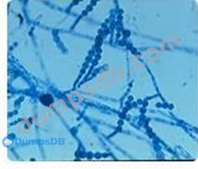
Question 22
FAB M5 is acute monoblastic leukemia
FAB M1 is acute myeloblastic leukemia without maturation
FAB M3 is acute promyelocytic leukemia
FAB M4 is acute myelomonocytic leukemia
Which FAB designation is called the "true" monocytic leukemia and is characterized by monoblasts, promonocytes, and monocytes?
Question 23
All of the following have been an inspection deficiency for CLIA-approved laboratories except:
Question 24
Alkaline over acid, or K/A, in TSI reactions is associated with the fermatation of glucose alone and the utilization of peptone.
Which of the following sugars has been fermented by a gram-negative rod that has produced an alkaline slant and an acid butt on triple sugar iron agar (TSI).?
Question 25
The electrolyte panel consists of potassium, sodium, chloride, carbon dioxide. These analytes are also typically ordered within other panels as well, including the basic metabolic and complete metabolic panels.
An electrolyte panel (lytes, chem-4) consists of: