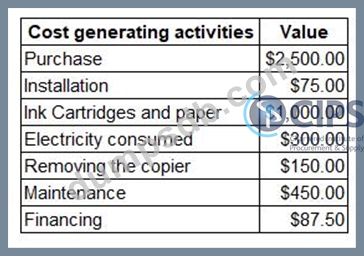
When devising a business case for purchasing a new copier, Maria analyses its whole-life costs as following: Though cost generating activities are identified, she has not categorised the costs. What is the total value of copier's end of life costs?
Correct Answer: C
Life cycle costing is a key asset management tool that takes into account the whole of life implications of planning, acquiring, operating, maintaining and disposing of an asset. The process is an evaluation method that considers all ownership and management costs. These include; - Concept and definition; - Design and development; - Manufacturing and installation; - Maintenance; - Support services; and - Retirement, remediation and disposal costs. End of life costs often comprise of decommissioning, removing and disposal costs. In the copier scenario, the end of life costs equal to removal cost, which is $150. Reference: - Life Cycle Cost Guidelines (dlgsc.wa.gov.au) - CIPS study guide page 36-40 LO 1, AC 1.2
Question 12
Why should procurement professionals develop business case before seeking approval to purchase capital equipment?
Correct Answer: D
A business case is developed during the early stages of a project and outlines the why, what, how, and who necessary to decide if it is worthwhile continuing a project. One of the first things you need to know when starting a new project are the benefits of the proposed business change and how to communicate those benefits to the business. Preparing the business case involves an assessment of: - Business problem or opportunity - Benefits - Risk - Costs including investment appraisal - Technical solutions - Timescale - Impact on operations - Organizational capability to deliver the project outcomes These project issues are an important part of the business case. They express the problems with the current situation and demonstrate the benefits of the new business vision. Making business case with multiple options and choices also prompts the procurement and senior management to consider alternatives. As a result, the organisation may opt out the best option. The business case brings together the benefits, disadvantages, costs, and risks of the current situa-tion and future vision so that executive management can decide if the project should go ahead. Reference: - CIPS study guide page 19-21 - How to Write a Business Case - Template & Examples | Adobe Workfront LO 1, AC 1.1
Question 13
Halfords is a major bicycle and car parts retailer with long history in the market. Its suppliers are plentiful and there is no threat of forward integration. Some other smaller retailers are applying 3D-printing technology to make personalized bicycle parts but their market share is relatively low. 3D-printing technology is an example of which competitive force?
Correct Answer: B
3D-printed parts can replace traditional metal parts. They are also more easily customised to fit customer's needs. This technology is an example of threat of substitute in Porter's Five Forces model. Substitute goods or services that can be used in place of a company's products or services pose a threat. Companies that produce goods or services for which there are no close substitutes will have more power to increase prices and lock in favorable terms. When close substitutes are available, customers will have the option to forgo buying a company's product, and a company's power can be weakened. Reference: - CIPS study guide page 85-96 - Porter's 5 Forces Definition: Analyzing Businesses (investopedia.com) LO 2, AC 2.2
Question 14
Which of the following factors are likely to be direct barriers to a new entrant in a supply market?
Correct Answer: C,E
There are many types of barriers to entry into a market. Some of these include: - Economies of Scale: When manufacturing or selling at a large scale, companies are able to avail cost advantages because per unit costs of the product fall. So the more the company produces in quantity the more the benefit. When existing companies have this advantage, it can act as a barrier to entry because a new entrant will have to try to match the scale to achieve the same cost ad-vantage as the existing company. This may not be possible at the initial stage. - A Differentiated Product: If the product being sold by the existing company or companies is highly differentiated or enjoys strong brand loyalty, then this can act as a strong barrier to entry. The new entrant will have to invest in creating a product with newer and unique features and bene-fits that surpass those offered by the old company. In addition, there will need to be strong efforts to break existing brand loyalties and shift them to a new untested company. - High Capital Costs: If an industry requires huge capital investments at the onset, then this will act as a barrier to entry for many of the potential entrants. Only those will attempt to enter the competitive fray who have the resources to make this high initial investment. - Other Cost Advantages: Apart from those cost benefits that come from economies of scale, there are other advantages that an existing firm may enjoy. These include access to the best suppliers, an understanding of existing materials and knowledge of their quality, possession of any necessary and important patents, and proprietary information and technological knowledge. There are also learning advantages, achieved over years of business and experience. - Cost of Switching: The cost associated with a consumer's move from one company or product or another is called the switching cost. If there are significant switching costs, then a new entrant may not be able to create means of removing these. Or, they may have to offer significant advantage to counter these switching costs at their own expense. - Distribution Network: Often, distribution relationships are well established and may prove to be a strong barrier to entry for a new company. A new entrant will obviously need access to these dis-tribution channels but will need to invest extra in order to engage distributors who have established relations with existing competitors. - Suppliers: As with distributors, suppliers may be vital to the operations of a new business. Exist-ing suppliers may have contracts or loyalties with existing companies and may prove to be difficult to form relationships with. - Legal and Government Created Barriers: Government and regulatory requirements such as permits and licenses may be a strong barrier to entry. There may also be laws governing ways to conduct business that may conflict with a company's practices in other countries. - Barriers to Exit: Interestingly, barriers to exit may act as a deterrent to entry by new companies. If a company is unable to easily leave a competitive environment in case business does not work out, then it will have to stay and compete even if that is a detrimental business practice. In this case, the company may choose to not enter the market in the first place. Reference: LO 2, AC 2.2
Question 15
A purchaser is looking for alternative supplies if there is a major disruption to their supply chain, including logistics, manufacturing and all support services. Which of the following method is that purchaser applying?
Correct Answer: A
Risk control is the process by which an organization reduces the likelihood of a risk event occurring or mitigates the effects that risk should it occur. CIPS preferred way to determine your risk control strategy is to use the four T's Process: Transferring Risk can be achieved through the use of various forms of insurance, or the payment to third parties who are prepared to take the risk on behalf of the organization Tolerating Risk is where no action is taken to mitigate or reduce a risk. This may be because the cost of instituting risk reduction or mitigation activity is not cost-effective or the risks of impact are at so low that they are deemed acceptable to the business. Even when these risks are tolerated they should be monitored because future changes may make it no longer tolerable. Treating Risk is a method of controlling risk through actions that reduce the likelihood of the risk occurring or minimize its impact prior to its occurrence. Also, there are contingent measures that can be developed to reduce the impact of an event once it has occurred. Finding an alternative sup-plier is an example of treating the risk. Terminating Risk is the simplest and most often ignored method of dealing with risk. It is the ap-proach that should be most favored where possible and simply involves risk elimination. This can be done by altering an inherently risky process or practice to remove the risk. The same can be used when reviewing practices and processes in all areas of the business. If an item presents a risk and can be changed or removed without it materially affecting the busi-ness, then removing the risk should be the first option considered; rather than attempting the treat, tolerate or transfer it. Reference: LO 3, AC 3.3