Explanation
Broadcast radiation is the accumulation of broadcast and multicast traffic on a computer network. Extreme amounts of broadcast traffic constitute a broadcast storm.
The amount of broadcast traffic you should see within a broadcast domain is directly proportional to the size of the broadcast domain. Therefore if the layer 2 domain in virtual machine environment is too large, broadcast radiation may occur -> VLANs should be used to reduce broadcast radiation.
Also if virtual machines communicate via broadcast too much, broadcast
radiation may occur.
Another reason for broadcast radiation is using a trunk (to extend VLANs) from the network switch to the physical server.
Note about the structure of virtualization in a hypervisor:
Hypervisors provide virtual switch (vSwitch) that Virtual Machines (VMs) use to communicate with other VMs on the same host. The vSwitch may also be connected to the host's physical NIC to allow VMs to get layer 2 access to the outside world.
Each VM is provided with a virtual NIC (vNIC) that is connected to the
virtual switch. Multiple vNICs can connect to a single vSwitch, allowing VMs on a physical host to communicate with one another at layer 2 without having to go out to a physical switch.
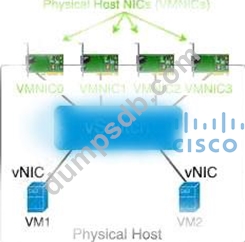
Although vSwitch does not run Spanning-tree protocol but vSwitch
implements other loop prevention mechanisms. For example, a
frame that enters from one VMNIC is not going to go out of the
physical host from a different VMNIC card.