Latest 350-701 Exam Premium Dumps provide by TrainingQuiz.com to help you Passing 350-701 Exam! TrainingQuiz.com offers the updated 350-701 exam dumps, the TrainingQuiz.com 350-701 exam questions has been updated to correct Answer. Get the latest TrainingQuiz.com 350-701 pdf dumps with Exam Engine here:
(727 Q&As Dumps, 40%OFF Special Discount: DumpsDB)
Which two aspects of the cloud PaaS model are managed by the customer but not the provider? (Choose two)
Correct Answer: D,E
Explanation Explanation Customers must manage applications and data in PaaS.
Question 52
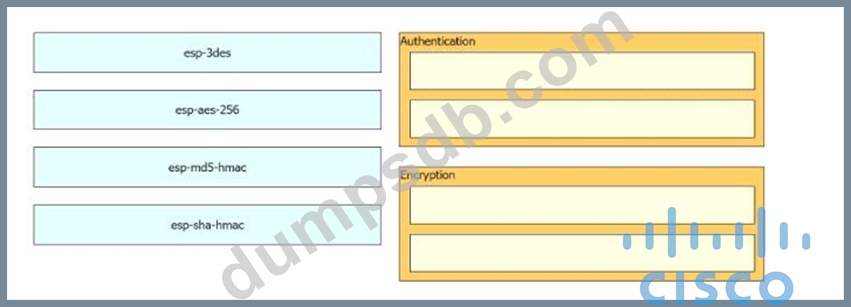
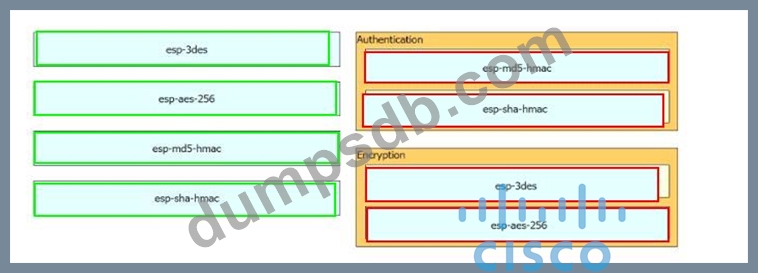
Drag and drop the cryptographic algorithms for IPsec from the left onto the cryptographic processes on the right.
Correct Answer:
Question 53
What are two Detection and Analytics Engines of Cognitive Threat Analytics? (Choose two)
Correct Answer: A,B
Cisco Cognitive Threat Analytics helps you quickly detect and respond to sophisticated, clandestine attacks that are already under way or are attempting to establish a presence within your environment. The solution automatically identifies and investigates suspicious or malicious web-based traffic. It identifies both potential and confirmed threats, allowing you to quickly remediate the infection and reduce the scope and damage of an attack, whether it's a known threat campaign that has spread across multiple organizations or a unique threat you've never seen before. Detection and analytics features provided in Cognitive Threat Analytics are shown below: + Data exfiltration: Cognitive Threat Analytics uses statistical modeling of an organization's network to identify anomalous web traffic and pinpoint the exfiltration of sensitive data. It recognizes data exfiltration even in HTTPS-encoded traffic, without any need for you to decrypt transferred content + Command-and-control (C2) communication: Cognitive Threat Analytics combines a wide range of data, ranging from statistics collected on an Internet-wide level to host-specific local anomaly scores. Combining these indicators inside the statistical detection algorithms allows us to distinguish C2 communication from benign traffic and from other malicious activities. Cognitive Threat Analytics recognizes C2 even in HTTPSencoded or anonymous traffic, including Tor, without any need to decrypt transferred content, detecting a broad range of threats ... Cisco Cognitive Threat Analytics helps you quickly detect and respond to sophisticated, clandestine attacks that are already under way or are attempting to establish a presence within your environment. The solution automatically identifies and investigates suspicious or malicious web-based traffic. It identifies both potential and confirmed threats, allowing you to quickly remediate the infection and reduce the scope and damage of an attack, whether it's a known threat campaign that has spread across multiple organizations or a unique threat you've never seen before. Detection and analytics features provided in Cognitive Threat Analytics are shown below: + Data exfiltration: Cognitive Threat Analytics uses statistical modeling of an organization's network to identify anomalous web traffic and pinpoint the exfiltration of sensitive data. It recognizes data exfiltration even in HTTPS-encoded traffic, without any need for you to decrypt transferred content + Command-and-control (C2) communication: Cognitive Threat Analytics combines a wide range of data, ranging from statistics collected on an Internet-wide level to host-specific local anomaly scores. Combining these indicators inside the statistical detection algorithms allows us to distinguish C2 communication from benign traffic and from other malicious activities. Cognitive Threat Analytics recognizes C2 even in HTTPSencoded or anonymous traffic, including Tor, without any need to decrypt transferred content, detecting a broad range of threats ... Reference: Cisco Cognitive Threat Analytics helps you quickly detect and respond to sophisticated, clandestine attacks that are already under way or are attempting to establish a presence within your environment. The solution automatically identifies and investigates suspicious or malicious web-based traffic. It identifies both potential and confirmed threats, allowing you to quickly remediate the infection and reduce the scope and damage of an attack, whether it's a known threat campaign that has spread across multiple organizations or a unique threat you've never seen before. Detection and analytics features provided in Cognitive Threat Analytics are shown below: + Data exfiltration: Cognitive Threat Analytics uses statistical modeling of an organization's network to identify anomalous web traffic and pinpoint the exfiltration of sensitive data. It recognizes data exfiltration even in HTTPS-encoded traffic, without any need for you to decrypt transferred content + Command-and-control (C2) communication: Cognitive Threat Analytics combines a wide range of data, ranging from statistics collected on an Internet-wide level to host-specific local anomaly scores. Combining these indicators inside the statistical detection algorithms allows us to distinguish C2 communication from benign traffic and from other malicious activities. Cognitive Threat Analytics recognizes C2 even in HTTPSencoded or anonymous traffic, including Tor, without any need to decrypt transferred content, detecting a broad range of threats ...
Question 54
Drag and drop the posture assessment flow actions from the left into a sequence on the right.
Correct Answer:
Question 55
An organization has two systems in their DMZ that have an unencrypted link between them for communication. The organization does not have a defined password policy and uses several default accounts on the systems. The application used on those systems also have not gone through stringent code reviews. Which vulnerability would help an attacker brute force their way into the systems?