Which suspicious pattern enables the Cisco Tetration platform to learn the normal behavior of users?
Correct Answer: C
The various suspicious patterns for which the Cisco Tetration platform looks in the current release are: + Shell code execution: Looks for the patterns used by shell code. + Privilege escalation: Watches for privilege changes from a lower privilege to a higher privilege in the process lineage tree. + Side channel attacks: Cisco Tetration platform watches for cache-timing attacks and page table fault bursts. Using these, it can detect Meltdown, Spectre, and other cache-timing attacks. + Raw socket creation: Creation of a raw socket by a nonstandard process (for example, ping). + User login suspicious behavior: Cisco Tetration platform watches user login failures and user login methods. + Interesting file access: Cisco Tetration platform can be armed to look at sensitive files. + File access from a different user: Cisco Tetration platform learns the normal behavior of which file is accessed by which user. + Unseen command: Cisco Tetration platform learns the behavior and set of commands as well as the lineage of each command over time. Any new command or command with a different lineage triggers the interest of the Tetration Analytics platform. The various suspicious patterns for which the Cisco Tetration platform looks in the current release are: + Shell code execution: Looks for the patterns used by shell code. + Privilege escalation: Watches for privilege changes from a lower privilege to a higher privilege in the process lineage tree. + Side channel attacks: Cisco Tetration platform watches for cache-timing attacks and page table fault bursts. Using these, it can detect Meltdown, Spectre, and other cache-timing attacks. + Raw socket creation: Creation of a raw socket by a nonstandard process (for example, ping). + User login suspicious behavior: Cisco Tetration platform watches user login failures and user login methods. + Interesting file access: Cisco Tetration platform can be armed to look at sensitive files. + File access from a different user: Cisco Tetration platform learns the normal behavior of which file is accessed by which user. + Unseen command: Cisco Tetration platform learns the behavior and set of commands as well as the lineage of each command over time. Any new command or command with a different lineage triggers the interest of the Tetration Analytics platform. The various suspicious patterns for which the Cisco Tetration platform looks in the current release are: + Shell code execution: Looks for the patterns used by shell code. + Privilege escalation: Watches for privilege changes from a lower privilege to a higher privilege in the process lineage tree. + Side channel attacks: Cisco Tetration platform watches for cache-timing attacks and page table fault bursts. Using these, it can detect Meltdown, Spectre, and other cache-timing attacks. + Raw socket creation: Creation of a raw socket by a nonstandard process (for example, ping). + User login suspicious behavior: Cisco Tetration platform watches user login failures and user login methods. + Interesting file access: Cisco Tetration platform can be armed to look at sensitive files. + File access from a different user: Cisco Tetration platform learns the normal behavior of which file is accessed by which user. + Unseen command: Cisco Tetration platform learns the behavior and set of commands as well as the lineage of each command over time. Any new command or command with a different lineage triggers the interest of the Tetration Analytics platform.
Question 37
What is a characteristic of a bridge group in ASA Firewall transparent mode''
Correct Answer: C
Question 38
Which product allows Cisco FMC to push security intelligence observable to its sensors from other products?
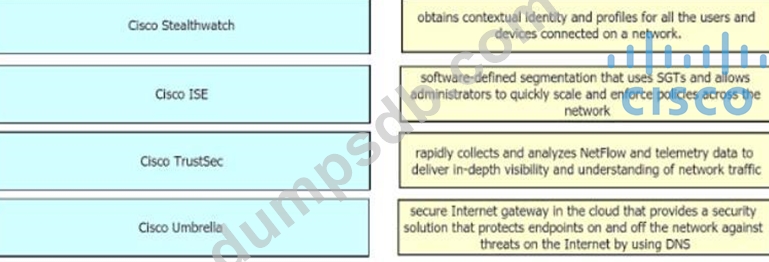
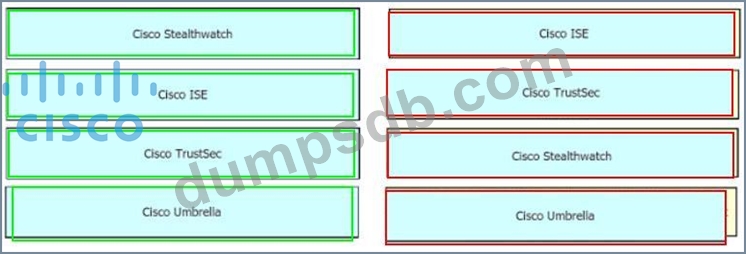
Drag and drop the solutions from the left onto the solution's benefits on the right.
Correct Answer:
Question 40
An engineer is configuring device-hardening on a router in order to prevent credentials from being seen if the router configuration was compromised. Which command should be used?