

Question 6
An organization has several RAPs at different locations that broadcast two SSIDs. The internet-only SSID is in bridge/always mode, and the corporate SSID is in split-tunneling/standard mode. The network administrator deploys 10 more RAPs in different locations.
Users can successfully connect to the corporate SSID that is propagated by a RAP at a remote location. However, they report that it takes too long to access public internet web sites.
What is one part of the configuration that should be checked by the network administrator to verify this RAP deployment?
Question 7
A network administrator assists with the migration of a WLAN from a third-party vendor to Aruba in different locations throughout the country. In order to manage the solution from a central point, the network administrator decides to deploy redundant Mobility Masters (MMs) in a datacenter that are reachable through the Internet.
Since not all locations own public IP addresses, the security team is not able to configure strict firewall polices at the datacenter without disrupting some MM to Mobility Controller (MC) communications. They are also concerned about exposing the MMs to unauthorized inbound connection attempts.
What should the network administrator do to ensure the solution is functional and secure?
Question 8
Refer to the exhibits.
Exhibit 1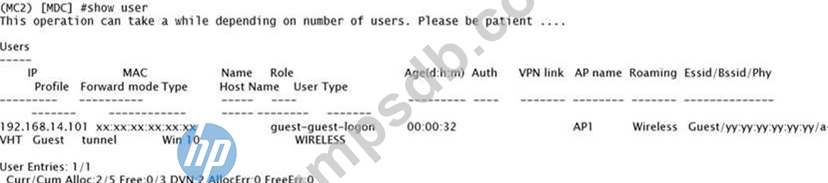
Exhibit 2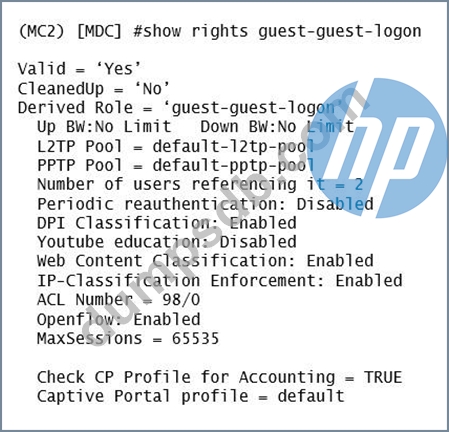
Exhibit 3
Exhibit 4
A captive portal-based solution is deployed in a Mobility Master (MM) - Mobility Controller (MC) network. A wireless station connects to the network and attempts the authentication process. The outputs are shown in the exhibits.
Which names correlate with the authentication and captive portal servers?
Question 9
Refer to the exhibit:
A company acquires ten barcode scanners to run inventory tasks. These WiFi devices support WPA2-PSK security only. The network administrator deploys a WLAN named scanners using the configuration shown in the exhibit.
What must the network administrator do next to ensure that the scanner devices successfully connect to their SSID?
Question 10
An organization owns a fully functional multi-controller Aruba network with a Virtual Mobility Master (VMM) in VLAN20. They have asked a network consultant to deploy a redundant MM on a different server. The solution must offer the lowest convergence time and require no human interaction in case of failure.
The servers host other virtual machines and are connected to different switches that implement ACLs to protect them. The organization grants the network consultant access to the servers only, and appoints a network administrator to assist with the deployment.
What must the network administrator do so the network consultant can successfully deploy the solution? (Choose two.)