

Question 166
You have an Azure subscription that contains the resource groups shown in the following table.
You create an Azure Resource Manager template named Template1 as shown in the following exhibit.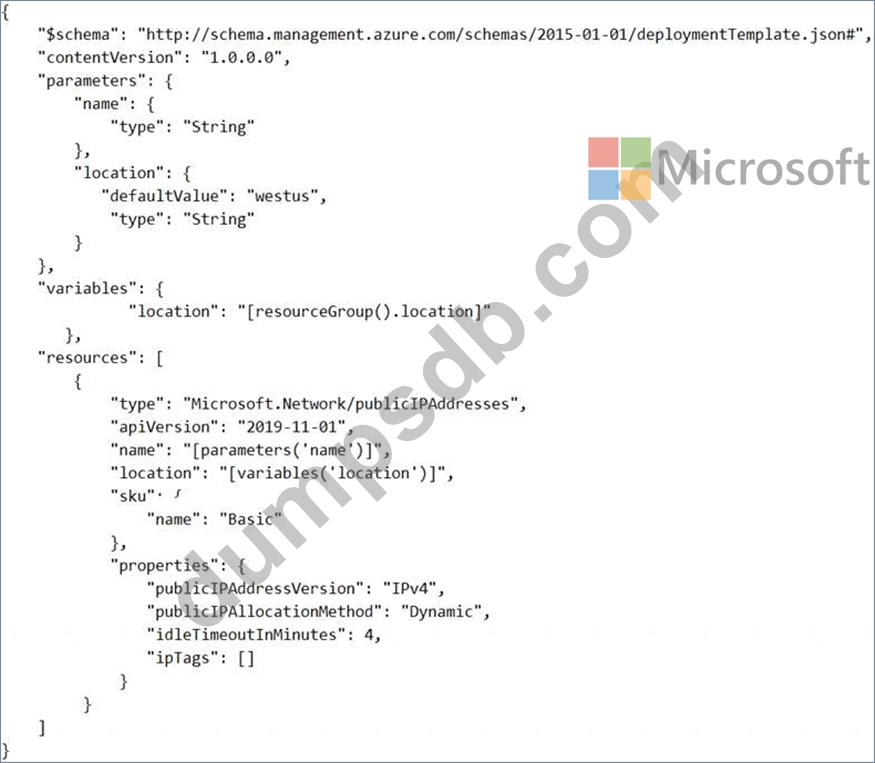
From the Azure portal, you deploy Template1 four times by using the settings shown in the following table.
What is the result of the deployment? To answer, select the appropriate options in the answer area.
NOTE: Each correct selection is worth one point.


Question 167
You have an Azure subscription named Sub1 that has a subscription ID of 12ab3cd4-5e67-8901-f234- g5hi67jkl8m9.
In Sub1, you create an Azure Storage account named storage1 and a table named Table1.
Which URI should you use to access Table1?
https://storage.core.windons.net/12ab3cd4-5e67-8901-f234-g5hi67jkl8m9/storagel/
Question 168
You have virtual machines (VMs) that run a mission-critical application.
You need to ensure that the VMs never experience down time.
What should you recommend? To answer, drag the appropriate solutions to the correct scenarios. Each solution may be used once, more than once, or not at all. You may need to drag the split bar between panes or scroll to view content.
NOTE: Each correct selection is worth one point.

Question 169
You have an Azure Active Directory (Azure AD) tenant.
All administrators must enter a verification code to access the Azure portal.
You need to ensure that the administrators can access the Azure portal only from your on-premises network.
What should you configure?
Question 170
Note: This question is part of a series of questions that present the same scenario. Each question in the series contains a unique solution that might meet the stated goals. Some question sets might have more than one correct solution, while others might not have a correct solution.
After you answer a question in this section, you will NOT be able to return to it. As a result, these questions will not appear in the review screen.
You have an app named App1 that uses data from two on-premises Microsoft SQL Server databases named DB1 and DB2.
You plan to move DB1 and DB2 to Azure.
You need to implement Azure services to host DB1 and DB2. The solution must support server-side transactions across DB1 and DB2.
Solution: You deploy DB1 and DB2 as Azure SQL databases each on a different Azure SQL Database server.
Does this meet the goal?