

Question 51
A retail company is using an Order API to accept new orders. The Order API uses a JMS queue to submit orders to a backend order management service. The normal load for orders is being handled using two (2) CloudHub workers, each configured with 0.2 vCore. The CPU load of each CloudHub worker normally runs well below 70%. However, several times during the year the Order API gets four times (4x) the average number of orders. This causes the CloudHub worker CPU load to exceed 90% and the order submission time to exceed 30 seconds. The cause, however, is NOT the backend order management service, which still responds fast enough to meet the response SLA for the Order API. What is the MOST resource-efficient way to configure the Mule application's CloudHub deployment to help the company cope with this performance challenge?
Question 52
A System API is designed to retrieve data from a backend system that has scalability challenges. What API policy can best safeguard the backend system?
Question 53
Refer to the exhibit.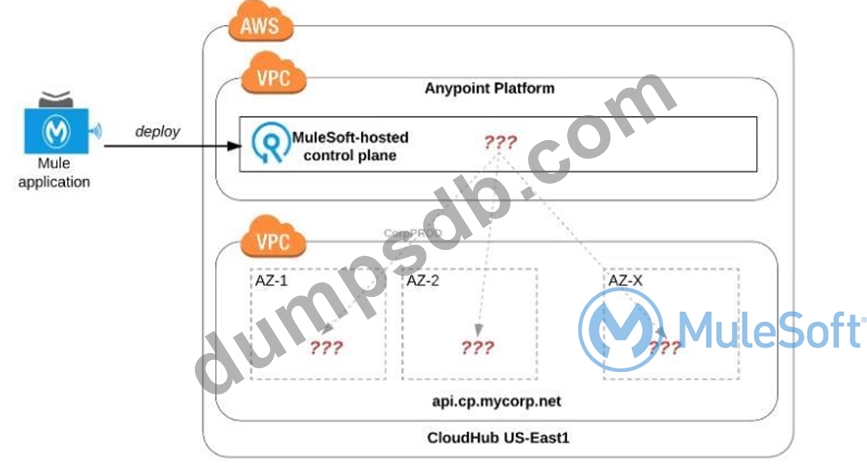
An organization uses one specific CloudHub (AWS) region for all CloudHub deployments.
How are CloudHub workers assigned to availability zones (AZs) when the organization's Mule applications are deployed to CloudHub in that region?
Question 54
How are an API implementation, API client, and API consumer combined to invoke and process an API?
Question 55
When designing an upstream API and its implementation, the development team has been advised to NOT set timeouts when invoking a downstream API, because that downstream API has no SLA that can be relied upon.
This is the only downstream API dependency of that upstream API.
Assume the downstream API runs uninterrupted without crashing. What is the impact of this advice?