

Question 61
Note: This question is part of a series of questions that use the same scenario. For your convenience, the scenario is repeated in each question. Each question presents a different goal and answer choices, but the text of the scenario is exactly the same in each question on this series.
You have a database that tracks orders and deliveries for customers in North America. System versioning is enabled for all tables. The database contains the Sales.Customers, Application.Cities, and Sales.CustomerCategories tables.
Details for the Sales.Customers table are shown in the following table: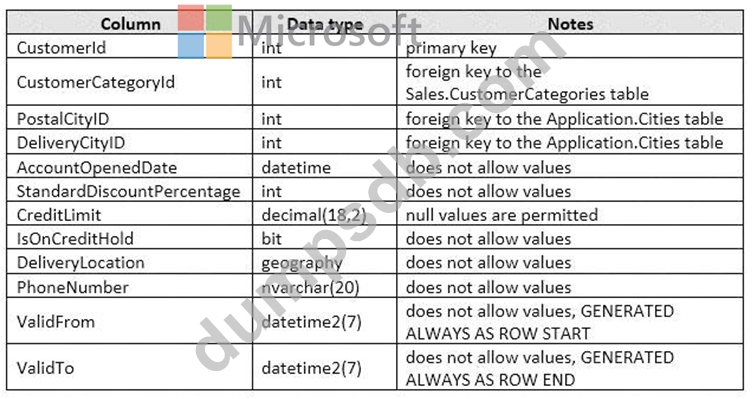
Details for the Application.Cities table are shown in the following table:
Details for the Sales.CustomerCategories table are shown in the following table:
You are creating a report to show when the first customer account was opened in each city. The report contains a line chart with the following characteristics:
- The chart contains a data point for each city, with lines connecting the points.
- The X axis contains the position that the city occupies relative to other cities.
- The Y axis contains the date that the first account in any city was opened.
An example chart is shown below for five cities: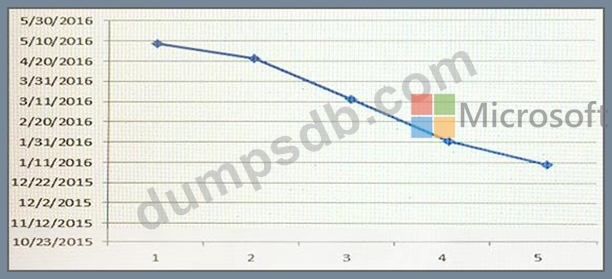
During a sales promotion, customers from various cities open new accounts on the same date.
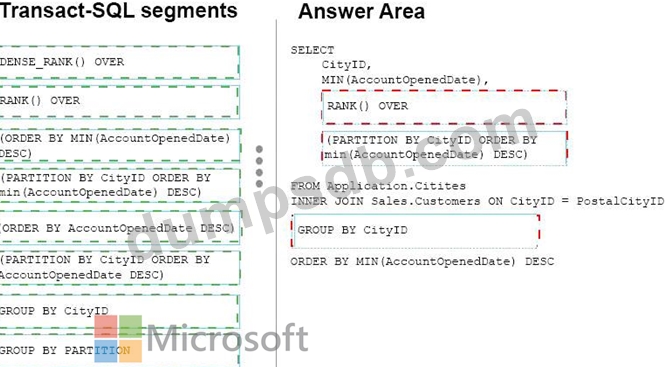
You need to write a query that returns the data for the chart.
How should you complete the Transact-SQL statement? To answer, drag the appropriate Transact-SQL segments to the correct locations. Each Transact-SQL segment may be used once, more than once, or not at all. You may need to drag the split bar between panes or scroll to view content.
NOTE: Each correct selection is worth one point.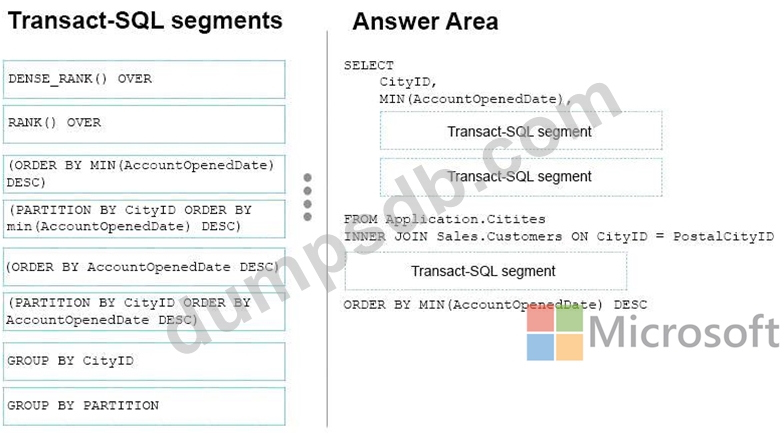

Question 62
CORRECT TEXT
You have a table named Cities that has the following two columns: CityID and CityName.
The CityID column uses the int data type, and CityName uses nvarchar(max).
You have a table named RawSurvey. Each row includes an identifier for a question and the number of persons that responded to that question from each of four cities. The table contains the following representative data: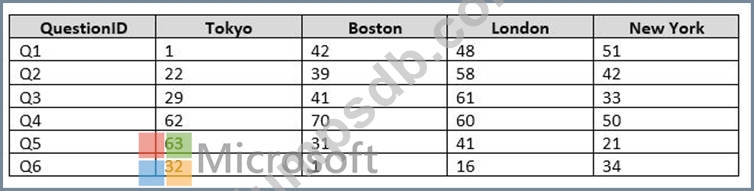
A reporting table named SurveyReport has the following columns: CityID, QuestionID, and RawCount, where RawCount is the value from the RawSurvey table.
You need to write a Transact-SQL query to meet the following requirements:
* Retrieve data from the RawSurvey table in the format of the SurveyReport table.
* The CityID must contain the CityID of the city that was surveyed.
* The order of cities in all SELECT queries must match the order in the RawSurvey table.
* The order of cities in all IN statements must match the order in the RawSurvey table.
Construct the query using the following guidelines:
* Use one-part names to reference tables and columns, except where not possible.
* ALL SELECT statements must specify columns.
* Do not use column or table aliases, except those provided.
* Do not surround object names with square brackets.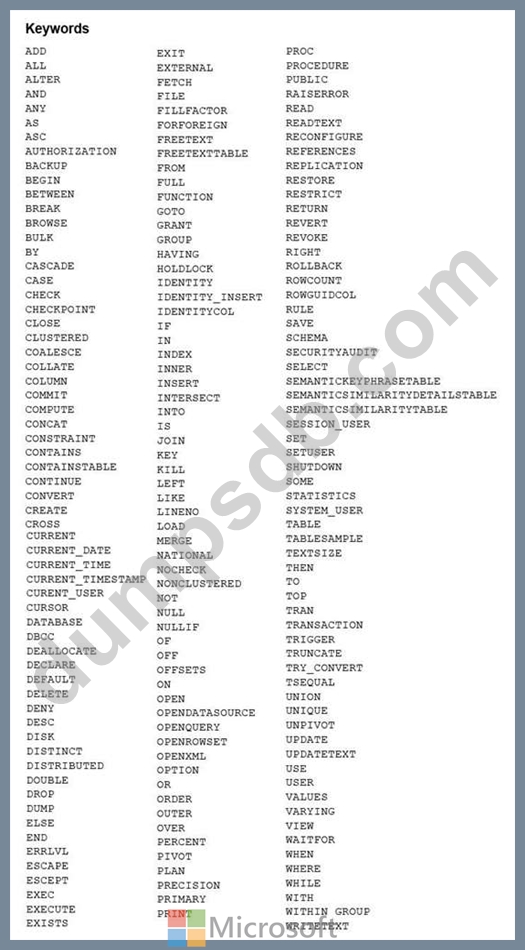
Part of the correct Transact-SQL has been provided in the answer area below. Enter the code in the answer area that resolves the problem and meets the stated goals or requirements. You can add code within the code that has been provided as well as below it.
Use the Check Syntax button to verify your work. Any syntax or spelling errors will be reported by line and character position.
Question 63
Note: This question is part of a series of questions that present the same scenario. Each question in the series contains a unique solution that might meet the stated goals. Some question sets might have more than one correct solution, while others might not have a correct solution.
After you answer a question in this section. You will NOT be able to return to it. As a result, these questions will not appear in the review screen.
You have a table named Products that stores information about products your company sells. The table has a column named ListPrice that stores retail pricing information for products.
Some products are used only internally by the company. Records for these products are maintained in the Products table for inventory purposes. The price for each of these products is $0.00. Customers are not permitted to order these products.
You need to increase the list price for products that cost less than $100 by 10 percent. You must only increase pricing for products that customers are permitted to order.
Solution: You run the following Transact-SQL statement: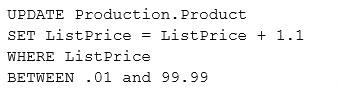
Does the solution meet the goal?
Question 64
Note: This question is part of a series of questions that use the same or similar answer choices. An answer choice may be correct for more than one question in the series. Each question is independent of the other questions in this series. Information and details provided in a question apply only to that question.
You create a table by running the following Transact-SQL statement: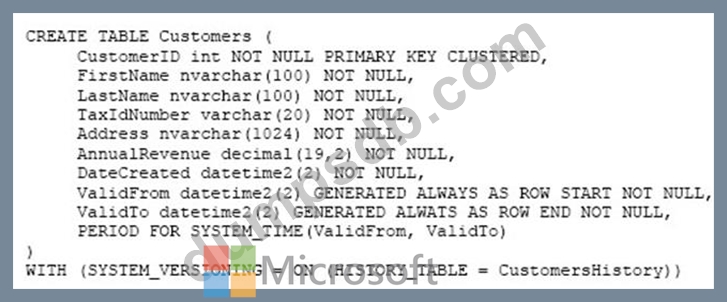
You are developing a report that aggregates customer data only for the year 2014. The report requires that the data be denormalized.
You need to return the data for the report.
Which Transact-SQL statement should you run?
A:
B:
C:
D:
E:
F:
G:
H:
Question 65
Note: This question is part of a series of questions that present the same scenario. Each question in the series contains a unique solution that might meet the stated goals. Some question sets might have more than one correct solution, while others might not have a correct solution.
After you answer a question in this section, you will NOT be able to return to it. As a result, these questions will not appear in the review screen.
You are building a stored procedure that will be used by hundreds of users concurrently.
You need to store rows that will be processed later by the stored procedure. The object that stores the rows must meet the following requirements:
Be indexable
Contain up-to-date statistics
Be able to scale between 10 and 100,000 rows
The solution must prevent users from accessing one another's data.
Solution: You create a user-defined table in the stored procedure.
Does this meet the goal?