

Question 76
You have a database that includes the following tables. All of the tables are in the Production schema.
You need to create a query that returns a list of product names for all products in the Beverages category.
Construct the query using the following guidelines:
* Use the first letter of the table name as the table alias.
* Use two-part column names.
* Do not surround object names with square brackets.
* Do not use implicit joins.
* Do not use variables.
* Use single quotes to surround literal values.
Part of the correct Transact-SQL has been provided in the answer area below. Enter the code in the answer area that resolves the problem and meets the stated goals or requirements. You can add code within the code that has been provided as well as below it.
Use the Check Syntax button to verify your work. Any syntax or spelling errors will be reported by line and character position. You may check syntax as many times as needed.
Question 77
DRAG DROP
Note: This question is part of a series of questions that use the same scenario. For your convenience, the scenario is repeated in each question. Each question presents a different goal and answer choices, but the text of the scenario is exactly the same in each question on this series.
You have a database that tracks orders and deliveries for customers in North America.
System versioning is enabled for all tables. The database contains the Sales.Customers, Application.Cities, and Sales.CustomerCategories tables.
Details for the Sales.Customers table are shown in the following table: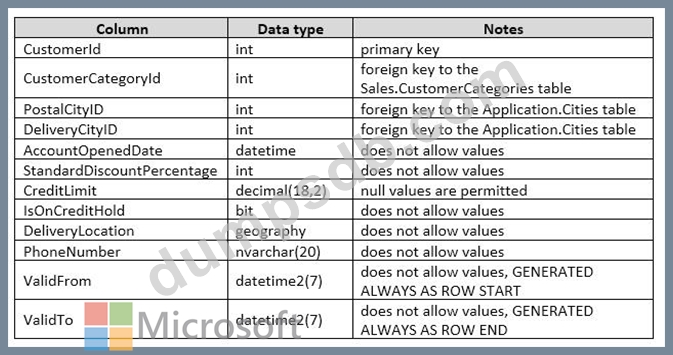
Details for the Application.Cities table are shown in the following table:
Details for the Sales.CustomerCategories table are shown in the following table:
The marketing department is performing an analysis of how discount affect credit limits.
They need to know the average credit limit per standard discount percentage for customers whose standard discount percentage is between zero and four.
You need to create a query that returns the data for the analysis.
How should you complete the Transact-SQL statement? To answer, drag the appropriate Transact-SQL segments to the correct locations. Each Transact-SQL segments may be used once, more than once, or not at all. You may need to drag the split bar between panes or scroll to view content.


Question 78
Note: This question is part of a series of questions that present the same scenario.
Each question in the series contains a unique solution that might meet the stated goals. Some question sets might have more than one correct solution, while others might not have a correct solution.
After you answer a question in this section, you will NOT be able to return to it. As a result, these questions will not appear in the review screen.
You have a database named DB1 that contains two tables named Sales.Customers and Sales.Orders.
Sales.Customers has a foreign key relationship to a column named CustomerID in SalesOrders.
You need to recommend a query that returns all the customers. The query must also return the number of orders that each customer placed in 2016.
Solution: You recommend the following query:
Does this meet the goal?
Question 79
You have a database named MyDb. You run the following Transact-SQL statements:
A value of 1 in the IsActive column indicates that a user is active.
You need to create a count for active users in each role. If a role has no active users. you must display a zero as the active users count.
Which Transact-SQL statement should you run?
Question 80
Note: This question is part of a series of questions that present the same scenario. Each question in the series contains a unique solution that might meet the stated goals. Some question sets might have more than one correct solution, while others might not have a correct solution.
After you answer a question in this section. You will NOT be able to return to it. As a result, these questions will not appear in the review screen.
A database has two tables as shown in the following database diagram:
You need to list all provinces that have at least two large cities. A large city is defined as having a population of at least one million residents. The query must return the following columns:
Solution: You run the following Transact-SQL statement:
Does the solution meet the goal?