

Question 71
Note: This question is part of a series of questions that present the same scenario. Each question in the series contains a unique solution that might meet the stated goals. Some question sets might have more than one correct solution, while others might not have a correct solution.
After you answer a question in this section. You will NOT be able to return to it. As a result, these questions will not appear in the review screen.
You have a database that contains a single table named tblVehicleRegistration. The table is defined as follows:
You run the following query:
The query output window displays the following error message: "Conversion failed when converting the varchar value 'AB012' to data type int." You need to resolve the error.
Solution: You modify the Transact-SQL statement as follows:
Does the solution meet the goal?
Question 72
Note: This question is part of a series of questions that present the same scenario. Each question in the series contains a unique solution that might meet the stated goals. Some question sets might have more than one correct solution, while others might not have a correct solution.
After you answer a question in this section. You will NOT be able to return to it. As a result, these questions will not appear in the review screen.
You have a database that tracks orders and deliveries for customers in North America. The database contains the following tables:
Sales.Customers
Application.Cities
Sales.CustomerCategories
Your company is developing a new social application that connects customers to each other based on the distance between their delivery locations.
You need to write a query that returns the nearest customer.
Solution: You run the following Transact-SQL statement:
SELECT TOP 1 B.CustomerID, A.DeliveryLocation.STDistance(B.DeliveryLocation) AS Dist FROM Sales.Customers AS A CROSS JOIN Sales.Customers AS B WHERE A.CustomerID = @custID AND A.CustomerID <> B.CustomerID ORDER BY Dist The variable @custID is set to a valid customer.
Does the solution meet the goal?
Question 73
Note: This question is part of a series of questions that use the same or similar answer choices. An answer choice may be correct for more than one question in the series. Each question is independent of the other questions in this series. Information and details provided in a question apply to that question.
You have a database for a banking system. The database has two tables named tblDepositAcct and tblLoanAcct that store deposit and loan accounts, respectively. Both tables contain the following columns:
You need to determine the total number of customers who have either deposit accounts or loan accounts, but not both types of accounts.
Which Transact-SQL statement should you run?
Question 74
CORRECT TEXT
You work for an organization that monitors seismic activity around volcanos. You have a table named GroundSensors. The table stored data collected from seismic sensors. It includes the columns describes in the following table:
The database also contains a scalar value function named NearestMountain that returns the name of the mountain that is nearest to the sensor.
You need to create a query that shows the average of the normalized readings from the sensors for each mountain. The query must meet the following requirements:
- Include the average normalized readings and nearest mountain name.
- Exclude sensors for which no normalized reading exists.
- Exclude those sensors with value of zero for tremor.
Construct the query using the following guidelines:
- Use one part names to reference tables, columns and functions.
- Do not use parentheses unless required.
- Do not use aliases for column names and table names.
- Do not surround object names with square brackets.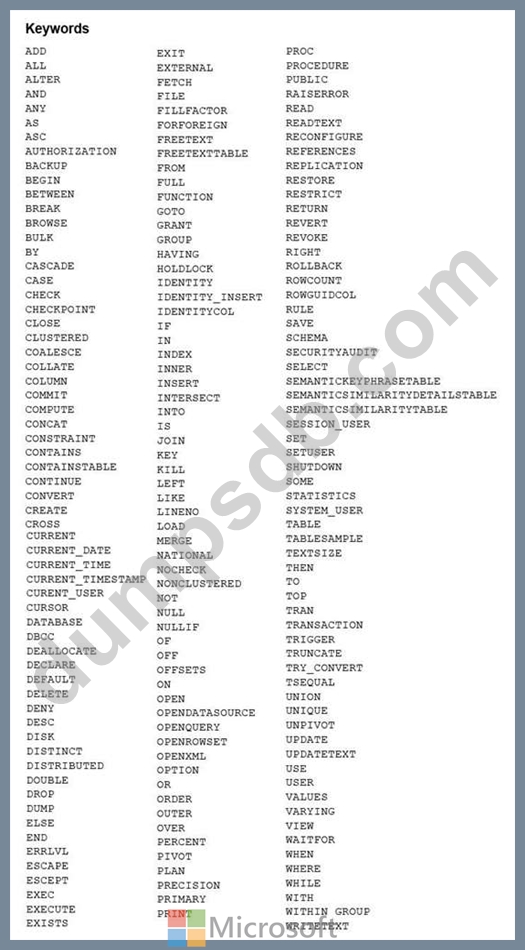
Part of the correct Transact-SQL has been provided in the answer area below. Enter the code in the answer area that resolves the problem and meets the stated goals or requirements. You can add code within the code that has been provided as well as below it.
Use the Check Syntax button to verify your work. Any syntax or spelling errors will be reported by line and character position.
Question 75
Note: This question is part of a series of questions that present the same scenario. Each question in the series contains a unique solution that might meet the stated goals. Some question sets might have more than one correct solution, while others might not have a correct solution.
After you answer a question in this section, you will NOT be able to return to it. As a result, these questions will not appear in the review screen.
You have a database named DB1 that contains two tables named Sales.Customers and Sales.Orders.
Sales.Customers has a foreign key relationship to a column named CustomerID in Sales.Orders.
You need to recommend a query that returns all the customers. The query must also return the number of orders that each customer placed in 2016.
Solution: You recommend the following query:
Does this meet the goal?