

Question 86
Note: This question is part of a series of questions that use the same or similar answer choices. An answer choice may be correct for more than one question in the series. Each question is independent of the other questions in this series. Information and details provided in a question apply to that question.
You have a database for a banking system. The database has two tables named tblDepositAcct and tblLoanAcct that store deposit and loan accounts, respectively. Both tables contain the following columns: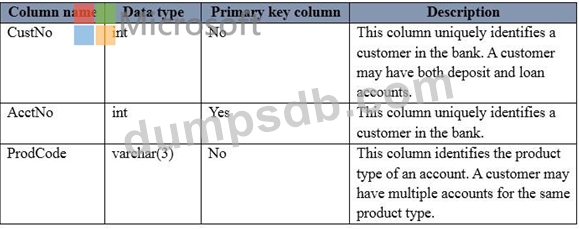
You need to determine the total number of deposit and loan accounts.
Which Transact-SQL statement should you run?
A:
B:
C:
D:
E:
F:
G:
H:
Question 87
Note: This question is part of a series of questions that use the same scenario. For your convenience, the scenario is repeated in each question. Each question presents a different goal and answer choices, but the text of the scenario is exactly the same in each question on this series.
You have a database that tracks orders and deliveries for customers in North America. System versioning is enabled for all tables. The database contains the Sales.Customers, Application.Cities, and Sales.CustomerCategories tables.
Details for the Sales.Customers table are shown in the following table:
Details for the Application.Cities table are shown in the following table:
Details for the Sales.CustomerCategories table are shown in the following table:
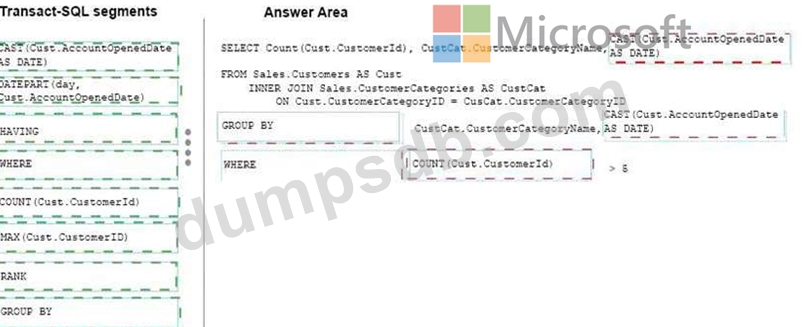
You are creating a report to measure the impact of advertising efforts that were designed to attract new customers. The report must show the number of new customers per day for each customer category, but only if the number of new customers is greater than five.
You need to write the query to return data for the report.
How should you complete the Transact-SQL statement? To answer, drag the appropriate Transact-SQL segments to the correct locations. Each Transact-SQL segment may be used once, more than once, or not at all. You may need to drag the split bar between panes or scroll to view content.

Question 88
Note: This question is part of a series of questions that present the same scenario. Each question in the series contains a unique solution that might meet the stated goals. Some question sets might have more than one correct solution, while others might not have a correct solution.
After you answer a question in this section. You will NOT be able to return to it. As a result, these questions will not appear in the review screen.
You have a database that tracks orders and deliveries for customers in North America. The database contains the following tables:
Sales.Customers
Application.Cities
Sales.CustomerCategories
Your company is developing a new social application that connects customers to each other based on the distance between their delivery locations.
You need to write a query that returns the nearest customer.
Solution: You run the following Transact-SQL statement:
SELECT TOP 1 B.CustomerID, A.DeliveryLocation.STDistance(B.DeliveryLocation) AS Dist FROM Sales.Customers AS A CROSS JOIN Sales.Customers AS B WHERE A.CustomerID = @custID AND A.CustomerID <> B.CustomerID ORDER BY Dist The variable @custID is set to a valid customer.
Does the solution meet the goal?
Question 89
DRAG DROP
You need to create a stored procedure that meets the following requirements:
- Produces a warning if the credit limit parameter is greater than 7,000
- Propagates all unexpected errors to the calling process
How should you complete the Transact-SQL statement? To answer, drag the appropriate Transact-SQP segments to the correct locations. Each Transact-SQL segments may be used once, more than once, or not at all. You may need to drag the split bar between panes or scroll to view content.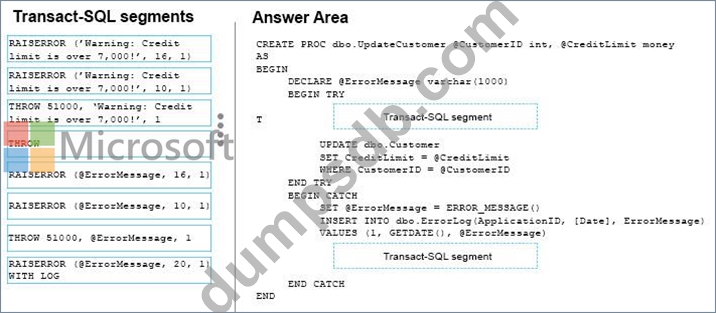


Question 90
You have the following Transact-SQL statement:
DELETE FROM Person
WHERE PersonID = 5
You need to implement error handling.
How should you complete Transact-SQL statement? To answer, select the appropriate options in the answer area.
NOTE: Each correct selection is worth one point.


