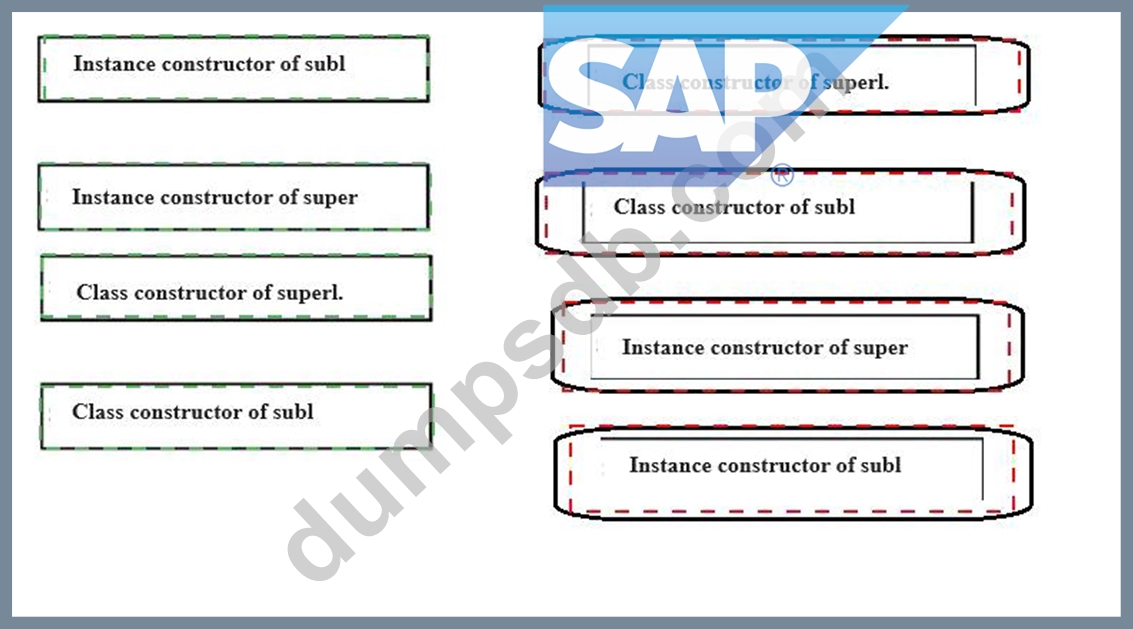
You have a superclass superl and a subclass subl of superl. Each class has an instance constructor and a static constructor. The first statement of your program creates an instance of subl. In which sequence will the constructors be executed?
Correct Answer:
Explanation The sequence in which the constructors will be executed is as follows: Class constructor of superl. This is because the class constructor is a static method that is executed automatically before the class is accessed for the first time. The class constructor is used to initialize the static attributes and components of the class. The class constructor of the superclass is executed before the class constructor of the subclass, as the subclass inherits the static components of the superclass12 Class constructor of subl. This is because the class constructor is a static method that is executed automatically before the class is accessed for the first time. The class constructor is used to initialize the static attributes and components of the class. The class constructor of the subclass is executed after the class constructor of the superclass, as the subclass inherits the static components of the superclass12 Instance constructor of superl. This is because the instance constructor is an instance method that is executed automatically when an instance of the class is created using the statement CREATE OBJECT. The instance constructor is used to initialize the instance attributes and components of the class. The instance constructor of the superclass is executed before the instance constructor of the subclass, as the subclass inherits the instance components of the superclass. The instance constructor of the subclass must call the instance constructor of the superclass explicitly using super->constructor, unless the superclass is the root node object12 Instance constructor of subl. This is because the instance constructor is an instance method that is executed automatically when an instance of the class is created using the statement CREATE OBJECT. The instance constructor is used to initialize the instance attributes and components of the class. The instance constructor of the subclass is executed after the instance constructor of the superclass, as the subclass inherits the instance components of the superclass. The instance constructor of the subclass must call the instance constructor of the superclass explicitly using super->constructor, unless the superclass is the root node object12 References: Constructors of Classes - ABAP Keyword Documentation, METHODS - constructor - ABAP Keyword Documentation
Question 77
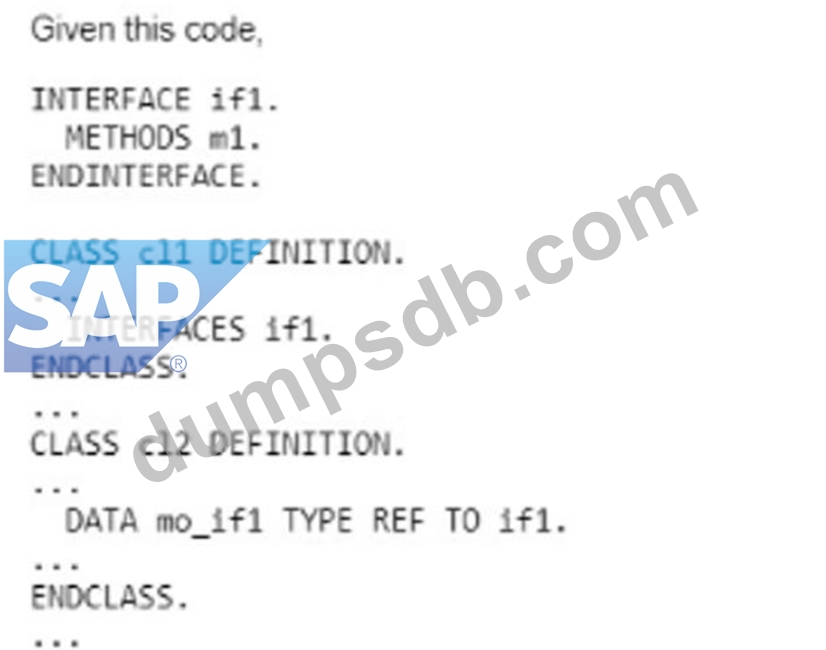
Refer to the Exhibit. What are valid statements? Note: There are 3 correct answers to this question
Correct Answer: C,D,E
The following are the explanations for each statement: C: This statement is valid. Class CL1 uses the interface. This is because class CL1 implements the interface ifl using the INTERFACES statement in the public section of the class definition. The INTERFACES statement makes the class compatible with the interface and inherits all the components of the interface. The class can then use the interface components, such as the method ml, by using the interface component selector ~, such as ifl~ml12 E: This statement is valid. Class CL1 implements the interface. This is because class CL1 implements the interface ifl using the INTERFACES statement in the public section of the class definition. The INTERFACES statement makes the class compatible with the interface and inherits all the components of the interface. The class must then provide an implementation for the interface method ml in the implementation part of the class, unless the method is declared as optional or abstract12 D: This statement is valid. In class CL2, the interface method is named ifl~ml. This is because class CL2 has a data member named m0_ifl of type REF TO ifl, which is a reference to the interface ifl. The interface ifl defines a method ml, which can be called using the reference variable m0_ifl. The interface method ml has the name ifl~ml in the class, where ifl is the name of the interface and the character ~ is the interface component selector12 The other statements are not valid, as they have syntax errors or logical errors. These statements are: A: This statement is not valid. In class CL1, the interface method is named ifl~ml, not if-ml. This is because class CL1 implements the interface ifl using the INTERFACES statement in the public section of the class definition. The interface ifl defines a method ml, which can be called using the class name or a reference to the class. The interface method ml has the name ifl~ml in the class, where ifl is the name of the interface and the character ~ is the interface component selector. Using the character - instead of the character ~ will cause a syntax error12 B: This statement is not valid. Class CL2 does not use the interface, but only has a reference to the interface. This is because class CL2 has a data member named m0_ifl of type REF TO ifl, which is a reference to the interface ifl. The interface ifl defines a method ml, which can be called using the reference variable m0_ifl. However, class CL2 does not implement the interface ifl, nor does it inherit the interface components. Therefore, class CL2 does not use the interface, but only references the interface12
Question 78
Exhibit: What are valid statements? Note: There are 3 correct answers to this question.
Correct Answer: A,B,E
The following are the explanations for each statement: * A: This statement is valid. go_ifl may call method ml with go_ifl->ml(). This is because go_ifl is a data object of type REF TO ifl, which is a reference to the interface ifl. The interface ifl defines a method ml, which can be called using the reference variable go_ifl. The class cll implements the interface ifl, which means that it provides an implementation of the method ml. The data object go_ifl is assigned to a new instance of the class cll using the NEW operator and the inline declaration operator @DATA. Therefore, when go_ifl->ml() is called, the implementation of the method ml in the class cll is executed123 * B: This statement is valid. Instead of go_cll = NEW #(...) you could use go_ifl = NEW cll(...). This is because go_ifl is a data object of type REF TO ifl, which is a reference to the interface ifl. The class cll implements the interface ifl, which means that it is compatible with the interface ifl. Therefore, go_ifl can be assigned to a new instance of the class cll using the NEW operator and the class name cll. The inline declaration operator @DATA is optional in this case, as go_ifl is already declared. The parentheses after the class name cll can be used to pass parameters to the constructor of the class cll, if any123 * E: This statement is valid. go_ifl may call method m2 with go_ifl->m2(...). This is because go_ifl is a data object of type REF TO ifl, which is a reference to the interface ifl. The class cll implements the interface ifl, which means that it inherits all the components of the interface ifl. The class cll also defines a method m2, which is a public method of the class cll. Therefore, go_ifl can call the method m2 using the reference variable go_ifl. The method m2 is not defined in the interface ifl, but it is accessible * through the interface ifl, as the interface ifl is implemented by the class cll. The parentheses after the method name m2 can be used to pass parameters to the method m2, if any123 The other statements are not valid, as they have syntax errors or logical errors. These statements are: * C: This statement is not valid. go_cll may call method ml with go_cll->ifl~ml(). This is because go_cll is a data object of type REF TO cll, which is a reference to the class cll. The class cll implements the interface ifl, which means that it inherits all the components of the interface ifl. The interface ifl defines a method ml, which can be called using the reference variable go_cll. However, the syntax for calling an interface method using a class reference is go_cll->ml(), not go_cll->ifl~ml(). The interface component selector ~ is only used when calling an interface method using an interface reference, such as go_ifl->ifl~ml(). Using the interface component selector ~ with a class reference will cause a syntax error123 * D: This statement is not valid. Instead of go_cll = NEW #() you could use go_ifl = NEW #(...). This is because go_ifl is a data object of type REF TO ifl, which is a reference to the interface ifl. The interface ifl cannot be instantiated, as it does not have an implementation. Therefore, go_ifl cannot be assigned to a new instance of the interface ifl using the NEW operator and the inline declaration operator @DATA. This will cause a syntax error or a runtime error. To instantiate an interface, you need to use a class that implements the interface, such as the class cll123 References: INTERFACES - ABAP Keyword Documentation, CLASS - ABAP Keyword Documentation, NEW - ABAP Keyword Documentation
Question 79
Which of the following are parts of the definition of a new database table?Note: There are 2 correct answers to this question.
Correct Answer: C,D
Question 80
For the assignment, gv_target = gv_source. which of the following data declarations will always work without truncation or rounding? Note: There are 2 correct answers to this question.
Correct Answer: B,C
Explanation The data declarations that will always work without truncation or rounding for the assignment gv_target = gv_source are B and C. This is because the target data type string is a variable-length character type that can hold any character string, including those of data types c (fixed-length character) and d (date). The assignment of a character or date value to a string variable will not cause any loss of information or precision, as the string variable will adjust its length to match the source value12. You cannot do any of the following: A: DATA gv_source TYPE string, to DATA gv_target TYPE c.: This data declaration may cause truncation for the assignment gv_target = gv_source. This is because the target data type c is a fixed-length character type that has a predefined length. If the source value of type string is longer than the target length of type c, the source value will be truncated on the right to fit the target length12. D: DATA gv_source TYPE p LENGTH 8 DECIMALS 3. to DATA gv_target TYPE p LENGTH 16 DECIMALS 2.: This data declaration may cause rounding for the assignment gv_target = gv_source. This is because the target data type p is a packed decimal type that has a predefined length and number of decimal places. If the source value of type p has more decimal places than the target type p, the source value will be rounded to the target number of decimal places12. References: 1: ABAP Data Types - ABAP Keyword Documentation - SAP Online Help 2: ABAP Assignment Rules - ABAP Keyword Documentation - SAP Online Help