What are some properties of database tables? Note: There are 2 correct answers to this question.
Correct Answer: A,D
Database tables are data structures that store information in two dimensions, using rows and columns. Each row represents a record or an entity, and each column represents an attribute or a field. Database tables may have key fields, which are columns that uniquely identify each row or a subset of rows. Key fields can be used to enforce data integrity, perform efficient searches, and establish relationships to other tables. Database tables can have relationships to other tables, which are associations or links between the key fields of two or more tables. Relationships can be used to model the logical connections between different entities, join data from multiple tables, and enforce referential integrity12. References: 1: Table (database) - Wikipedia 2: Database design basics - Microsoft Support
Question 47
Which extensibility type does SAP recommend you use to enhance the existing UI for an SAP Fiori app?
Correct Answer: D
According to the SAP clean core extensibility and ABAP cloud topic, SAP recommends using developer extensibility to enhance the existing UI for an SAP Fiori app. Developer extensibility allows you to use the UI adaptation editor in SAP Web IDE to modify the UI layout, add or remove fields, and bind them to the data model. You can also use the SAPUI5 framework to create custom controls, views, and controllers. Developer extensibility is based on the in-app extensibility concept, which means that the extensions are part of the same application and are deployed together with the app. Developer extensibility requires developer skills and access to the source code of the app. References: SAP Learning Hub, SAP S/4HANA Cloud Extensibility - In-App Extensibility, SAP Fiori: Extensibility
Question 48
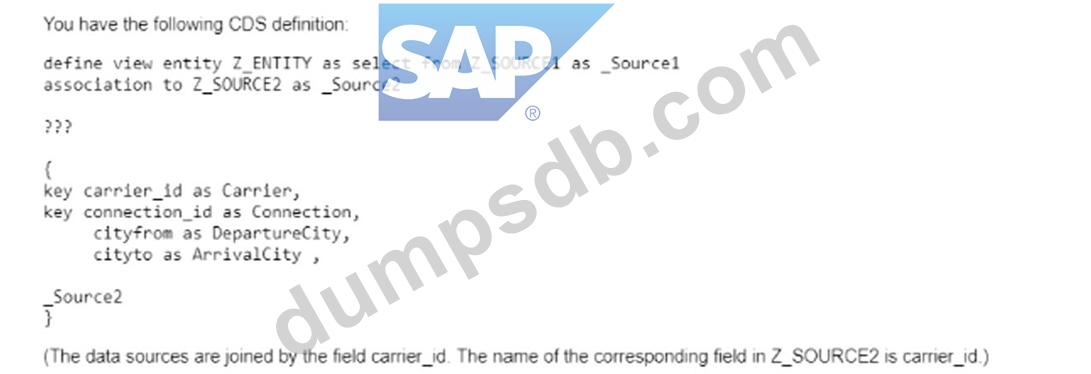
Which of the following ON conditions must you insert in place of "???"?
Correct Answer: D
Explanation The correct ON condition that must be inserted in place of "???" is: ON Sprojection.carrier_id=Z_Source2.carrier_id This ON condition specifies the join condition between the CDS view Sprojection and the database table Z_Source2. The join condition is based on the field carrier_id, which is the primary key of both the CDS view and the database table. The ON condition ensures that only the records that have the same value for the carrier_id field are joined together1. The other options are not valid ON conditions, because: A: ON Z_Sourcel.camer_id = 7_Source2 carrier_id is not valid because Z_Sourcel and 7_Source2 are not valid data sources in the given code. There is no CDS view or database table named Z_Sourcel or 7_Source2. The correct names are Z_Source1 and Z_Source2. Moreover, the field camer_id is not a valid field in the given code. There is no field named camer_id in any of the data sources. The correct name is carrier_id. B: ON Sprojection Camer=Source2 carrier_id is not valid because Sprojection and Source2 are not valid data sources in the given code. There is no CDS view or database table named Sprojection or Source2. The correct names are Sprojection and Z_Source2. Moreover, the field Camer is not a valid field in the given code. There is no field named Camer in any of the data sources. The correct name is carrier_id. Furthermore, the ON condition is missing the dot (.) operator between the data source name and the field name, which is required to access the fields of the data source1. C: ON Sprojection. Carrier Source2.carrier is not valid because Carrier and carrier are not valid fields in the given code. There is no field named Carrier or carrier in any of the data sources. The correct name is carrier_id. Moreover, the ON condition is missing the dot (.) operator between the data source name and the field name, which is required to access the fields of the data source1. References: 1: ON Condition - ABAP Keyword Documentation
Question 49
In a subclass subl you want to redefine a component of a superclass superl. How do you achieve this? Note: There are 2 correct answers to this question.
Correct Answer: A,C
To redefine a component of a superclass in a subclass, you need to do the following12: You add the clause REDEFINITION to the component declaration in the subclass. This indicates that the component is inherited from the superclass and needs to be reimplemented in the subclass. The redefinition must happen in the same visibility section as the component declaration in the superclass. For example, if the superclass has a public method m1, the subclass must also declare the redefined method m1 as public with the REDEFINITION clause. You implement the redefined component in the subclass. This means that you provide the new logic or behavior for the component that is specific to the subclass. The redefined component in the subclass will override the original component in the superclass when the subclass object is used. For example, if the superclass has a method m1 that returns 'Hello', the subclass can redefine the method m1 to return 'Hi' instead. You cannot do any of the following: You implement the redefined component for a second time in the superclass. This is not possible, because the superclass already has an implementation for the component that is inherited by the subclass. The subclass is responsible for providing the new implementation for the redefined component, not the superclass. You add the clause REDEFINITION to the component in the superclass. This is not necessary, because the superclass does not need to indicate that the component can be redefined by the subclass. The subclass is the one that needs to indicate that the component is redefined by adding the REDEFINITION clause to the component declaration in the subclass.
Question 50
In what order are objects created to generate a RESTful Application Programming application?
Correct Answer: C
Explanation The order in which objects are created to generate a RESTful Application Programming application is A, D, C, B. This means that the following steps are followed: First, a database table is created to store the data for the application. A database table is a CDS DDIC-based view that defines a join or union of database tables. A database table has an SQL view attached and can be accessed by Open SQL or native SQL. Second, a data model view is created to define a data model based on the database table or other CDS view entities. A data model view is a CDS view entity that can have associations, aggregations, filters, parameters, and annotations. A data model view can also define the behavior definition and implementation for the business object. Third, a service definition is created to define the service interface for the application. A service definition is a CDS view entity that defines a projection on a data model view or another service definition. A service definition can also define service metadata, such as service name, version, description, and annotations. Fourth, a service binding is created to define the service binding for the application. A service binding is a CDS view entity that defines a projection on a service definition. A service binding can also define the service protocol, such as OData V2, OData V4, or REST, and the service URL. References: CDS Data Model Views - ABAP Keyword Documentation, CDS Service Definitions - ABAP Keyword Documentation, CDS Service Bindings - ABAP Keyword Documentation, CDS Projection Views - ABAP Keyword Documentation