Which RESTful Application Programming object can be used to organize the display of fields in an app?
Correct Answer: B
A metadata extension is a RESTful Application Programming object that can be used to organize the display of fields in an app. A metadata extension is a CDS view that annotates another CDS view with UI annotations, such as labels, icons, or facets. These annotations define how the data should be presented in the app, such as which fields should be shown on the object page, which fields should be editable, or which fields should be used for filtering or sorting. A metadata extension can also be used to add custom actions or validations to the app12. References: 1: Refine the Object Page with Annotations | SAP Tutorials 2: ABAP RAP : Enabling custom actions with a dialog for additional input fields | SAP Blogs
Question 42
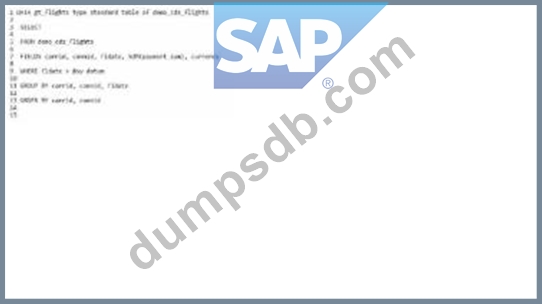
Refer to the Exhibit. To adhere to the most recent ABAP SQL syntax conventions from SAP, on which line must you insert the "INTO TABLE @gt flights" clause to complete the SQL statement?
Correct Answer: B
To adhere to the most recent ABAP SQL syntax conventions from SAP, you must insert the "INTO TABLE @gt flights" clause on line #4 to complete the SQL statement. This is because the INTO or APPENDING clause should be specified immediately after the SELECT clause, according to the ABAP SQL syntax conventions1. The INTO or APPENDING clause defines the data object to which the results set of the SELECT statement is assigned. The data object can be an internal table, a work area, or an inline declaration. In this case, the data object is an internal table named gt_flights, which is created using the inline declaration operator @DATA. The inline declaration operator allows you to declare and create a data object in the same statement where it is used, without the need for a separate DATA statement2. The other lines are not suitable for inserting the "INTO TABLE @gt flights" clause, as they would violate the ABAP SQL syntax conventions or cause syntax errors. These lines are: #6: This line is not suitable for inserting the "INTO TABLE @gt flights" clause, as it would cause a syntax error. This is because the FROM clause must be specified before the INTO or APPENDING clause, according to the ABAP SQL syntax conventions1. The FROM clause defines the data sources from which the data is read, such as database tables, CDS view entities, or CDS DDIC-based views. In this case, the data source is the database table flights. #8: This line is not suitable for inserting the "INTO TABLE @gt flights" clause, as it would cause a syntax error. This is because the ORDER BY clause must be specified after the INTO or APPENDING clause, according to the ABAP SQL syntax conventions1. The ORDER BY clause defines the sort order of the results set of the SELECT statement. In this case, the results set is sorted by the fields carrid, connid, and fltime. #15: This line is not suitable for inserting the "INTO TABLE @gt flights" clause, as it would violate the ABAP SQL syntax conventions. This is because the INTO or APPENDING clause should be specified as close as possible to the SELECT clause, according to the ABAP SQL syntax conventions1. The INTO or APPENDING clause should not be separated from the SELECT clause by other clauses, such as the WHERE clause, the GROUP BY clause, the HAVING clause, the UNION clause, or the ORDER BY clause. This is to improve the readability and maintainability of the ABAP SQL statement.
Question 43
In the assignment, data (gv_result) = 1/8. what will be the data type of gv_result?
Correct Answer: B
Explanation The data type of gv_result in the assignment data (gv_result) = 1/8 will be TYPE DECFLOAT 16. This is because the assignment operator (=) in ABAP performs an implicit type conversion from the source type to the target type, according to the following rules12: If the target type is specified explicitly, the source value is converted to the target type. If the target type is not specified explicitly, the source type is used as the target type, unless the source type is a literal or an expression, in which case the target type is determined by the following priority order: DECFLOAT34, DECFLOAT16, P, F, I, C, N, X, STRING, XSTRING. In this case, the target type is not specified explicitly, and the source type is an expression (1/8). Therefore, the target type is determined by the priority order, and the first matching type is DECFLOAT16, which is a decimal floating point type with 16 digits of precision12. References: 1: ABAP Assignment Rules - ABAP Keyword Documentation - SAP Online Help 2: ABAP Data Types - ABAP Keyword Documentation - SAP Online Help
Question 44
Which RESTful Application Programming object can be used to organize the display of fields in an app?
Correct Answer: B
Explanation A metadata extension is a RESTful Application Programming object that can be used to organize the display of fields in an app. A metadata extension is a CDS view that annotates another CDS view with UI annotations, such as labels, icons, or facets. These annotations define how the data should be presented in the app, such as which fields should be shown on the object page, which fields should be editable, or which fields should be used for filtering or sorting. A metadata extension can also be used to add custom actions or validations to the app12. References: 1: Refine the Object Page with Annotations | SAP Tutorials 2: ABAP RAP : Enabling custom actions with a dialog for additional input fields | SAP Blogs
Question 45
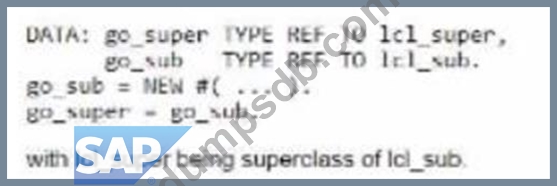
Refer to the Exhibit. When accessing the subclass instance through go_super, what can you do? Note: There are 2 correct answers to this question.
Correct Answer: A,B
When accessing the subclass instance through go_super, you can do both of the following: Access the inherited private components: A subclass inherits all the private attributes and methods of its superclass, unless they are explicitly overridden by the subclass. Therefore, you can access the inherited private components of the superclass through go_super, as long as they are not hidden by other attributes or methods in the subclass12. Access the inherited public components: A subclass inherits all the public attributes and methods of its superclass, unless they are explicitly overridden by the subclass. Therefore, you can access the inherited public components of the superclass through go_super, as long as they are not hidden by other attributes or methods in the subclass12. You cannot do any of the following: Call a subclass specific public method: A subclass does not have any public methods that are not inherited from its superclass. Therefore, you cannot call a subclass specific public method through go_super12. Call inherited public redefined methods: A subclass does not have any public methods that are redefined from its superclass. Therefore, you cannot call inherited public redefined methods through go_super12.