
- Home
- SAP Certification
- C_ABAPD_2309 Exam
- SAP.C_ABAPD_2309.v2026-01-15.q82 Dumps

Question 21
In RESTful Application Programming, which EML statement retrieves an object?
Correct Answer: C
Explanation
In RESTful Application Programming, the EML statement that retrieves an object is GET entity. The GET entity statement is used to read data of an entity instance from the database or the transaction buffer. The GET entity statement can specify the entity name, the entity key, and the entity elements to be retrieved. The GET entity statement can also use the IN LOCAL MODE addition to bypass the access control, authorization control, and feature control checks. The GET entity statement returns a single entity instance or raises an exception if no instance is found or multiple instances match the key.
The other EML statements are not used to retrieve an object, but have different purposes and effects. These statements are:
FIND entity: This statement is used to search for entity instances that match a given condition. The FIND entity statement can specify the entity name, the entity elements to be returned, and the condition to be applied. The FIND entity statement can also use the IN LOCAL MODE addition to bypass the access control, authorization control, and feature control checks. The FIND entity statement returns a table of entity instances or an empty table if no instances match the condition.
SELECT entity: This statement is used to query data of entity instances from the database or the transaction buffer. The SELECT entity statement can specify the entity name, the entity elements to be returned, and the filter, order, and aggregation options to be applied. The SELECT entity statement can also use the IN LOCAL MODE addition to bypass the access control, authorization control, and feature control checks. The SELECT entity statement returns a table of entity instances or an empty table if no instances match the query.
READ entity: This statement is not a valid EML statement, but an ABAP statement. The READ statement is used to access a single row of an internal table using the table index or the table key. The READ statement can also use the TRANSPORTING addition to specify which fields should be returned, and the INTO addition to specify the target variable. The READ statement returns a single row of the internal table or raises an exception if no row is found or multiple rows match the key.
References: GET ENTITY - ABAP Keyword Documentation, FIND ENTITY, ENTITIES - ABAP Keyword Documentation, SELECT ENTITY, ENTITIES - ABAP Keyword Documentation, READ - ABAP Keyword Documentation
In RESTful Application Programming, the EML statement that retrieves an object is GET entity. The GET entity statement is used to read data of an entity instance from the database or the transaction buffer. The GET entity statement can specify the entity name, the entity key, and the entity elements to be retrieved. The GET entity statement can also use the IN LOCAL MODE addition to bypass the access control, authorization control, and feature control checks. The GET entity statement returns a single entity instance or raises an exception if no instance is found or multiple instances match the key.
The other EML statements are not used to retrieve an object, but have different purposes and effects. These statements are:
FIND entity: This statement is used to search for entity instances that match a given condition. The FIND entity statement can specify the entity name, the entity elements to be returned, and the condition to be applied. The FIND entity statement can also use the IN LOCAL MODE addition to bypass the access control, authorization control, and feature control checks. The FIND entity statement returns a table of entity instances or an empty table if no instances match the condition.
SELECT entity: This statement is used to query data of entity instances from the database or the transaction buffer. The SELECT entity statement can specify the entity name, the entity elements to be returned, and the filter, order, and aggregation options to be applied. The SELECT entity statement can also use the IN LOCAL MODE addition to bypass the access control, authorization control, and feature control checks. The SELECT entity statement returns a table of entity instances or an empty table if no instances match the query.
READ entity: This statement is not a valid EML statement, but an ABAP statement. The READ statement is used to access a single row of an internal table using the table index or the table key. The READ statement can also use the TRANSPORTING addition to specify which fields should be returned, and the INTO addition to specify the target variable. The READ statement returns a single row of the internal table or raises an exception if no row is found or multiple rows match the key.
References: GET ENTITY - ABAP Keyword Documentation, FIND ENTITY, ENTITIES - ABAP Keyword Documentation, SELECT ENTITY, ENTITIES - ABAP Keyword Documentation, READ - ABAP Keyword Documentation
Question 22
Which of the following are parts of answers to this question.
Correct Answer: B,C
Explanation
A CDS view is a data definition that defines a data structure and a data selection from one or more data sources. A CDS view consists of several parts, but two of them are:
Extension: An extension is an optional clause that allows a CDS view to extend another CDS view by adding new elements, annotations, or associations. The extension clause has the syntax EXTEND VIEW view_name WITH view_name. The first view_name is the name of the CDS view that is being extended, and the second view_name is the name of the CDS view that is doing the extension1.
Field list: A field list is a mandatory clause that specifies the elements of the CDS view. The field list has the syntax SELECT FROM data_source { element_list }. The data_source is the name of the data source that the CDS view selects data from, and the element_list is a comma-separated list of elements that the CDS view exposes. The elements can be fields of the data source, expressions, associations, or annotations2.
The following example shows a CDS view that extends another CDS view and defines a field list:
@AbapCatalog.sqlViewName: 'ZCDS_EXT' define view Z_CDS_Extension extend view Z_CDS_Base with Z_CDS_Extension as select from ztable { // field list key ztable.id as ID, ztable.name as Name, ztable.age as Age, // extension @Semantics.currencyCode: true ztable.currency as Currency } The other options are not parts of a CDS view, but rather related concepts:
Partitioning attributes: Partitioning attributes are attributes that are used to partition a table into smaller subsets of data. Partitioning attributes are defined in the ABAP Dictionary for transparent tables and can improve the performance and scalability of data access. Partitioning attributes are not part of the CDS view definition, but rather the underlying table definition3.
Semantic table attributes: Semantic table attributes are attributes that provide additional information about the meaning and usage of a table. Semantic table attributes are defined in the ABAP Dictionary for transparent tables and can be used to enhance the data modeling and consumption of the table. Semantic table attributes are not part of the CDS view definition, but rather the underlying table definition4.
References: 1: Extending CDS Views | SAP Help Portal 2: SELECT List - ABAP Keyword Documentation 3:
Partitioning Attributes - ABAP Keyword Documentation 4: Semantic Table Attributes - ABAP Keyword Documentation
A CDS view is a data definition that defines a data structure and a data selection from one or more data sources. A CDS view consists of several parts, but two of them are:
Extension: An extension is an optional clause that allows a CDS view to extend another CDS view by adding new elements, annotations, or associations. The extension clause has the syntax EXTEND VIEW view_name WITH view_name. The first view_name is the name of the CDS view that is being extended, and the second view_name is the name of the CDS view that is doing the extension1.
Field list: A field list is a mandatory clause that specifies the elements of the CDS view. The field list has the syntax SELECT FROM data_source { element_list }. The data_source is the name of the data source that the CDS view selects data from, and the element_list is a comma-separated list of elements that the CDS view exposes. The elements can be fields of the data source, expressions, associations, or annotations2.
The following example shows a CDS view that extends another CDS view and defines a field list:
@AbapCatalog.sqlViewName: 'ZCDS_EXT' define view Z_CDS_Extension extend view Z_CDS_Base with Z_CDS_Extension as select from ztable { // field list key ztable.id as ID, ztable.name as Name, ztable.age as Age, // extension @Semantics.currencyCode: true ztable.currency as Currency } The other options are not parts of a CDS view, but rather related concepts:
Partitioning attributes: Partitioning attributes are attributes that are used to partition a table into smaller subsets of data. Partitioning attributes are defined in the ABAP Dictionary for transparent tables and can improve the performance and scalability of data access. Partitioning attributes are not part of the CDS view definition, but rather the underlying table definition3.
Semantic table attributes: Semantic table attributes are attributes that provide additional information about the meaning and usage of a table. Semantic table attributes are defined in the ABAP Dictionary for transparent tables and can be used to enhance the data modeling and consumption of the table. Semantic table attributes are not part of the CDS view definition, but rather the underlying table definition4.
References: 1: Extending CDS Views | SAP Help Portal 2: SELECT List - ABAP Keyword Documentation 3:
Partitioning Attributes - ABAP Keyword Documentation 4: Semantic Table Attributes - ABAP Keyword Documentation
Question 23
Exhibit: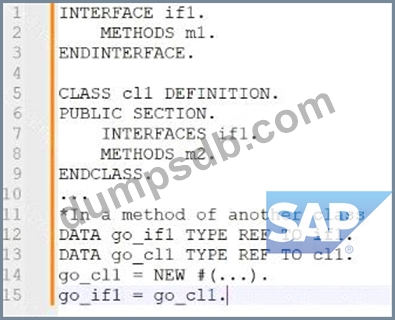
What are valid statements? Note: There are 3 correct answers to this question.
Correct Answer: A,B,E
Explanation
The following are the explanations for each statement:
A: This statement is valid. go_ifl may call method ml with go_ifl->ml(). This is because go_ifl is a data object of type REF TO ifl, which is a reference to the interface ifl. The interface ifl defines a method ml, which can be called using the reference variable go_ifl. The class cll implements the interface ifl, which means that it provides an implementation of the method ml. The data object go_ifl is assigned to a new instance of the class cll using the NEW operator and the inline declaration operator @DATA. Therefore, when go_ifl->ml() is called, the implementation of the method ml in the class cll is executed123 B: This statement is valid. Instead of go_cll = NEW #(...) you could use go_ifl = NEW cll(...). This is because go_ifl is a data object of type REF TO ifl, which is a reference to the interface ifl. The class cll implements the interface ifl, which means that it is compatible with the interface ifl. Therefore, go_ifl can be assigned to a new instance of the class cll using the NEW operator and the class name cll. The inline declaration operator @DATA is optional in this case, as go_ifl is already declared. The parentheses after the class name cll can be used to pass parameters to the constructor of the class cll, if any123 E: This statement is valid. go_ifl may call method m2 with go_ifl->m2(...). This is because go_ifl is a data object of type REF TO ifl, which is a reference to the interface ifl. The class cll implements the interface ifl, which means that it inherits all the components of the interface ifl. The class cll also defines amethod m2, which is a public method of the class cll. Therefore, go_ifl can call the method m2 using the reference variable go_ifl. The method m2 is not defined in the interface ifl, but it is accessible through the interface ifl, as the interface ifl is implemented by the class cll. The parentheses after the method name m2 can be used to pass parameters to the method m2, if any123 The other statements are not valid, as they have syntax errors or logical errors. These statements are:
C: This statement is not valid. go_cll may call method ml with go_cll->ifl~ml(). This is because go_cll is a data object of type REF TO cll, which is a reference to the class cll. The class cll implements the interface ifl, which means that it inherits all the components of the interface ifl. The interface ifl defines a method ml, which can be called using the reference variable go_cll. However, the syntax for calling an interface method using a class reference is go_cll->ml(), not go_cll->ifl~ml(). The interface component selector ~ is only used when calling an interface method using an interface reference, such as go_ifl->ifl~ml(). Using the interface component selector ~ with a class reference will cause a syntax error123 D: This statement is not valid. Instead of go_cll = NEW #() you could use go_ifl = NEW #(...). This is because go_ifl is a data object of type REF TO ifl, which is a reference to the interface ifl. The interface ifl cannot be instantiated, as it does not have an implementation. Therefore, go_ifl cannot be assigned to a new instance of the interface ifl using the NEW operator and the inline declaration operator @DATA.
This will cause a syntax error or a runtime error. To instantiate an interface, you need to use a class that implements the interface, such as the class cll123 References: INTERFACES - ABAP Keyword Documentation, CLASS - ABAP Keyword Documentation, NEW - ABAP Keyword Documentation
The following are the explanations for each statement:
A: This statement is valid. go_ifl may call method ml with go_ifl->ml(). This is because go_ifl is a data object of type REF TO ifl, which is a reference to the interface ifl. The interface ifl defines a method ml, which can be called using the reference variable go_ifl. The class cll implements the interface ifl, which means that it provides an implementation of the method ml. The data object go_ifl is assigned to a new instance of the class cll using the NEW operator and the inline declaration operator @DATA. Therefore, when go_ifl->ml() is called, the implementation of the method ml in the class cll is executed123 B: This statement is valid. Instead of go_cll = NEW #(...) you could use go_ifl = NEW cll(...). This is because go_ifl is a data object of type REF TO ifl, which is a reference to the interface ifl. The class cll implements the interface ifl, which means that it is compatible with the interface ifl. Therefore, go_ifl can be assigned to a new instance of the class cll using the NEW operator and the class name cll. The inline declaration operator @DATA is optional in this case, as go_ifl is already declared. The parentheses after the class name cll can be used to pass parameters to the constructor of the class cll, if any123 E: This statement is valid. go_ifl may call method m2 with go_ifl->m2(...). This is because go_ifl is a data object of type REF TO ifl, which is a reference to the interface ifl. The class cll implements the interface ifl, which means that it inherits all the components of the interface ifl. The class cll also defines amethod m2, which is a public method of the class cll. Therefore, go_ifl can call the method m2 using the reference variable go_ifl. The method m2 is not defined in the interface ifl, but it is accessible through the interface ifl, as the interface ifl is implemented by the class cll. The parentheses after the method name m2 can be used to pass parameters to the method m2, if any123 The other statements are not valid, as they have syntax errors or logical errors. These statements are:
C: This statement is not valid. go_cll may call method ml with go_cll->ifl~ml(). This is because go_cll is a data object of type REF TO cll, which is a reference to the class cll. The class cll implements the interface ifl, which means that it inherits all the components of the interface ifl. The interface ifl defines a method ml, which can be called using the reference variable go_cll. However, the syntax for calling an interface method using a class reference is go_cll->ml(), not go_cll->ifl~ml(). The interface component selector ~ is only used when calling an interface method using an interface reference, such as go_ifl->ifl~ml(). Using the interface component selector ~ with a class reference will cause a syntax error123 D: This statement is not valid. Instead of go_cll = NEW #() you could use go_ifl = NEW #(...). This is because go_ifl is a data object of type REF TO ifl, which is a reference to the interface ifl. The interface ifl cannot be instantiated, as it does not have an implementation. Therefore, go_ifl cannot be assigned to a new instance of the interface ifl using the NEW operator and the inline declaration operator @DATA.
This will cause a syntax error or a runtime error. To instantiate an interface, you need to use a class that implements the interface, such as the class cll123 References: INTERFACES - ABAP Keyword Documentation, CLASS - ABAP Keyword Documentation, NEW - ABAP Keyword Documentation
Question 24
In an Access Control Object, which clauses are used? Note: There are 3 correct answers to this question.
Correct Answer: A,D,E
Explanation
An Access Control Object (ACO) is a CDS annotation that defines the access control rules for a CDS view entity. An ACO consists of one or more clauses that specify the role name, the data source, the access conditions, and the return code of the authority check12. Some of the clauses that are used in an ACO are:
Where (to specify the access conditions): This clause is used to define the logical expression that determines whether a user has access to the data source or not. The expression can use the fields of the data source, the parameters of the CDS view entity, or the predefined variables $user and $session. The expression can also use the functions check_authorization and check_role to perform additional authority checks12.
Define role (to specify the role name): This clause is used to assign a name to the role that is defined by the ACO. The role name must be unique within the namespace of the CDS view entity and must not contain any special characters. The role name can be used to reference the ACO in other annotations, such as @AccessControl.authorizationCheck or @AccessControl.grant12.
Revoke (to remove access to the data source): This clause is used to explicitly deny access to the data source for a user who meets the conditions of the where clause. The revoke clause overrides any grant clause that might grant access to the same user. The revoke clause can be used to implement the principle of least privilege or to enforce data segregation12.
You cannot do any of the following:
Grant (to identify the data source): This is not a valid clause in an ACO. The grant clause is a separate annotation that is used to grant access to a CDS view entity or a data source for a user who has a specific role. The grant clause can reference an ACO by its role name to apply the access conditions defined by the ACO12.
Return code (to assign the return code of the authority check): This is not a valid clause in an ACO. The return code of the authority check is a predefined variable that is set by the system after performing the access control check. The return code can be used in the where clause of the ACO to specify different access conditions based on the outcome of the check12.
References: 1: Access Control Objects - ABAP Keyword Documentation - SAP Online Help 2: Access Control in Core Data Services (CDS) | SAP Help Portal
An Access Control Object (ACO) is a CDS annotation that defines the access control rules for a CDS view entity. An ACO consists of one or more clauses that specify the role name, the data source, the access conditions, and the return code of the authority check12. Some of the clauses that are used in an ACO are:
Where (to specify the access conditions): This clause is used to define the logical expression that determines whether a user has access to the data source or not. The expression can use the fields of the data source, the parameters of the CDS view entity, or the predefined variables $user and $session. The expression can also use the functions check_authorization and check_role to perform additional authority checks12.
Define role (to specify the role name): This clause is used to assign a name to the role that is defined by the ACO. The role name must be unique within the namespace of the CDS view entity and must not contain any special characters. The role name can be used to reference the ACO in other annotations, such as @AccessControl.authorizationCheck or @AccessControl.grant12.
Revoke (to remove access to the data source): This clause is used to explicitly deny access to the data source for a user who meets the conditions of the where clause. The revoke clause overrides any grant clause that might grant access to the same user. The revoke clause can be used to implement the principle of least privilege or to enforce data segregation12.
You cannot do any of the following:
Grant (to identify the data source): This is not a valid clause in an ACO. The grant clause is a separate annotation that is used to grant access to a CDS view entity or a data source for a user who has a specific role. The grant clause can reference an ACO by its role name to apply the access conditions defined by the ACO12.
Return code (to assign the return code of the authority check): This is not a valid clause in an ACO. The return code of the authority check is a predefined variable that is set by the system after performing the access control check. The return code can be used in the where clause of the ACO to specify different access conditions based on the outcome of the check12.
References: 1: Access Control Objects - ABAP Keyword Documentation - SAP Online Help 2: Access Control in Core Data Services (CDS) | SAP Help Portal
Question 25
Which of the following are incomplete ABAP types? Note: There are 2 correct answers to this question.
Correct Answer: C,D
Explanation
Incomplete ABAP types are types that do not specify all the attributes of a data type, such as the length, the number of decimal places, or the value range. Incomplete types can only be used for the typing of field symbols and formal parameters, not for the definition of data objects or constants. Incomplete types can be either predefined or user-defined1.
The following are incomplete ABAP types:
C). C is a type for character strings with a generic length. The length of the character string has to be specified when a data object or a constant is defined with this type. For example, DATA text TYPE c LENGTH 10 defines a data object named text with a type c and a length of 10 characters2.
D). P is a type for packed numbers with a generic length and a generic number of decimal places. The length and the number of decimal places of the packed number have to be specified when a data object or a constant is defined with this type. For example, DATA amount TYPE p LENGTH 8 DECIMALS 2 defines a data object named amount with a type p, a length of 8 bytes, and 2 decimal places3.
The following are not incomplete ABAP types, because they specify all the attributes of a data type:
A). String is a type for variable-length character strings. The length of the character string is determined at runtime and can vary from 0 to 2,147,483,647 characters. The length does not have to be specified when a data object or a constant is defined with this type. For example, DATA text TYPE string defines a data object named text with a type string and a variable length4.
B). T is a type for time values in the format HHMMSS. The length of the time value is fixed at 6 characters and does not have to be specified when a data object or a constant is defined with this type.
For example, DATA time TYPE t defines a data object named time with a type t and a length of 6 characters.
References: 1: Generic ABAP Types - ABAP Keyword Documentation 2: C - ABAP Keyword Documentation 3: P - ABAP Keyword Documentation 4: String - ABAP Keyword Documentation : T - ABAP Keyword Documentation
Incomplete ABAP types are types that do not specify all the attributes of a data type, such as the length, the number of decimal places, or the value range. Incomplete types can only be used for the typing of field symbols and formal parameters, not for the definition of data objects or constants. Incomplete types can be either predefined or user-defined1.
The following are incomplete ABAP types:
C). C is a type for character strings with a generic length. The length of the character string has to be specified when a data object or a constant is defined with this type. For example, DATA text TYPE c LENGTH 10 defines a data object named text with a type c and a length of 10 characters2.
D). P is a type for packed numbers with a generic length and a generic number of decimal places. The length and the number of decimal places of the packed number have to be specified when a data object or a constant is defined with this type. For example, DATA amount TYPE p LENGTH 8 DECIMALS 2 defines a data object named amount with a type p, a length of 8 bytes, and 2 decimal places3.
The following are not incomplete ABAP types, because they specify all the attributes of a data type:
A). String is a type for variable-length character strings. The length of the character string is determined at runtime and can vary from 0 to 2,147,483,647 characters. The length does not have to be specified when a data object or a constant is defined with this type. For example, DATA text TYPE string defines a data object named text with a type string and a variable length4.
B). T is a type for time values in the format HHMMSS. The length of the time value is fixed at 6 characters and does not have to be specified when a data object or a constant is defined with this type.
For example, DATA time TYPE t defines a data object named time with a type t and a length of 6 characters.
References: 1: Generic ABAP Types - ABAP Keyword Documentation 2: C - ABAP Keyword Documentation 3: P - ABAP Keyword Documentation 4: String - ABAP Keyword Documentation : T - ABAP Keyword Documentation