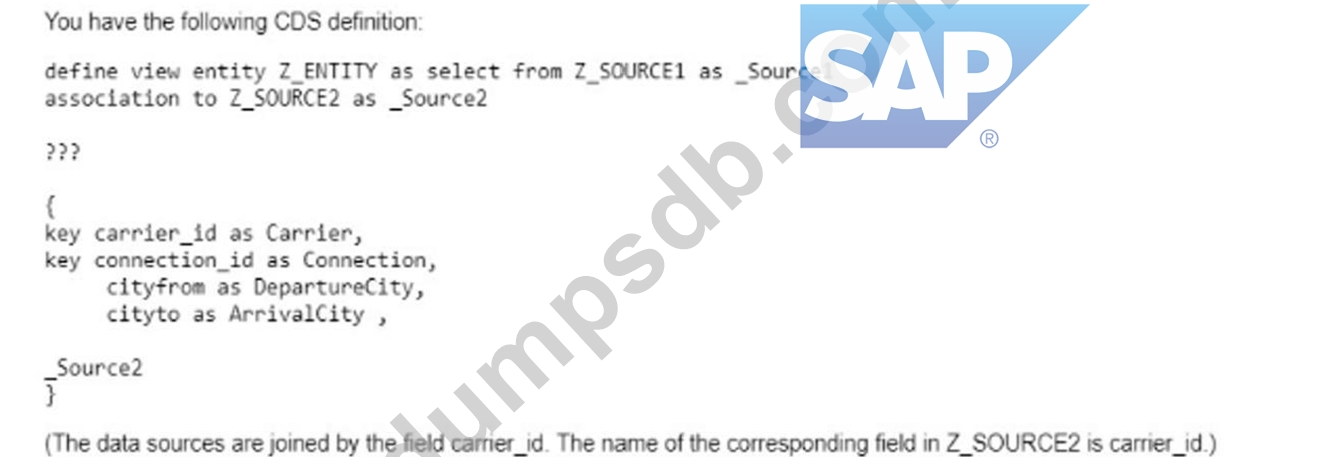
Which of the following ON conditions must you insert in place of "???"?
Correct Answer: D
Explanation The correct ON condition that must be inserted in place of "???" is: ON Sprojection.carrier_id=Z_Source2.carrier_id This ON condition specifies the join condition between the CDS view Sprojection and the database table Z_Source2. The join condition is based on the field carrier_id, which is the primary key of both the CDS view and the database table. The ON condition ensures that only the records that have the same value for the carrier_id field are joined together1. The other options are not valid ON conditions, because: A). ON Z_Sourcel.camer_id = 7_Source2 carrier_id is not valid because Z_Sourcel and 7_Source2 are not valid data sources in the given code. There is no CDS view or database table named Z_Sourcel or 7_Source2. The correct names are Z_Source1 and Z_Source2. Moreover, the field camer_id is not a valid field in the given code. There is no field named camer_id in any of the data sources. The correct name is carrier_id. B). ON Sprojection Camer=Source2 carrier_id is not valid because Sprojection and Source2 are not valid data sources in the given code. There is no CDS view or database table named Sprojection or Source2. The correct names are Sprojection and Z_Source2. Moreover, the field Camer is not a valid field in the given code. There is no field named Camer in any of the data sources. The correct name is carrier_id. Furthermore, the ON condition is missing the dot (.) operator between the data source name and the field name, which is required to access the fields of the data source1. C). ON Sprojection. Carrier Source2.carrier is not valid because Carrier and carrier are not valid fields in the given code. There is no field named Carrier or carrier in any of the data sources. The correct name is carrier_id. Moreover, the ON condition is missing the dot (.) operator between the data source name and the field name, which is required to access the fields of the data source1. References: 1: ON Condition - ABAP Keyword Documentation
Question 7
You have the following CDS definition: Which of the following ON conditions must you insert in place of "???"?
Correct Answer: D
The correct ON condition that must be inserted in place of "???" is: ON Sprojection.carrier_id=Z_Source2.carrier_id This ON condition specifies the join condition between the CDS view Sprojection and the database table Z_Source2. The join condition is based on the field carrier_id, which is the primary key of both the CDS view and the database table. The ON condition ensures that only the records that have the same value for the carrier_id field are joined together1. The other options are not valid ON conditions, because: * A. ON Z_Sourcel.camer_id = 7_Source2 carrier_id is not valid because Z_Sourcel and 7_Source2 are not valid data sources in the given code. There is no CDS view or database table named Z_Sourcel or 7_Source2. The correct names are Z_Source1 and Z_Source2. Moreover, the field camer_id is not a valid field in the given code. There is no field named camer_id in any of the data sources. The correct name is carrier_id. * B. ON Sprojection Camer=Source2 carrier_id is not valid because Sprojection and Source2 are not valid data sources in the given code. There is no CDS view or database table named Sprojection or Source2. The correct names are Sprojection and Z_Source2. Moreover, the field Camer is not a valid field in the given code. There is no field named Camer in any of the data sources. The correct name is carrier_id. Furthermore, the ON condition is missing the dot (.) operator between the data source name and the field name, which is required to access the fields of the data source1. * C. ON Sprojection. Carrier Source2.carrier is not valid because Carrier and carrier are not valid fields in the given code. There is no field named Carrier or carrier in any of the data sources. The correct name is carrier_id. Moreover, the ON condition is missing the dot (.) operator between the data source name and the field name, which is required to access the fields of the data source1. References: 1: ON Condition - ABAP Keyword Documentation
Question 8
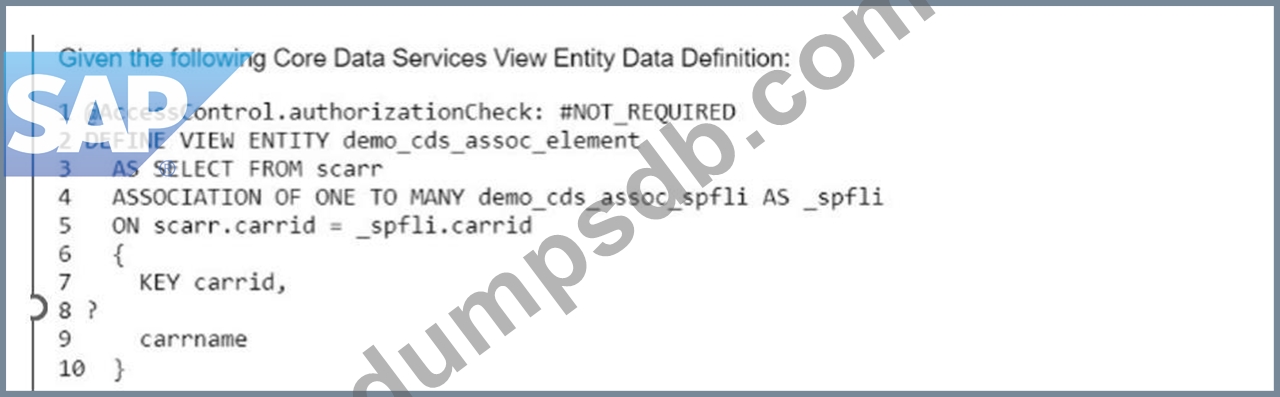
The "demo_ods_assoc_spfi data source referenced in line #4 contains a field "connid" which you would like to expose in the element list. Which of the following statements would do this if inserted on line #8?
Correct Answer: A
Explanation The statement that can be used to expose the field "connid" of the data source "demo_ods_assoc_spfli" in the element list is A. demo_ods_assoc_spfli.connid,. This statement uses the dot notation to access the field "connid" of the data source "demo_ods_assoc_spfli", which is an association defined on line #4. The association "demo_ods_assoc_spfli" links the data source "demo_ods" with the table "spfli" using the field "carrid". The statement also ends with a comma to separate it from the next element in the list12. You cannot do any of the following: B). demo_ods_assoc_spfli-connid/: This statement uses the wrong syntax to access the field "connid" of the data source "demo_ods_assoc_spfli". The dash notation is used to access the components of a structure or a table, not the fields of a data source. The statement also ends with a slash, which is not a valid separator for the element list12. C). spfli-connid,: This statement uses the wrong data source name to access the field "connid". The data source name should be "demo_ods_assoc_spfli", not "spfli". The statement also uses the wrong syntax to access the field "connid", as explained above12. D). _spfli.connid/: This statement uses the wrong data source name and the wrong separator to access the field "connid". The data source name should be "demo_ods_assoc_spfli", not "_spfli". The statement also ends with a slash, which is not a valid separator for the element list12. References: 1: ABAP CDS - SELECT, select_list - ABAP Keyword Documentation - SAP Online Help 2: ABAP CDS - SELECT, from - ABAP Keyword Documentation - SAP Online Help
Question 9
For what kind of applications would you consider using on-stack developer extensions? Note: There are 2 correct answers to this question.
Correct Answer: A,B
On-stack developer extensibility is a type of extensibility that allows you to create development projects directly on the SAP S/4HANA Cloud technology stack. It gives you the opportunity to develop cloud-ready and upgrade-stable custom ABAP applications and services inside the SAP S/4HANA Cloud, public edition system. You can use the ABAP Development Tools in Eclipse to create and deploy your on-stack extensions. On-stack developer extensibility is suitable for the following kinds of applications: * Applications that provide APIs for side by side SAP BTP apps. On-stack developer extensibility allows you to create OData services or RESTful APIs based on CDS view entities or projection views. These services or APIs can expose SAP S/4HANA data and logic to other applications that run on the SAP Business Technology Platform (SAP BTP) or other platforms. This way, you can create a loosely coupled integration between your SAP S/4HANA system and your side by side SAP BTP apps. * Applications that access SAP S/4HANA data using complex SQL. On-stack developer extensibility allows you to use ABAP SQL to access SAP S/4HANA data using complex queries, such as joins, aggregations, filters, parameters, and code pushdown techniques. You can also use ABAP SQL to perform data manipulation operations, such as insert, update, delete, and upsert. This way, you can create applications that require advanced data processing and analysis on SAP S/4HANA data. The other kinds of applications are not suitable for on-stack developer extensibility, as they have different requirements and challenges. These kinds of applications are: * Applications that integrate data from several different systems. On-stack developer extensibility is not meant for creating applications that integrate data from multiple sources, such as other SAP systems, third-party systems, or cloud services. This is because on-stack developer extensibility does not support remote access or data replication, and it may cause performance or security issues. For this kind of * applications, you should use side by side extensibility, which allows you to create applications that run on the SAP BTP and communicate with the SAP S/4HANA system via public APIs or events. * Applications that run separate from SAP S/4HANA. On-stack developer extensibility is not meant for creating applications that run independently from the SAP S/4HANA system, such as standalone apps, microservices, or web apps. This is because on-stack developer extensibility requires a tight coupling with the SAP S/4HANA system, and it may limit the scalability, flexibility, and portability of the applications. For this kind of applications, you should use side by side extensibility, which allows you to create applications that run on the SAP BTP and leverage the cloud-native features and services of the platform. References: Developer Extensibility in SAP S/4HANA Cloud ABAP Environment, SAP S/4HANA Extensibility - Simplified Guide for Beginners
Question 10
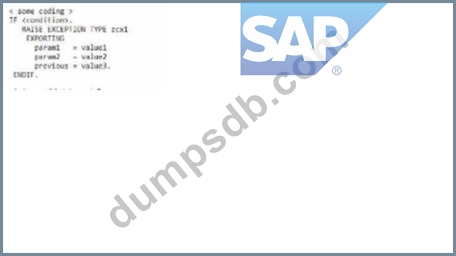
Refer to the Exhibit. What are valid statements? Note: There are 2 correct answers to this question.
Correct Answer: C,D
The code snippet in the image is an example of using the RAISE EXCEPTION statement to raise a class-based exception and create a corresponding exception object. The code snippet also uses the EXPORTING addition to pass parameters to the instance constructor of the exception class12. Some of the valid statements about the code snippet are: The code creates an exception object and raises an exception: This is true. The RAISE EXCEPTION statement raises the exception linked to the exception class zcxl and generates a corresponding exception object. The exception object contains the information about the exception, such as the message, the source position, and the previous exception12. "previous" expects the reference to a previous exception: This is true. The previous parameter is a predefined parameter of the instance constructor of the exception class cx_root, which is the root class of all class-based exceptions. The previous parameter expects the reference to a previous exception object that was caught during exception handling. The previous parameter can be used to chain multiple exceptions and preserve the original cause of the exception12. You cannot do any of the following: "zcxl" is a dictionary structure, and "paraml" and "param2" are this structure: This is false. zcxl is not a dictionary structure, but a user-defined exception class that inherits from the predefined exception class cx_static_check. param1 and param2 are not components of this structure, but input parameters of the instance constructor of the exception class zcxl. The input parameters can be used to pass additional information to the exception object, such as the values that caused the exception12. "paraml" and "param2" are predefined names: This is false. param1 and param2 are not predefined names, but user-defined names that can be chosen arbitrarily. However, they must match the names of the input parameters of the instance constructor of the exception class zcxl. The names of the input parameters can be declared in the interface of the exception class using the RAISING addition12.